
Go Unlimited with Magzter GOLD
Get unlimited access to 10,000+ magazines, newspapers and Premium stories for just
Try GOLD - Free
GUTENBERG'S PRINTING PRESS DID NOT SUCCEED?
All About History UK
|Issue 132
How reform could have been stifled and the empowerment of literacy controlled by the elites of Church and State

The world of the 15th century had become a powder keg of ideas, commerce, invention and renaissance in the arts. The old world was being left behind as a new, more hopeful and brighter future dawned. The printing press of Johannes Gutenberg brought with it the ability to print books and pamphlets at a speed and in quantities never seen before. Information and ideas could circulate through Europe, gathering pace as they went. Gutenberg's inventiveness brought together the right elements, in the right place, at the right time. But if that moment had never happened, the world could have remained trapped in time.
What might have stopped Gutenberg developing his invention?
Johannes Gutenberg's invention, the printing press with moveable type, was the solution to a well-known problem: how best to exploit a growing market in books? It was a race, and in 1455, with the printing of his Bible, Gutenberg won. But it was a close-run thing.
In the early 15th century, when Gutenberg was young, the production of books had brought Christians ever further and ever faster out of the dark ages that had clouded Europe after the fall of the Roman Empire. Produced by scribes, books - most of them religious were easier to read with brightly coloured capitals and chapter divisions. As trade links grew and towns evolved, ordinary people wanted schools and books for their children. The rich built libraries and needed books to fill them. Similar demands came from new universities. Latin was the language of the Church, but increasingly people wanted information in their own language: instruction manuals, verses, histories, legends. Europe was on the verge of the Renaissance.
But scribes were slow and expensive. So, books were also printed in a simple way, with wood blocks engraved in reverse then smeared with ink, and covered with paper, which was pressed firmly to transfer the image.
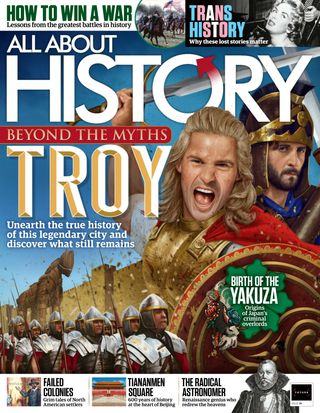

This story is from the Issue 132 edition of All About History UK.
Subscribe to Magzter GOLD to access thousands of curated premium stories, and 10,000+ magazines and newspapers.
Already a subscriber? Sign In
MORE STORIES FROM All About History UK

All About History UK
HOT FUDGE SUNDAE
USA, 19-20TH CENTURY

1 mins
Issue 169

All About History UK
HISTORY OF THE WORLD CUP
Football writer Jonathan Wilson explains why the tournament has always been a reflection of its time
10 mins
Issue 169

All About History UK
THE MAKING OF THE MIDDLE AGES AN ATLAS OF EUROPE
Explore the medieval world with this guide
1 min
Issue 169
All About History UK
PROPHECIES OMENS, AUGURIES, DIVINATION, ORACLES, DREAMS, APOCALYPSE
How humanity tries to predict the future
1 min
Issue 169

All About History UK
MICHAEL JACKSON: AN AMERICAN TRAGEDY
A by-the-book examination of the rise and fall of the King of Pop
2 mins
Issue 169
All About History UK
LECHAEUM
In 391 BCE (or 390 BCE, sources differ) during the Corinthian War (395-387 BCE), a force of lightly armed and armoured peltasts under the command of the Athenian Iphicrates faced almost 600 Spartan hoplites at Lechaeum, near Corinth.
11 mins
Issue 169

All About History UK
AGE of ALCHEMY
How occult ritual and a thirst for gold paved the way for modern chemistry
12 mins
Issue 169

All About History UK
THE QUEEN'S CLOTHES
An exhibition at Buckingham Palace explores Elizabeth II's life in fashion
2 mins
Issue 169

All About History UK
WHAT IF...9/11 HAD BEEN FOILED?
It was a day that shook the world. But what would preventing the attack mean for the 'War on Terror'?
6 mins
Issue 169
All About History UK
CURIOUS CATS AND FANTASTICAL FELINES
An entertaining jaunt through furry folklore
2 mins
Issue 169
Translate
Change font size