
Go Unlimited with Magzter GOLD
Get unlimited access to 10,000+ magazines, newspapers and Premium stories for just
Try GOLD - Free
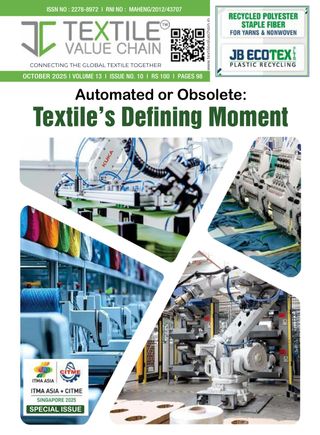
The Impact of Textile Automation: Transforming an Industry Thread by Thread
Textile Value Chain
|October 2025
Walk into any modern textile factory today, and you'll witness something remarkable. Machines that once needed constant human guidance now hum along independently, making split-second decisions. Robots handle delicate fabrics with precision that would make veteran seamstresses nod in approval. This isn't science fiction; it's the reality reshaping the $31 billion textile machinery market right now.

The Numbers Tell a Story
Let's start with what's actually happening. According to Mordor Intelligence, the global textile machinery market stood at USD 31.10 billion in 2025 and is forecast to reach USD 40.11 billion by 2030, advancing at a 5.22% CAGR. But here's what matters more: according to a Technavio estimate, the automation in the textile industry market is forecast to increase by USD 664 million at a CAGR of 3.2% between 2024 and 2029.
What's driving this growth? Companies are tired of production bottlenecks, inconsistent quality, and margins that keep shrinking. They're looking at automation like a drowning person looks at a life raft.
Why Everyone's Racing to Automate
The reasons are straightforward, even if the solutions aren't simple.
Labour shortages have become critical. For instance, in Germany, many training posts remain unfilled, pointing to a wider skills-gap issue. Young people aren't lining up for factory jobs like previous generations did. Meanwhile, experienced workers are retiring, taking decades of knowledge with them.
Quality consistency is nonnegotiable now. Consumers won't accept defects, and brands can't afford recalls. Automated inspection systems can detect defects in fabrics with minimal human intervention, and innovations such as automation, artificial intelligence, and IoT integration are streamlining operations, reducing labour costs, and minimising waste.
Energy efficiency matters—to both profits and the planet. Textile manufacturers are increasingly financing automation technology, predictive maintenance, and Al-driven workflow management to optimise energy consumption and reduce costs. When machines can self-monitor and optimise their own energy use, savings compound quickly.

This story is from the October 2025 edition of Textile Value Chain.
Subscribe to Magzter GOLD to access thousands of curated premium stories, and 10,000+ magazines and newspapers.
Already a subscriber? Sign In
MORE STORIES FROM Textile Value Chain

Textile Value Chain
The New Age of Men's Tailoring: From Bespoke to Hybrid Models
Part 1 of the Series: The Evolving World of Men's Tailored Wear

4 mins
January 2026

Textile Value Chain
The Textile Landscape of 2025: A Year of Transformation
Navigating Policy Reforms, Trade Agreements, and Global Events
5 mins
January 2026

Textile Value Chain
Recycled Fibres vs Virgin Fibres: The Real Cost, Footprint & Business Opportunity
For decades, the textile industry asked only one question when choosing raw material:
3 mins
January 2026

Textile Value Chain
2025 in Perspective: A Stronger, Cleaner, Smarter Future for Textiles
The year 2025 reminded the textile and apparel sector that resilience now matters more than pace.
5 mins
January 2026

Textile Value Chain
Heimtextil as a Working lab for Sutlej and its Customers
When the global home textiles industry gathers in Frankfurt this January, Sutlej Textiles is approaching Heimtextil with a clear intent: to treat the fair less as a product parade and more as a live development lab with its buyers and partners.
4 mins
January 2026

Textile Value Chain
Weaving Heritage into Future: A Conversation with Ms Roop Rashi Mahapatra
In an era where fast fashion dominates the global textile landscape, Khadi stands as a timeless symbol of India's heritage, sustainability, and self-reliance.
11 mins
January 2026

Textile Value Chain
Home Textiles: Ever-growing Market to Evergreen Product Source
Indian Home textiles have always enjoyed a special market position, and demand continues to increase, capturing a premium to the budgeted market across different markets, but with one constant hunger for extraordinary design, a super comfortable feel, and the appeal of sophistication, along with changing market dynamics.
4 mins
January 2026

Textile Value Chain
The Velvet Revolution: How This Timeless Fabric is Redefining Modern Textiles
When you run your hand across velvet, something happens.
3 mins
January 2026

Textile Value Chain
SPGPrints Achieves Landmark Success at ITMA ASIA 2025 With Transformative Textile Printing Technology and Key Order Closures
SPGPrints, the global leader in innovative textile printing solutions, announced an overwhelmingly successful participation in ITMA ASIA 2025 at the Singapore Expo.
2 mins
January 2026

Textile Value Chain
Development of Home Textile Products from Post-Consumer Textile Waste
With the growing concern over textile waste and its environmental impact, sustainable approaches for fabric reuse are urgently needed.
5 mins
January 2026
Listen
Translate
Change font size