Try GOLD - Free
Thinking of farming Afrikaners? Here's what you should know
Farmer's Weekly
|August 01-08, 2025
Free State cattle farmer Jannie Visagie spoke to Octavia Avesca Spandiel about the resilience, adaptability, and economic benefits of the Afrikaner cattle breed. He shares valuable insights and practical advice for farmers considering this hardy breed for South African conditions.
-
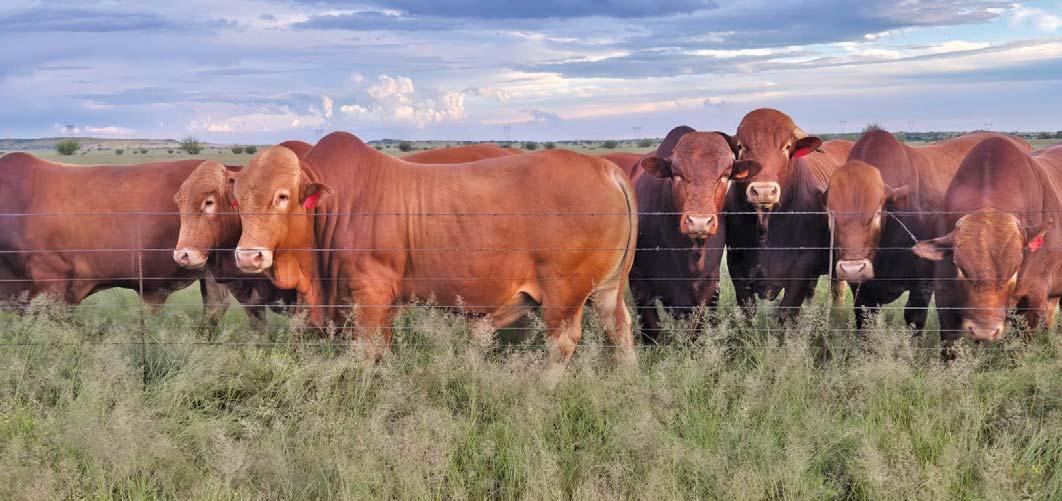
As South Africa’s agriculture sector adapts to changing climate conditions, rising input costs, and increasing demand for sustainable beef production, some farmers are revisiting traditional livestock breeds known for their hardiness and efficiency. The Afrikaner cattle breed, with its deep local roots and unmatched resilience, can be a contender for modern beef systems.
Speaking to Farmer’s Weekly, Free State farmer and Afrikaner breeder Jannie Visagie, who farms on 7 500ha of natural veld, says the time has come to reconsider this indigenous beef breed not only for its historical value, but for its economic and environmental advantages.
“The Afrikaner is one of the toughest breeds you can run. They might not be as popular as some exotic breeds in the feedlot market, but when it comes to surviving heat, drought and veld conditions, nothing beats them,” he says.
TOUGH TRAITS FOR TOUGH CONDITIONS
According to Visagie, the Afrikaner breed originates from the indigenous Sanga cattle of Southern Africa and has been bred over centuries to suit local environments. With their characteristic red coats and strong frames, they are well adapted to both high temperatures and limited grazing.
“Afrikaner cattle don’t struggle in extreme heat. Our bulls cover cows just as well in summer as they do in winter. We see no drop in conception rate during the warmer months,” says Visagie.
He added that their performance during drought is equally impressive. “I once spoke to a farmer in Namibia during a bad drought. He said the Afrikaner cows got thinner but didn’t die. They kept going, even when other breeds gave up,” says Visagie.
A NATURAL FIT FOR EXTENSIVE SYSTEMS
According to Visagie, one of the Afrikaner’s strongest advantages is its suitability for extensive veld-based production systems.

This story is from the August 01-08, 2025 edition of Farmer's Weekly.
Subscribe to Magzter GOLD to access thousands of curated premium stories, and 10,000+ magazines and newspapers.
Already a subscriber? Sign In
MORE STORIES FROM Farmer's Weekly

Farmer's Weekly
More about growing vegetable seedlings in trays
By considering various factors and tailoring care to specific vegetable needs, you can produce healthy, robust seedlings ready for transplanting into the garden, writes Shane Brody.

2 mins
March 27 - April 3, 2026

Farmer's Weekly
Prodigy of agriculture and land is now a presidential envoy
Wandile Sihlobo will be armed by state powers to accelerate any decision-making that the Presidency deems crucial to grow the sectors of agriculture and land
2 mins
March 27 - April 3, 2026

Farmer's Weekly
Notes from the Western Cape agricultural roadshow
We spent time last week engaging with agribusinesses and farmers in the Western Cape. The primary agricultural focus of the province is various fruits, citrus, table grapes, wine, wheat, barley, livestock, and aquaculture, among many value chains.
3 mins
March 27 - April 3, 2026

Farmer's Weekly
AGOA's promise fades under new US tariffs
Although the African Growth and Opportunity Act has been extended for another year, new US reciprocal tariffs have largely erased its duty-free benefits. Recent modelling shows sharp declines in African exports to the US, particularly in apparel-dependent economies such as Lesotho and Madagascar.
4 mins
March 27 - April 3, 2026
Farmer's Weekly
Egon Zunckel: a lifetime of learning from the soil
The Zunckel name is synonymous with no-till farming in South Africa. Egon Zunckel, a pioneer in the field and a passionate advocate for soil health, shared with Lindi Botha the lessons he has learnt over the years about building resilient soils and sustainable farming systems.
10 mins
March 27 - April 3, 2026
Farmer's Weekly
Researchers explore new tools to combat herbicide resistance
Research by students from Stellenbosch University aimed at combatting herbicide resistance was highlighted during a recent technical trial information day hosted by the Western Cape Department of Agriculture.
6 mins
March 27 - April 3, 2026

Farmer's Weekly
Lepas leaps into South Africa as the latest Chery-owned brand
Lepas has become Chinese carmaker Chery's latest local subbrand with the introduction of the L4 compact SUV. The Citizen's Charl Bosch reports.
2 mins
March 27 - April 3, 2026
Farmer's Weekly
La Rhone Limousins: a small mixed herd turned renowned stud
The Western Cape is not typically known for cattle farming, particularly in its fruit-growing regions. Yet nestled among the orchards below the mountains of Tulbagh is a Limousin stud that has made a name for itself. AJ du Toit of La Rhone Limousins spoke to Henning Naudé about producing high-quality genetics now found on farms in all nine provinces.
6 mins
March 27 - April 3, 2026
Farmer's Weekly
Nitrogen: no easy fix
Products that claim to herald a nitrogen revolution that will boost global food production are nothing more than snake oil, say scientists.
4 mins
March 27 - April 3, 2026

Farmer's Weekly
Potato soup
Rich, creamy, and indulgent, this soup is the ultimate in comfort food.
1 mins
March 27 - April 3, 2026
Listen
Translate
Change font size