Try GOLD - Free
The Revolutionary Change Manager
DataQuest
|May 2023
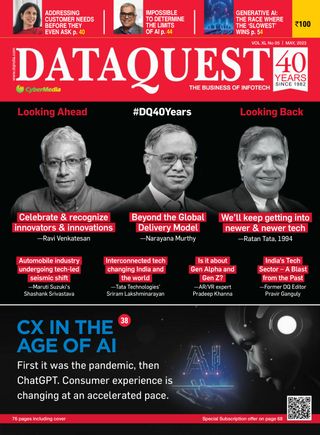
The simple but elegant office belies the power Ratan Tata wields. Arguably, one of the most powerful men in the realm, Ratan Tata is also some kind of an electronics 'aficionado'. His private lobby, at Bombay House, has only electronics magazines. At 53, Tata, chairman of Tata Sons, is responsible for retaining the group's #1 status in India. Ratan Tata started his career with Nelco-an electronics company of the Tata stable and has always been considered 'technology friendly. Today, as many as nine Tata companies are involved with computers and software. Ratan Tata has forged alliances with companies like AT&T and OKI to spearhead the group's foray into the telecom sector. In an exclusive interview with DATAQUEST Managing Editor. Shyam Malhotra and Editor, L Subramanyan, Ratan Tata discussed his vision of holding on to the Tata hegemony in the technology race. And the future of Tatas in information technology Excerpts:
-

Given the fact that India is opening up, what are the bottlenecks that still need to be looked at, specially in the IT Industry?
"I believe, we should really try at this stage to make the Indian industry price competitive as the Indian IT industry has to become globally competitive. I think all tariffs on all components and peripherals should be reduced further so that we are really able to source components at international prices.
But wouldn't this hurt the existing manufacturing units in India?
This would appear somewhat unfair to those who have set up manufacturing facilities in India. But I would counter that by saying that I would not be opposed to removing tariffs from finished products, except to the extent of compensating excise duty or sales tax so that the end product is also cheaper. Ultimately, the end-user should also have the opportunity to source (even end products) from elsewhere.
Don't you feel that this liberalization process, which came a little after TISL was conceived, has had some adverse Impact on the company?
Well, adverse impact... now, again you need to define what your business is going to be. I think it would be a very narrow description of your business if you set out to manufacture hardware. A more accurate definition would be that you want to build the company that will provide solutions, that is, IT solutions for your (Indian) industry. I think that solution should be the best price and the best quality solution. (Once you have that) you can then divide it into software and hardware...and creativity.

This story is from the May 2023 edition of DataQuest.
Subscribe to Magzter GOLD to access thousands of curated premium stories, and 10,000+ magazines and newspapers.
Already a subscriber? Sign In
MORE STORIES FROM DataQuest

DataQuest
If Only The Mentalist Solved Cybercrimes too
Is there not a human mind sitting beneath every cyber-criminal's brain? From Stockholm effect, Lima syndrome, to how cyber-criminals neutralise guilt and can we use psychology to defeat and cure cyber- criminals- here is a social scientist and criminologist cracking some human doors of the dark cybercrime cave.

20 mins
May 2026

DataQuest
Made-in-India Chips: 'Wedge'ing the Semicon Door Open
We are doing pretty okay in design, packaging and talent availability. But can we cross the hedge with going-fabless, fully-oiled ecosystems, advanced architecture and our own IP?
5 mins
May 2026

DataQuest
AWS wants to be more than cloud in India's startup story
AWS's Tiffany Bloomquist says Indian startups are moving from AI demos to practical execution, with voice, finance, and faster product builds leading the shift.
7 mins
May 2026

DataQuest
Are You Talented Enough?
Here's a skillet of seven skills for you to consider cultivating to get and retain a job in the AI era
6 mins
May 2026

DataQuest
Where Al is already executing work in aerospace
GE Aerospace is moving AI beyond insight and into design, maintenance, and inspection, with human oversight still central to every critical decision.
3 mins
May 2026

DataQuest
Why CloudMoyo sees intelligent operations as the next AI frontier
CloudMoyo CEO Manish Kedia explains why real AI value lies beyond CLM and copilots, in unified data, real-time intelligence, and execution-led enterprise workflow.
8 mins
May 2026

DataQuest
Why India's Al future needs both sovereign control and heritage depth
India's AI next phase may depend on combining sovereign control with heritage depth, while enterprises build domain-specific models from their own knowledge.
11 mins
May 2026

DataQuest
The Tariff Turnpike - Now a Make-in-India Turnstile
India's new Soft Power on the Tariff Tables could lie in how, and when, we leverage self-reliance through Make-in-India outcomes and new import-export mathematics
4 mins
May 2026

DataQuest
As AI Reshapes IT Infrastructure, can Telecom Operators Move Up the Stack?
As AI reshapes infrastructure and value creation, Accenture's Boris Maurer explains why telecom operators may gain a bigger role in the digital stack.
8 mins
May 2026

DataQuest
From Clad-in-India to Made-in-India: How Far Have We Come?
And how much grit and gravel we need to still cover before appearing strong and bright on the global manufacturing map. Almost ten years forward- that's a good time for a quick X-Ray.
9 mins
May 2026
Translate
Change font size