
Go Unlimited with Magzter GOLD
Get unlimited access to 10,000+ magazines, newspapers and Premium stories for just
Try GOLD - Free
Quantum Computing: Future of diagnostics is being coded today
BioSpectrum Asia
|BioSpectrum Asia Sep 2025
A silent revolution is being built at the intersection of biology and quantum physics. After decades of pushing the boundaries of diagnostics with advanced imaging and AI, we are now approaching a hard computational wall. For complex conditions like Alzheimer's, Parkinson's, and many cancers, the interacting variables of genomics, proteomics, and real-world patient data are simply too vast for classical computers to master. This limitation caps the ability to move from merely spotting correlations to uncovering true causation. Unlike traditional AI, quantum computing can simulate underlying physical systems to derive precise solutions. The transition from correlational analysis to causal simulation will enable a more valuable and advanced frontier in diagnostics.
The global quantum computing in healthcare market, valued at $120 million in 2024, is projected to grow at a CAGR of 42.5 per cent, reaching $750 million by 2029. With the ability to process exponentially large datasets, simulate molecular structures, and identify subtle diagnostic signals at unprecedented speed, quantum technology is poised to redefine the limits of precision medicine.
Limitations of current diagnostic capabilities
• Multi-omics overload: A full human genome alone contains 3 billion base pairs, generating hundreds of gigabytes of raw data per individual. When proteomic and metabolomic data are layered on top, the resulting datasets quickly reach petabyte scales, overwhelming traditional computing systems and slowing the ability to process, store, and analyse this information efficiently
• Imaging strain: AI-driven medical imaging generates petabytes of data, straining storage and processing. High-resolution MRI and CT scans outpace the classical GPU capabilities, creating bottlenecks
• Siloed systems: Lab tests, medical imaging, and clinical records are often managed in disconnected systems, slowing diagnosis, duplicating effort, and diluting insights
New market areas for quantum value zone
The potential applications of quantum computing in diagnostics span a wide spectrum. Here are the most impactful ones:
• Pre-symptomatic disease detection: Quantum-enhanced analytics can identify subtle, pre-symptomatic signals across genomics, imaging, and lifestyle data before conventional thresholds are met. This accelerates the window for preventive action when interventions can most alter disease trajectories
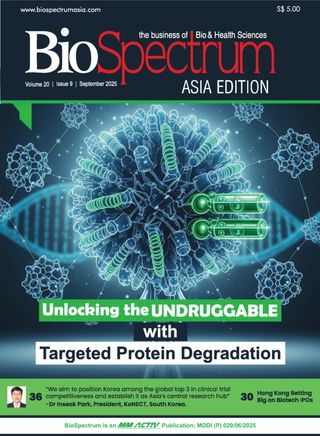

This story is from the BioSpectrum Asia Sep 2025 edition of BioSpectrum Asia.
Subscribe to Magzter GOLD to access thousands of curated premium stories, and 10,000+ magazines and newspapers.
Already a subscriber? Sign In
MORE STORIES FROM BioSpectrum Asia

BioSpectrum Asia
Alphamab Oncology appoints Fei Wang as Chief Financial Officer
Hong Kong-based Alphamab Oncology has announced the appointment of Fei Wang as the Chief Financial Officer (CFO).

1 min
BioSpectrum Asia April 2027

BioSpectrum Asia
CarbGeM inks MoU with DSS Imagetech to expand AI business in Indian market
DSS Imagetech, a leading player in medical and research imaging equipment, has announced the signing of a Memorandum of Understanding (MoU) with Japan-based CarbGeM Inc., a developer of artificial intelligence (AI)-powered life science solutions to expand its AI business in the Indian market.
1 min
BioSpectrum Asia April 2027
BioSpectrum Asia
PHCbi introduces LiCellGrow Cell Expansion System
PHC Corporation's Biomedical Division, a global provider of laboratory sample storage and cell cultivation solutions and subsidiary of Japan's PHC Holdings Corporation, has announced the launch of its new cell expansion system LiCellGrow for research use in Japan and other select countries worldwide.
1 min
BioSpectrum Asia April 2027

BioSpectrum Asia
CitiusTech appoints Dhaval Shah as Chief Business Officer - MedTech & Life Sciences
CitiusTech, a leading provider of healthcare technology services driving digital and AI excellence in India, has appointed Dhaval Shah to Chief Business Officer - MedTech & Life Sciences.
1 min
BioSpectrum Asia April 2027
BioSpectrum Asia
Thermo Fisher expands immunodiagnostics operations with new distribution centre in Uppsala
Thermo Fisher Scientific Inc. has announced the opening of a new 8,000-square-meter distribution & labeling centre supporting its immunodiagnostics business in Uppsala.
1 min
BioSpectrum Asia April 2027

BioSpectrum Asia
Harbour BioMed appoints Dr Jenny Xie as Head of Global External Innovation
Harbour BioMed, a global biopharmaceutical company focused on the discovery and development of novel antibody therapeutics in immunology and oncology, has announced the appointment of Dr Jenny Xie as Chief Scientific Officer, Immunology and Head of Global External Innovation.
1 min
BioSpectrum Asia April 2027

BioSpectrum Asia
Argo Biopharma ropes in Dr Gena Wang as CFO and CSO
China-based Argo Biopharmaceutical Co., a clinical-stage biotechnology company committed to developing next-generation siRNA therapies, has announced the appointment of Dr Gena Wang as Chief Financial Officer (CFO) and Chief Strategy Officer (CSO), effective March 1, 2026.
1 min
BioSpectrum Asia April 2027
BioSpectrum Asia
IISc launches "Moonshot" project on brain co-processors supported by Pratiksha Trust
The Indian Institute of Science (IISc), Bengaluru has launched an ambitious \"moonshot\" project to develop brain co-processors that combine neuromorphic hardware and artificial intelligence (AI) algorithms to enhance or restore brain function.
1 min
BioSpectrum Asia April 2027
BioSpectrum Asia
Korea designs model for accurate and scalable drug-drug interaction prediction
A research team from the School of International Engineering and Science at Jeonbuk National University (JBNU), South Korea, has developed DDINet, a lightweight and scalable model, specifically designed to predict interactions for new, unseen drugs.
1 min
BioSpectrum Asia April 2027

BioSpectrum Asia
Australia-Singapore study advocates role of intranasal vaccine booster against sarbecoviruses
Researchers at the Yong Loo Lin School of Medicine, National University of Singapore (NUS Medicine) and Monash University in Australia, have demonstrated that an intranasal vaccine booster may confer significantly stronger and broader immune responses, and provide robust neutralising antibody and resident T cell responses in the lung and nasal tissues, outperforming conventional mRNA booster vaccination.
1 min
BioSpectrum Asia April 2027
Listen
Translate
Change font size