Try GOLD - Free
WARNING SIGNAL
Down To Earth
|May 16, 2020
Why does India fail to caution its farmers of weather changes despite a rich meteorological infrastructure?

BHAGWAN LAL Nitharwal is a big farmer in Gudaliya village of Chaimu tehsil in Jaipur, Rajasthan. This year he harvested 300 quintals (1 quintal equals 100 kg) of wheat and barley each from his 16-hectare (ha) farm. But before he could move the grains from the farm, a sudden hailstorm on April 25 night soaked all his produce. By the next day, the grains had turned dark. Watermelons he grew on 1.6 ha also got ruined.
That night, another farmer in Chaimu Mool Chand lost most of his green chilly, kakdi, cucumber, tomato and bottle gourd he had grown on 1.6 ha. “I had spent ₹2 lakh on the crop and could have brought home ₹5 lakh,” he says.
“I have not seen a hailstorm like this in my life,” says Ashok Yadav, 30, of Mauli Khas village in Siddharthnagar district of Uttar Pradesh. In the state’s Banda district, rabi crop is grown on 324,000 ha, says A K Singh, deputy director, agriculture department. Of this, black gram is grown on 100,010 ha; the rest is wheat. When sudden rains came, some of the wheat had been harvested and labourers were still threshing it. Though losses are not huge, it will affect the grain quality.
March and April were bad for farmers of 13 states and Union territories in northern, central and east-central India. The India Meteorological Department (IMD) recorded 77 per cent more than normal rainfall in the country between March 1 and March 19. Bihar received nine times the usual rainfall, while Jharkhand got eight times more. Uttar Pradesh and Delhi recorded 698 per cent and 621 per cent excess rains respectively. Chhattisgarh got excessive rains in 25 of its 27 districts.
A large part of India lost a substantial amount of ready wheat crop. Bihar, the worst hit, also lost
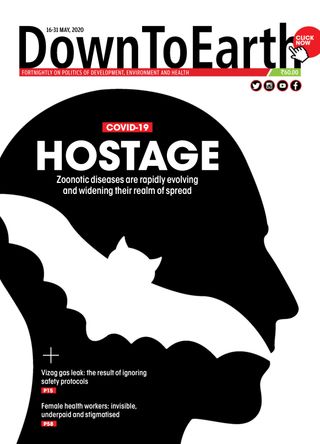

This story is from the May 16, 2020 edition of Down To Earth.
Subscribe to Magzter GOLD to access thousands of curated premium stories, and 10,000+ magazines and newspapers.
Already a subscriber? Sign In
MORE STORIES FROM Down To Earth

Down To Earth
BEYOND COLLATERAL DAMAGE
Recent geopolitical conflicts are urging a reconsideration of what constitutes environmental harm in war and the limits of existing legal frameworks

3 mins
April 01, 2026

Down To Earth
Masterstroke
Residents of a small Kerala town reject an inadequate state-led development blueprint and create their own master plan that prioritises protection of historic water systems and urban commons
4 mins
April 01, 2026

Down To Earth
Rethinking E20
It is pertinent to explore potential of ethanol as high-value industrial feedstock
4 mins
April 01, 2026
Down To Earth
Food in the age of climate change
WHEN WE eat, we contribute to climate change. But food is also about livelihoods, about nutrition and about nature.
3 mins
April 01, 2026

Down To Earth
FADING WINTER
India's winters are warming, becoming shorter, shifting and spilling beyond their traditional bounds. The consequences are already evident in meltwater availability, forest-fire intensity and changes in flowering cycles and insect behaviour.
20 mins
April 01, 2026

Down To Earth
War on Iran strikes India's pharmaceuticals sector
Shortages of critical raw materials and rising input costs for the drug industry will have global consequences
4 mins
April 01, 2026

Down To Earth
POWER IN AN AGE OF INSECURITY
Energy transition is no longer solely about emission reduction but also about energy security
3 mins
April 01, 2026
Down To Earth
Re-discovery of fuelwood
THE WEST Asia conflict has made visible a multi-billion dollar energy market in India.
2 mins
April 01, 2026

Down To Earth
A CASE THAT RESHAPED INDIA'S ENVIRONMENT
The case of MC Mehta v Union of India stands as proof that a proactive judiciary can accelerate action even when the executive drags its feet
4 mins
April 01, 2026

Down To Earth
FOREVER DEPENDENT
India depends on global fertiliser supply chains for 70 per cent of its needs, leaving its food security exposed to geopolitical disruptions
6 mins
April 01, 2026
Translate
Change font size