Try GOLD - Free
THEY HAD US FOOLED
Down To Earth
|March 01, 2021
“We sold our land to the Rishiganga hydropower plant because we needed money. But it turns out that we paid for the dam with my sister’s life. The Chamoli flash flood just wiped out everything that came in its way”

THE RESIDENTS of Uttarakhand’s Raini village are seething with anger. “We kept warning the government about the damage being caused to our houses and our fragile region by the Rishiganga dam, but no one paid heed to us. Now, see what has happened,” says Asha Devi Rana. The sexagenarian was referring to the flash floods in the upper reaches of the Himalayas that battered Chamoli district on February 7.
“At about 10:00 in the morning that day, a deafening roar came out of nowhere,” recalls her 32-year-old niece Godavari Devi. Nestled on both sides of a deep gorge in the Himalayas, with three footbridges connecting the settlements, her village overlooks the Rishiganga hydroelectric power project. At a distance, Nanda Devi, the second-highest mountain in India after Kangchenjunga, stands tall. “It was the loudest and most ferocious noise I have heard in my life, as if hundreds of aeroplanes were flying together in the valley. Within seconds, there were gusts of extremely strong winds. The valley, which was glistening in the morning sun till then, got filled with fog. Then a massive wall of water emerged from the riverbend and gushed towards us,” she says.
That wall of water was the Rishiganga river in spate. A glacier had broken off along with its bedrock at around 5,600 m above the sea level from the Ronti mountain peak, causing flood and landslide (see ‘Snowball effect’ on p24), first in the Rishiganga and then in the Dhauliganga (of which the Rishiganga is a tributary). The deluge wiped out the Rishiganga hydropower plant and choked the Tapovan-Vishnugad hydropower project on the Dhauliganga, killing nearly 70 people; 204 were still missing, as per multiple firs filed at the Joshimath police station between February 7 and 21.
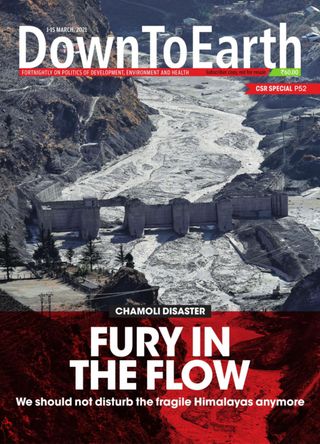

This story is from the March 01, 2021 edition of Down To Earth.
Subscribe to Magzter GOLD to access thousands of curated premium stories, and 10,000+ magazines and newspapers.
Already a subscriber? Sign In
MORE STORIES FROM Down To Earth

Down To Earth
BEYOND COLLATERAL DAMAGE
Recent geopolitical conflicts are urging a reconsideration of what constitutes environmental harm in war and the limits of existing legal frameworks

3 mins
April 01, 2026

Down To Earth
Masterstroke
Residents of a small Kerala town reject an inadequate state-led development blueprint and create their own master plan that prioritises protection of historic water systems and urban commons
4 mins
April 01, 2026

Down To Earth
Rethinking E20
It is pertinent to explore potential of ethanol as high-value industrial feedstock
4 mins
April 01, 2026
Down To Earth
Food in the age of climate change
WHEN WE eat, we contribute to climate change. But food is also about livelihoods, about nutrition and about nature.
3 mins
April 01, 2026

Down To Earth
FADING WINTER
India's winters are warming, becoming shorter, shifting and spilling beyond their traditional bounds. The consequences are already evident in meltwater availability, forest-fire intensity and changes in flowering cycles and insect behaviour.
20 mins
April 01, 2026

Down To Earth
War on Iran strikes India's pharmaceuticals sector
Shortages of critical raw materials and rising input costs for the drug industry will have global consequences
4 mins
April 01, 2026

Down To Earth
POWER IN AN AGE OF INSECURITY
Energy transition is no longer solely about emission reduction but also about energy security
3 mins
April 01, 2026
Down To Earth
Re-discovery of fuelwood
THE WEST Asia conflict has made visible a multi-billion dollar energy market in India.
2 mins
April 01, 2026

Down To Earth
A CASE THAT RESHAPED INDIA'S ENVIRONMENT
The case of MC Mehta v Union of India stands as proof that a proactive judiciary can accelerate action even when the executive drags its feet
4 mins
April 01, 2026

Down To Earth
FOREVER DEPENDENT
India depends on global fertiliser supply chains for 70 per cent of its needs, leaving its food security exposed to geopolitical disruptions
6 mins
April 01, 2026
Translate
Change font size