Try GOLD - Free
Dr Jekyll And Mr Hyde
Down To Earth
|May 01, 2018
Why are the peddlers of populism proving so popular in democracy?
-

POPULISM IS everywhere on the rise. Why is this happening? Are there deep forces driving the spread of their style of politics, and what, if anything, has populism to do with democracy? Is populism democracy’s essence, as some maintain?
Is the new populism therefore to be welcomed, harnessed and “mainstreamed” in support of more democracy? Or is populism on balance politically dangerous, a cultish recipe for damaging democracy by bringing to life what George Orwell termed the “smelly little orthodoxies” that feed demagogy, big business and bossy power?
As USA voted for Donald Trump, and Filipino citizens live with the fall-out of Rodrigo Duterte’s populist rhetoric, scholars from China to Brazil to Australia analyse the phenomena behind populism’s ascent.
JOHN KEANE, UNIVERSITY OF SYDNEY
Ancient Greeks knew democracy could be snuffed out by rich and powerful aristoi backed by demagogues ruling the people in their own name. They even had a verb (now obsolete) for describing how people are ruled while seeming to rule. They called it dêmokrateo. It’s the word we need for making sense of the contradiction that cuts through contemporary populism.
Populism is a democratic phenomenon. Mobilised through available democratic freedoms, it’s a public protest by millions of people (the demos) who feel annoyed, powerless, no longer “held” in the arms of society.
The analyst D W Winnicott used the term to warn that people who feel dropped strike back. That’s the populist moment when humiliated people lash out in support of demagogues promising them dignity. They do so not because they “naturally” crave leaders, or yield to the inherited “fascism in us all”.
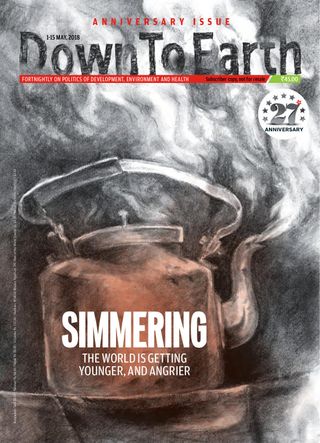

This story is from the May 01, 2018 edition of Down To Earth.
Subscribe to Magzter GOLD to access thousands of curated premium stories, and 10,000+ magazines and newspapers.
Already a subscriber? Sign In
MORE STORIES FROM Down To Earth

Down To Earth
BEYOND COLLATERAL DAMAGE
Recent geopolitical conflicts are urging a reconsideration of what constitutes environmental harm in war and the limits of existing legal frameworks

3 mins
April 01, 2026

Down To Earth
Masterstroke
Residents of a small Kerala town reject an inadequate state-led development blueprint and create their own master plan that prioritises protection of historic water systems and urban commons
4 mins
April 01, 2026

Down To Earth
Rethinking E20
It is pertinent to explore potential of ethanol as high-value industrial feedstock
4 mins
April 01, 2026
Down To Earth
Food in the age of climate change
WHEN WE eat, we contribute to climate change. But food is also about livelihoods, about nutrition and about nature.
3 mins
April 01, 2026

Down To Earth
FADING WINTER
India's winters are warming, becoming shorter, shifting and spilling beyond their traditional bounds. The consequences are already evident in meltwater availability, forest-fire intensity and changes in flowering cycles and insect behaviour.
20 mins
April 01, 2026

Down To Earth
War on Iran strikes India's pharmaceuticals sector
Shortages of critical raw materials and rising input costs for the drug industry will have global consequences
4 mins
April 01, 2026

Down To Earth
POWER IN AN AGE OF INSECURITY
Energy transition is no longer solely about emission reduction but also about energy security
3 mins
April 01, 2026
Down To Earth
Re-discovery of fuelwood
THE WEST Asia conflict has made visible a multi-billion dollar energy market in India.
2 mins
April 01, 2026

Down To Earth
A CASE THAT RESHAPED INDIA'S ENVIRONMENT
The case of MC Mehta v Union of India stands as proof that a proactive judiciary can accelerate action even when the executive drags its feet
4 mins
April 01, 2026
Down To Earth
FOREVER DEPENDENT
India depends on global fertiliser supply chains for 70 per cent of its needs, leaving its food security exposed to geopolitical disruptions
6 mins
April 01, 2026
Translate
Change font size