Try GOLD - Free
Using magnets to influence the brain could lead to revolutionary new depression treatment
BBC Science Focus
|March 2022
The method, tested in rats, targets star-shaped brain cells called astrocytes. Neuroscientists Dr Yichao Yu and Prof Mark Lythgoe at University College London tell us more...

YOUR TECHNIQUE FOCUSED ON ASTROCYTES. WHAT EXACTLY ARE THEY?
Yichao Yu: They're a type of glial cell [non-neuronal cells that are found in the brain and spinal cord]. They're very abundant, they outnumber neurons (nerve cells] many times over. Traditionally they're viewed as support cells, they recycle the neurotransmitters that neurons release. They do many logistical maintenance jobs in the brain. But in recent years, as we've learnt more about these cells, we've found that they have many other functions, such as regulating cognitive behaviour.
Mark Lythgoe: For the last hundred years they've been the second-class citizen in the brain in terms of cells. Neurons have taken the limelight because they're electrically active (send electrical signals) and supposedly control all our functions. But astrocytes, although not electrically active in the same way, can communicate and sense and process and control bodily functions.
About 30 years ago, they were called the genius cell. This is because when Einstein died in 1955, his brain was taken out by the pathologist Thomas Harvey and it remained hidden for nearly 30 years. Harvey then started to release a couple of the sections to Marian Diamond, an amazing neuroscientist. She found that Einstein did not have more neurons in certain areas of his brain. He actually had more glial cells, and because of that they were known as the genius cell.
WHAT ARE THE MICRO MAGNETS THAT YOU USE MADE FROM?
YY: They're very simple magnetic particles. They have a core that is made of iron oxide and a polymer shell, which enables us to attach various things to their surface. For example, we attach the antibody to the surface of these magnetic particles so that they will be targeted to astrocytes specifically.


This story is from the March 2022 edition of BBC Science Focus.
Subscribe to Magzter GOLD to access thousands of curated premium stories, and 10,000+ magazines and newspapers.
Already a subscriber? Sign In
MORE STORIES FROM BBC Science Focus
BBC Science Focus
HOW FISH COULD SAVE MILLIONS OF PEOPLE'S SIGHT
There's nowhere near enough donors to meet the demand for corneal transplants. A pioneering treatment that relies on fish scales could change that

3 mins
May 2026

BBC Science Focus
Your Wi-Fi is lying to you
Wi-Fi 7's giant speed claims might look impressive, but the realities of our homes – and the laws of physics – mean that real-world performance will never get close
6 mins
May 2026

BBC Science Focus
WHICH ANIMAL IS MOST LIKELY TO ESCAPE FROM THE ZOO?
Have you heard the one about the monkey and the Yorkshire pudding?
2 mins
May 2026

BBC Science Focus
THE BLACK SERVAL
The black serval (Leptailurus serval) is an unusual, melanistic version of the African serval, a medium-sized wild cat that's native to Africa.
2 mins
May 2026
BBC Science Focus
Cryosleep vs hibernation: What's the difference?
When hibernating animals, such as hedgehogs and dormice, disappear for winter, they don't freeze like the Siberian salamander.
1 mins
May 2026
BBC Science Focus
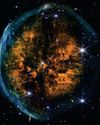
Space brain
The greatest names in science are often said to be 'big-brained', but this cosmic wonder puts them all to shame. Nebula PMR 1 - otherwise known as the 'Exposed Cranium' nebula for its distinctive shape - measures around 3.2 light-years across.
1 min
May 2026

BBC Science Focus
Your most draining relationships are taking years off your life, study suggests
Difficult people don't just zap your energy - they may also accelerate your biological ageing
4 mins
May 2026

BBC Science Focus
DOES EARTH HAVE A HEARTBEAT?
Move over, Ringo Starr.
1 mins
May 2026
BBC Science Focus
WEIGHT-LOSS DRUGS FOR ALL?
The obesity crisis is ruining lives and costing governments trillions. But some healthcare experts think there's now a radical solution: roll out GLP-1 jabs to everyone who needs them for free. Could it work?
9 mins
May 2026
BBC Science Focus
HOW TO SEE VENUS ON APPROACH TO JUPITER
Venus has been slowly moving away from the Sun's glare over the past few weeks, heading into the evening twilight after sunset.
1 mins
May 2026
Translate
Change font size