Try GOLD - Free
India-Pakistan Controlled War?
Outlook
|March 11, 2019
From ‘all-out war’ to ‘controlled war’, India has changed gear in its military response to Pakistan-sponsored terrorism

As young officers in the Indian army in the late seventies, we learnt that the Line of Control (LoC) is a zone of NWNP (No war no peace). Over the years we saw the scenario change into ‘forever at war’, as India got embroiled in fighting a hybrid war waged by Pakistan, using jehadis as proxy. The hostility manifested as terrorist actions, gun duels along the Line of Control, Border Action Teams (BAT), propaganda, indoctrination, radicalisation of the population and soon. several new coinages came into the lexicon to describe the state of affairs—fragile peace, situation simmering, pot boiling and so on; semantics for justifying and tolerating abnormality as the ‘new normal’.
For too long, India has fought this proxy war with two self-imposed limitations. First, geographical i.e. the Line of Control is the ‘Lakshmanrekha’. Second, the type of force i.e. fight primarily with the army, CAPF (Central Armed Police Forces) and state police. Employ weapons only up to a certain calibre. India, unlike several other countries, has not used air power and artillery for counter-terrorist operations. So inviolable was the ‘Lakshmanrekha’ that even in a situation like the Kargil war we chose to uphold the sanctity of the ‘Line of Control’.
In a significant departure from this position of restraint, post the September 2016 attack on the army base in Uri, India decided to shed the first limitation. It took the war across the Line of Control to strike at some forward launch pads used for infiltrating terrorists by their handlers in Pakistan. In responding to the Pulwama attack, India chose to shed the second limitation on the type of force. India retaliated on February 26 with surgical air strikes at the sprawling Jaish-e-Mohammed (JeM) training camp in Balakot.
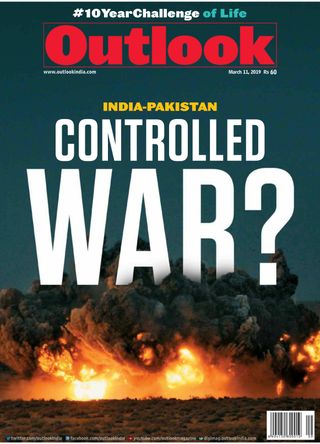

This story is from the March 11, 2019 edition of Outlook.
Subscribe to Magzter GOLD to access thousands of curated premium stories, and 10,000+ magazines and newspapers.
Already a subscriber? Sign In
MORE STORIES FROM Outlook

Outlook
'Why GDP Growth Doesn't Always Translate Into Votes'
The recent election results have once again shown that economic growth alone does not guarantee electoral victory.

3 mins
June 06, 2026

Outlook
Lights, Camera, Othering
The establishment of Israel has been accompanied by a national cinema devoted to negating and erasing the Palestinian Other
5 mins
June 06, 2026

Outlook
Goodbye to All That
Booker-winning British author Julian Barnes' Departure(s) is a unique hybrid work: playful, philosophical, whimsical
4 mins
June 06, 2026

Outlook
Collapse of Trust
As the NEET-UG 2026 paper leak forced the cancellation of India’s biggest medical entrance exam, more than 22 lakh aspirants find themselves trapped in uncertainty
11 mins
June 06, 2026

Outlook
NO LONGER A TWELFTH MAN
Bihar cricket, which has languished in the shadows for long, is all set to improve its strike rate, thanks to Vaibhav Sooryavanshi, the new Bihari kid on the block
5 mins
June 06, 2026

Outlook
BLAZE OF GLORY
The challenges of being a celebrity cricketer at a young age can be tough to handle
5 mins
June 06, 2026

Outlook
THE SWASHBUCKLERS
A new generation of fearless stars is emerging and finding its feet at the very top of an extremely competitive cricketing environment
5 mins
June 06, 2026

Outlook
THE TEEN TORNAD
At the age of 15, Vaibhav Sooryavanshi is already a cricketing legend
10 mins
June 06, 2026

Outlook
A Journey to Remember
The prerecorded message crackled over the din in the compartment: ‘Welcome to the Shatabdi Express.
4 mins
June 06, 2026

Outlook
Crossing Borders
Ruth Martin is the translator of German-Iranian author Shida Bazyar’s novel The Nights are Quiet in Tehran (originally written in German), which has been shortlisted for the 2026 International Booker Prize.
4 mins
June 06, 2026
Translate
Change font size