
Go Unlimited with Magzter GOLD
Get unlimited access to 10,000+ magazines, newspapers and Premium stories for just
Try GOLD - Free
Blood On The Barbed Wire
Outlook
|June 29, 2020
Named after Ladakhi explorer Ghulam Rasool Galwan, the Galwan river flows west from Aksai Chin to converge with the Shyok in Ladakh. It slices through high-altitude mountains and the peaks overlook the valleys and pass—especially a stretch of India’s 255-km Darbuk-Shyok-Daulat Beg Oldi road running close to Galwan valley.

Although a fierce battle was fought in 1962 in Galwan valley, the area has been peaceful since. Chinese transgressions have been mostly concentrated in Pangong Tso, Demchok, and Daulat Beg Oldi. But China perceives the new road as a threat to Aksai Chin and the Tibet-Xinjiang highway. It wants to control the heights in Galwan valley.
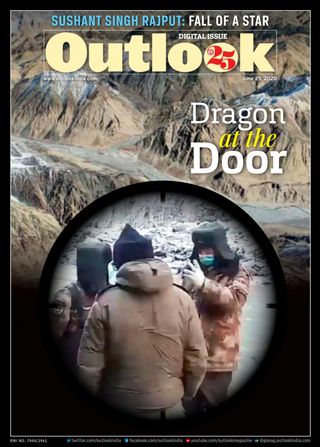
This summer, Chinese soldiers entered Galwan valley and billeted in camps, leading to an Indian pushback. They exchanged blows, threw stones...(an informal agreement forbids troops from carrying guns in the buffer area). On June 15/16, the Chinese attacked Indian troops with nail-studded clubs, killing 20 and capturing ten.
Can war and pestilence come together? A pandemic is already upon us, akin to hemorrhage for the body of systems and resources that make up a nation. War is no less severe: the blood loss it entails is of another (if equally real) sort; the debility it causes gradually leaches into the economy too. Can the body even take two extreme stressors, two co-morbidities, at once? India came close to testing that proposition this week, with the violent India-China face-off at Galway in eastern Ladakh making world headlines. No bullets were fired, but so blood-soaked was the episode that it was described as the biggest military confrontation between the two countries in over five decades. Even as New Delhi claimed military and diplomatic engagement had de-escalated a testy situation, Chinese People’s Liberation Army (PLA) soldiers, armed with iron rods and batons wrapped in barbed wire, attacked Indian troops in unprecedented and brutal combat, killing 20 of them.

This story is from the June 29, 2020 edition of Outlook.
Subscribe to Magzter GOLD to access thousands of curated premium stories, and 10,000+ magazines and newspapers.
Already a subscriber? Sign In
MORE STORIES FROM Outlook

Outlook
'Why GDP Growth Doesn't Always Translate Into Votes'
The recent election results have once again shown that economic growth alone does not guarantee electoral victory.

3 mins
June 06, 2026
Outlook
Lights, Camera, Othering
The establishment of Israel has been accompanied by a national cinema devoted to negating and erasing the Palestinian Other
5 mins
June 06, 2026

Outlook
Goodbye to All That
Booker-winning British author Julian Barnes' Departure(s) is a unique hybrid work: playful, philosophical, whimsical
4 mins
June 06, 2026
Outlook
Collapse of Trust
As the NEET-UG 2026 paper leak forced the cancellation of India’s biggest medical entrance exam, more than 22 lakh aspirants find themselves trapped in uncertainty
11 mins
June 06, 2026
Outlook
NO LONGER A TWELFTH MAN
Bihar cricket, which has languished in the shadows for long, is all set to improve its strike rate, thanks to Vaibhav Sooryavanshi, the new Bihari kid on the block
5 mins
June 06, 2026
Outlook
BLAZE OF GLORY
The challenges of being a celebrity cricketer at a young age can be tough to handle
5 mins
June 06, 2026
Outlook
THE SWASHBUCKLERS
A new generation of fearless stars is emerging and finding its feet at the very top of an extremely competitive cricketing environment
5 mins
June 06, 2026

Outlook
THE TEEN TORNAD
At the age of 15, Vaibhav Sooryavanshi is already a cricketing legend
10 mins
June 06, 2026

Outlook
A Journey to Remember
The prerecorded message crackled over the din in the compartment: ‘Welcome to the Shatabdi Express.
4 mins
June 06, 2026

Outlook
Crossing Borders
Ruth Martin is the translator of German-Iranian author Shida Bazyar’s novel The Nights are Quiet in Tehran (originally written in German), which has been shortlisted for the 2026 International Booker Prize.
4 mins
June 06, 2026
Translate
Change font size