
Go Unlimited with Magzter GOLD
Get unlimited access to 10,000+ magazines, newspapers and Premium stories for just
Try GOLD - Free
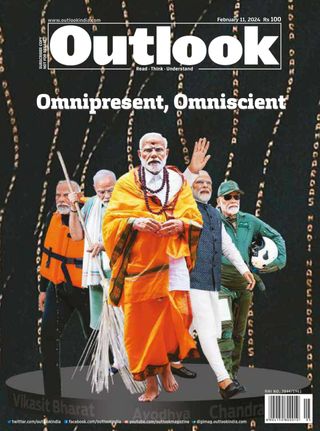
A 'Modi-Fied' Reality
Outlook
|February 11, 2024
The Prime Minister has managed to ace the image game by being all-pervasive, and, at the same time, being an elusive political persona

HINDUISM and neoliberalism emerged as strange bedfellows in India at the turn of the century. Postcolonial India was prided for its somewhat sacred separation between spirituality and materiality. It was often argued that even under colonial rule, the ‘inside’ India, marked by its spiritual pursuit, remained sovereign, and it was only the ‘outside’ that got colonised by materiality, the market and technology. In today’s—or rather Modi’s—‘New India’, the market and spirituality are having a gala time together in a bonhomie that is here to last.
What is even more important to note is that both Hinduism and neoliberalism are decentred and decentralised. Hinduism is more of a ‘way of life’ encompassing countless local practices, whereas neoliberalism is a faceless post-Westphalia phenomenon without an anchor. In a sense, both Hinduism and neoliberalism have no nation or sanctum sanctorum to reach out to.
In an earlier articulation, Gandhi struck a chord by mobilising diversity in all its beauty, and the Congress party, in its post-independence avatar, became representative of a decentred polity with the state through its planning and welfare-oriented social democratic vision—a conduit to hold dispersed realities together. India was classically typified as a ‘nation in the making’. Neoliberalism replaced the centrality of state and welfare and replaced it with the processes of globalisation and privatisation.
The emergence of an omnipresent Modi is the personification of this transformed, ‘Modi-fied’ reality. Modi represents the uncertainty that Hinduism came to represent in neoliberal times. Both the processes lacking an anchor gave rise to a mass psyche of insecurity, confusion and a sense of directionlessness. In such a context, Modi rose to fame with a larger-than-life image that can provide the new anchor.

This story is from the February 11, 2024 edition of Outlook.
Subscribe to Magzter GOLD to access thousands of curated premium stories, and 10,000+ magazines and newspapers.
Already a subscriber? Sign In
MORE STORIES FROM Outlook
Outlook
'Why GDP Growth Doesn't Always Translate Into Votes'
The recent election results have once again shown that economic growth alone does not guarantee electoral victory.

3 mins
June 06, 2026

Outlook
Lights, Camera, Othering
The establishment of Israel has been accompanied by a national cinema devoted to negating and erasing the Palestinian Other
5 mins
June 06, 2026

Outlook
Goodbye to All That
Booker-winning British author Julian Barnes' Departure(s) is a unique hybrid work: playful, philosophical, whimsical
4 mins
June 06, 2026
Outlook
Collapse of Trust
As the NEET-UG 2026 paper leak forced the cancellation of India’s biggest medical entrance exam, more than 22 lakh aspirants find themselves trapped in uncertainty
11 mins
June 06, 2026

Outlook
NO LONGER A TWELFTH MAN
Bihar cricket, which has languished in the shadows for long, is all set to improve its strike rate, thanks to Vaibhav Sooryavanshi, the new Bihari kid on the block
5 mins
June 06, 2026
Outlook
BLAZE OF GLORY
The challenges of being a celebrity cricketer at a young age can be tough to handle
5 mins
June 06, 2026
Outlook
THE SWASHBUCKLERS
A new generation of fearless stars is emerging and finding its feet at the very top of an extremely competitive cricketing environment
5 mins
June 06, 2026

Outlook
THE TEEN TORNAD
At the age of 15, Vaibhav Sooryavanshi is already a cricketing legend
10 mins
June 06, 2026
Outlook
A Journey to Remember
The prerecorded message crackled over the din in the compartment: ‘Welcome to the Shatabdi Express.
4 mins
June 06, 2026

Outlook
Crossing Borders
Ruth Martin is the translator of German-Iranian author Shida Bazyar’s novel The Nights are Quiet in Tehran (originally written in German), which has been shortlisted for the 2026 International Booker Prize.
4 mins
June 06, 2026
Translate
Change font size