
Go Unlimited with Magzter GOLD
Get unlimited access to 10,000+ magazines, newspapers and Premium stories for just
Try GOLD - Free
A Line Of Control For Women
Outlook
|February 26, 2018
Ankit Saxena’s murder and khap killings over a woman’s free choice expose society’s anxiety about its property rights

THE headlines are relentless, every day bringing fresh news of society’s revenge upon women. The image is starkest in parts of India where they were lucky enough to live in the first place. Where gynocide—a genocide of newborn/unborn women—is a silent, ongoing routine. The acts of violence are a way of saying, in incredulity, ‘And then she has the gall to go and develop a free will!’ To think, act and, most of all, to love. Often the revenge takes the form of the object of her desire being crushed. The latest to join the list of young social martyrs is Ankit Saxena. On a list lengthening like a dark shadow over modern Indian life, it’s an intriguing presence: an inversion of the normal ‘love jehad’ pattern of Hindu girl/Muslim boy. Ankit’s killing is a way of saying: our right over our women is supreme; even a minority status won’t change it.
Classic honour killing, in short. Instead of a regional caste, a national community feels the anger of someone trespassing on property. Love itself is branded as fake and women, of course, deemed unfit to make that choice. So, a father in Delhi ends his young daughter’s romance by slashing the throat of her boyfriend. Ankit’s girlfriend is in hiding, afraid for her life too, a living symbol of what happens to those who transgress. Before the extra seasoning in the episode—the fact that the woman’s father is a Muslim, which both explains the murder and almost became the only way to decipher it—abates, another middle-aged man masturbates on a bus next to a woman, again in the heart of the capital. (As if she was an image, not a living being.) Fresh outrage is triggered, rinse and repeat. In Bhilwara, Rajasthan, a Jat woman dies of TB, but no one turns up for the funeral. She, a widow, had dared to marry a Dalit. No outrage, rinse and repeat.
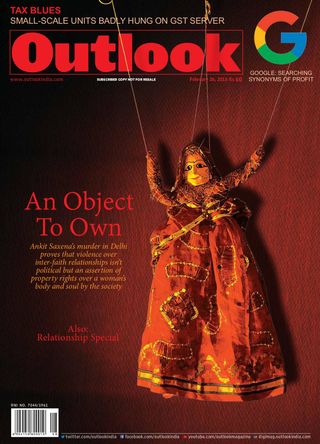

This story is from the February 26, 2018 edition of Outlook.
Subscribe to Magzter GOLD to access thousands of curated premium stories, and 10,000+ magazines and newspapers.
Already a subscriber? Sign In
MORE STORIES FROM Outlook

Outlook
'Why GDP Growth Doesn't Always Translate Into Votes'
The recent election results have once again shown that economic growth alone does not guarantee electoral victory.

3 mins
June 06, 2026

Outlook
Lights, Camera, Othering
The establishment of Israel has been accompanied by a national cinema devoted to negating and erasing the Palestinian Other
5 mins
June 06, 2026

Outlook
Goodbye to All That
Booker-winning British author Julian Barnes' Departure(s) is a unique hybrid work: playful, philosophical, whimsical
4 mins
June 06, 2026

Outlook
Collapse of Trust
As the NEET-UG 2026 paper leak forced the cancellation of India’s biggest medical entrance exam, more than 22 lakh aspirants find themselves trapped in uncertainty
11 mins
June 06, 2026

Outlook
NO LONGER A TWELFTH MAN
Bihar cricket, which has languished in the shadows for long, is all set to improve its strike rate, thanks to Vaibhav Sooryavanshi, the new Bihari kid on the block
5 mins
June 06, 2026

Outlook
BLAZE OF GLORY
The challenges of being a celebrity cricketer at a young age can be tough to handle
5 mins
June 06, 2026

Outlook
THE SWASHBUCKLERS
A new generation of fearless stars is emerging and finding its feet at the very top of an extremely competitive cricketing environment
5 mins
June 06, 2026

Outlook
THE TEEN TORNAD
At the age of 15, Vaibhav Sooryavanshi is already a cricketing legend
10 mins
June 06, 2026

Outlook
A Journey to Remember
The prerecorded message crackled over the din in the compartment: ‘Welcome to the Shatabdi Express.
4 mins
June 06, 2026

Outlook
Crossing Borders
Ruth Martin is the translator of German-Iranian author Shida Bazyar’s novel The Nights are Quiet in Tehran (originally written in German), which has been shortlisted for the 2026 International Booker Prize.
4 mins
June 06, 2026
Translate
Change font size