
Go Unlimited with Magzter GOLD
Get unlimited access to 10,000+ magazines, newspapers and Premium stories for just
Try GOLD - Free
The Making Of Indian Railways Passenger Reservation System
Voice and Data
|July 2017
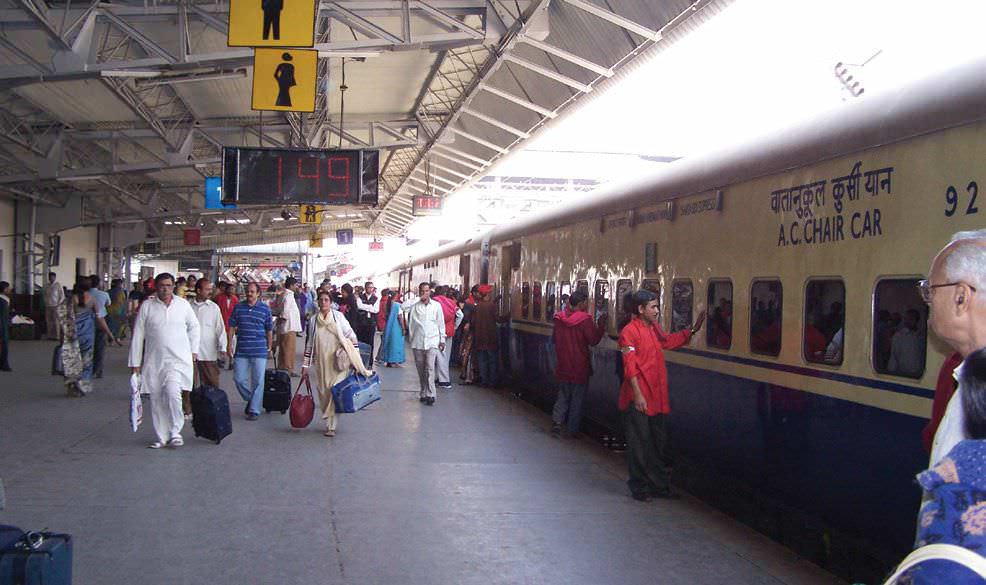
Indian Railways (IR) is the second largest train systems in the world carrying more than 20 million passengers every single day.
-

This is in addition to carrying many more millions in suburban trains across the metros of Mumbai, Delhi, Chennai and Kolkata, that too with the lowest tariffs asked globally and thus providing and serving even “poorest of the poor”.
IR is the 4th largest railway network in the world comprising 119,630 kilometres of total track and 92,081 km of running track over a route of 66,687 km with 7,216 stations at the end of 2015-16. In 2015-16, IR carried 8,107 billion passengers and 1.101 billion tons of freight with ₹442.83 billion (US$6.9 billion) earnings from the passenger segment alone.
Needless to say, IR is the backbone of our Nation. In fact, till the year 2016, IR even had a separate annual Budget, independent of the Budget of the Government of India; in February 2017 the Railway Budget finally got merged into the main governmental Budget.
It is well known that for nearly three decades “seat booking” on the Indian Railway was done manually. In 1976, as a preliminary experiment, Secunderabad-based CMC Ltd., the then leading public sector IT services company, was asked to develop a computerized passenger reservation system (PRS) called IMPRESS. IMPRESS started as an Open VMS-based system running on DEC mini-computers. It must be noted with great pride that over the past four decades this preliminary system has grown enormously, keeping the core objective exactly the same, namely, a “state-of-the-art”, cost effective and efficient home-grown system. To a country the size of India, it cannot be overstated how this is most important.


This story is from the July 2017 edition of Voice and Data.
Subscribe to Magzter GOLD to access thousands of curated premium stories, and 10,000+ magazines and newspapers.
Already a subscriber? Sign In
MORE STORIES FROM Voice and Data

Voice and Data
“THE TRADITIONAL KILL CHAIN HAS EVOLVED INTO A KILL WEB”
GP. CAPT. DR. ASHOK KUMAR Ex Indian Air Force & Member – Board of Advisors, CyberAl Commune

5 mins
April 2026

Voice and Data
Mesh vs extenders: Rethinking home Wi-Fi design
As Indian homes grow in size and device density, Wi-Fi is shifting from patch fixes to a core digital infrastructure layer, shaping coverage, resilience, and performance.
3 mins
April 2026

Voice and Data
India turns to AI infrastructure for data-driven governance
AI integration across platforms is enabling real-time querying, automated analysis, and improved decision-making across India's public data ecosystem.
3 mins
April 2026

Voice and Data
Al in networks: Speed up front, strain beneath the hood
Behind automation and predictive gains, Al in networks demands deep data integration, orchestration, and infrastructure upgrades to scale reliably.
5 mins
April 2026

Voice and Data
THE AI SURGE CAN INDIA HOLD ITS GROUND?
India's AI infrastructure is expanding at speed, but constraints on power availability, orchestration, and access will determine whether this surge can sustain itself.
9 mins
April 2026

Voice and Data
Networks shift from connectivity to intelligence at scale
As Al, edge, and digital platforms scale, networks are evolving into deterministic, secure, programmable systems enabling real-time, high-reliability operations.
5 mins
April 2026

Voice and Data
Cloud risks rising as security gaps widen across systems
Misconfigurations, weak access control, and new architectures are exposing cloud environments, making continuous monitoring and automated protection critical.
3 mins
April 2026

Voice and Data
"Orbital data centres are the next evolution of AI infrastructure"
India's AI ambitions are increasingly tied to infrastructure—compute, data centres, and the networks that bind them. Yet, as AI workloads grow denser and more latency-sensitive, terrestrial constraints around power, cooling, and geography are becoming harder to ignore.
3 mins
April 2026
Voice and Data
Global 5G IoT market to touch USD 85 billion by 2036
Enterprises are scaling 5G IoT beyond trials to cut downtime, improve efficiency and gain real-time supply chain visibility, reshaping industry operations.
2 mins
April 2026

Voice and Data
Al-led SOC infrastructure shifts from data to outcomes
As Al reshapes SOC systems, organisations must measure what matters, aligning data, analytics, and workflows to deliver outcome-driven decisions at scale.
5 mins
April 2026
Translate
Change font size