Try GOLD - Free
A History Lesson (From Year One) for Trump and the Brexit Crowd: Isolationism Has Never Worked!
The Smart Manager
|March/April 2017
Professor Stephane Garelli on growing isolationism.

From Trump’s wall and immigrant ban, to Britain pulling away from its longtime partners, the tendency toward isolationist policies is on the rise in the west.
We have seen this before but it has never had the intended effect of making any country in question “great again”.
When Chinese admiral Zheng He returned to his country in 1424 after his impressive fleet vessels—of up to 120 meters in length—had navigated the world’s oceans, he was ordered by the new Emperor Hongxi to erase all traces of his expedition. Thus, began a long period of isolationism for China. In 1793, when Sir George McCartney led a British Embassy visit to Chinese Emperor Qianlong, he found a rich court, but a nation in disarray. This period of Chinese history was later described as the ‘Immobile Empire’ in a book by French writer and politician Alain Peyrefitte.
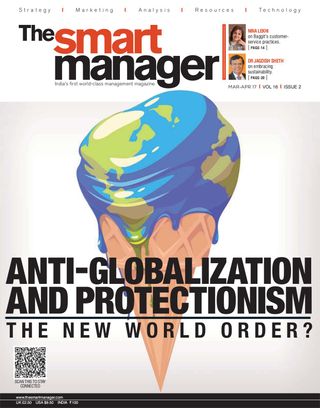

This story is from the March/April 2017 edition of The Smart Manager.
Subscribe to Magzter GOLD to access thousands of curated premium stories, and 10,000+ magazines and newspapers.
Already a subscriber? Sign In
MORE STORIES FROM The Smart Manager

The Smart Manager
What Are You Doing Wrong In Business?
The havoc incompetent managers can wreak is immeasurable. And incompetence and failure have costs: financial, organizational, and human. When a business fails, or when it suffers a serious setback, its entire mission is compromised. It can no longer serve its customers; it can no longer perform the social function for which it was created. In an interview with The Smart Manager, Morgen Witzel offers a peep into the seven sins of management detailed in his latest book Managing for Success, and tells us how managers can shape cultures that minimize failure.

9 mins
March-April 2016

The Smart Manager
Building A Quality Culture
A strong company culture defined by its values, beliefs, and behaviors, has a profound impact on its products and services. More so in today’s VUCA world, where to stay relevant and maintain a competitive edge, it is critical for organizations to build a culture that focuses on quality. Suresh Lulla, author of Quality Fables, elucidates through significant examples how creating a culture of quality is imperative to driving success and productivity.
5 mins
July-August 2016

The Smart Manager
Customers For Life
The history of General Motors in India can be traced back to the 1920s, when it became the first automotive company to set up an assembly plant in the country. The relationship since then has not been as fruitful as GM would have hoped. GM’s flagship brand, Chevrolet, was introduced in India to build upon the success of the popular Opel marque. However, success has been fleeting at best—an issue that GM India is determined to rectify. It aims to do so by adopting a two-pronged approach: using customer feedback to influence product development, and delivering a superior sales-to-service experience.
4 mins
July-August 2016

the smart manager
the mark of a leader
leaders and the value they bring to organizations have always been a topic of much discussion. but what often gets forgotten in this dialog is the equally vital aspect of followership. good leadership entails good followership, and in a sense, a good leader has to be a good follower. morgen witzel dwells on the relationship between leaders and their followers—why true leaders do not consider themselves to be a cut above the rest. they interact with their followers, help them achieve their personal goals even while drawing them to a common sense of purpose.
9 mins
september-october 2016

the smart manager
intrinsic motivation: the missing piece in changing employee behavior
“intrinsic motivation is about helping employees become more productive, engaged, and happier in their work.” shlomo ben-hur and nik kinley talk about fostering a culture of intrinsic motivation and how it can better organizational performance.
7 mins
september-october 2016

the smart manager
healthy employee, healthy business
organizations with strong wellness programs had lower rates of obesity than “loweffectiveness” companies, and had lower unplanned absence rates (3.3 vs. 4.0 days/year).*today your wellness is not just your own personal issue; it is also a concern of your company. parag pande, accenture india, showcases how designing effective and exhaustive wellness plans can help businesses achieve both short-term and longterm success.
4 mins
september-october 2016

The Smart Manager
Machine Power
..what is machine learning, exactly? Stanford University computer science professor Andrew Ng defines it as “the science of getting computers to act without being explicitly programmed.” In fundamental terms, machine learning is a branch of artificial intelligence that is meant to replicate the way humans take in information from their environment to make better-informed choices for the future*. But realistically, will machine learning transform the way businesses are managed?
5 mins
November-December 2016

The Smart Manager
A Fresh Start
Three experts reflect on their experience of pursuing a management development course and how it reshaped their journey.
3 mins
January/February 2017

The Smart Manager
Fighting The Trolls
The number of people who feel bad reviews have the power to make or break their business has risen from 17% (2014) to 21%. * However, most are struggling to find the right solution. Along with the benefits it provides, the internet also has a dark side. Today, it has become a cesspool of hatred where users openly abuse individuals or companies without any hint of shame or guilt. This culture of trolling has tarnished the brand image of several companies. It is time organizations anticipate such situations and design strategies to combat the menace.
5 mins
January/February 2017

The Smart Manager
Sustainability Is A Marketing Problem
In their recent book, The Sustainability Edge, Suhas Apte and Dr Jagdish Sheth equate the sustainability journey to the game of golf—they say the intent is not to get the best score but rather pursue continuous improvement. They believe companies should embrace sustainability as it is the only way to build long-term competitive advantage. And for this, companies need to effectively engage with all key stakeholders and influence them too. In this exclusive to The Smart Manager, Dr Sheth, talks about why consumers form the biggest piece in this puzzle and why they will play a major role in how this discourse unfolds. Edited excerpts:
11 mins
March/April 2017
Translate
Change font size