
Go Unlimited with Magzter GOLD
Get unlimited access to 10,000+ magazines, newspapers and Premium stories for just
Try GOLD - Free
Blood, Setbacks And Tears
Forbes Woman Africa
|August-September 2017
Two sisters with common failures and a dream to eventually succeed.

MY GUESTS IN THE office on a warm weekday afternoon in Johannesburg are two sisters, two entrepreneurs from Pretoria, bonded by business and blood.
As we settle for the interview, Zahra Rawjee, the older sister, speaks with a firm voice while Nadia comes across as more bubbly.
The two were raised in a business family, but are now CEOs of a company they both created ground-up. In 1937, their grandfather had set up a food distribution business, a small shop called Hoxies in Marabastad in South Africa’s capital city Pretoria, then passed on to their father, Karim Rawjee.
As young girls, during school vacations, Zahra and Nadia spent most of their time at the shop packing and selling goods, even fish. It was expected of them to be fully involved in the business.
In their growing years, they would prepare weekly reports for their father on where the markets were sitting, and what was happening in the food business internationally.
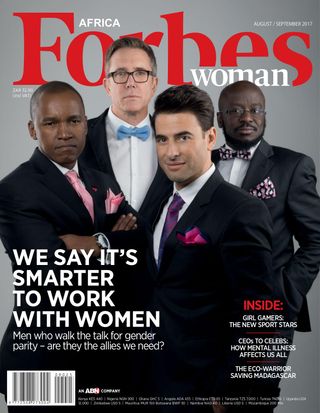

This story is from the August-September 2017 edition of Forbes Woman Africa.
Subscribe to Magzter GOLD to access thousands of curated premium stories, and 10,000+ magazines and newspapers.
Already a subscriber? Sign In
MORE STORIES FROM Forbes Woman Africa

Forbes Woman Africa
Wives. Widows. Survivors.
The widows of Marikana. Different faces. The same setting. The same inconsolable fate. The same seething anger at the cops who killed their men and changed their lives forever.

4 mins
October-November 2015

Forbes Woman Africa
Lupita Nyong'o: What I've Learned
The Oscar-winning Kenyan actress talks about sudden fame, why she has a lot to thank television for, self-righteousness and why her childhood prepared her for this life in more ways than she could have imagined.
3 mins
October-November 2016

Forbes Woman Africa
From The White House To The World
How much has changed since women first got their right to vote almost a century ago? Whether Hillary Clinton wins or not, it signals the slow but sure ascent of women in public office the world over.
6 mins
October-November 2016

Forbes Woman Africa
Why The Richest And Most Powerful Go To Davos
For years, I’ve been a silent observer of the World Economic Forum (WEF), reading about it on the internet, editing reams of copy on it or watching it on TV. But one question has always remained in my mind. What drives thousands of people each year to a small alpine town in Switzerland to live out Professor Klaus Schwab’s dream, who founded the forum in 1971?
3 mins
February-March 2017

Forbes Woman Africa
Tales From A Tense Place
Two women, one country, one fear. The tales of Linda Masarira and Nyasha Musandu tell of the fear on the ground in Zimbabwe with its tottering economy. They are an unlikely duo, an activist and a communications strategist, but both have felt the hand of authority over them for speaking out, sitting in a park and asking questions.
2 mins
February-March 2017

Forbes Woman Africa
Gloom, Growth And The New World Order
Global prospects with international economist Dambisa Moyo in Cape Town.
3 mins
April-May 2017

Forbes Woman Africa
The Kind Soul With Iron Resolve
Ahmed Kathrada was one of the great worker bees of south Africa’s struggle against apartheid in the 1950s and early 1960s; at Liliesleaf farm, in the middle class Johannesburg suburb of rivonia that was used as a hideout for the underground movement, Kathrada, wrote, worked and photocopied pamphlets tirelessly.
3 mins
April-May 2017

Forbes Woman Africa
Beating The Expiry Date Of A Human Egg
The answer to the ever-ticking biological clock is the woman who can freeze her eggs – and serve as her own future egg donor.
2 mins
April-May 2017

Forbes Woman Africa
Fighting To The End
In May, 82 more Chibok girls were released in exchange for Boko Haram prisoners. Oby Ezekwesili, a strong advocate in the campaign to bring them back, has vowed to never stop fighting.
2 mins
June-July 2017

Forbes Woman Africa
Not Just Hard Work, But Heart Work
As incidents of gender-based violence increase in Africa, those like Nigeria’s Kemi Dasilva-Ibru, are trying to bring relief to stigmatized victims.
5 mins
June-July 2017
Translate
Change font size