
Ga onbeperkt met Magzter GOLD
Krijg onbeperkte toegang tot meer dan 9000 tijdschriften, kranten en Premium-verhalen voor slechts
Poging GOUD - Vrij
Low-voltage earthing systems and bonding
EPR Magazine (Electrical & Power Review)
|January 2026
Earthing is the connection of a conductive part to the local earth. The connection to the local earth can be intentional, unintentional, or accidental, and permanent or temporary.
Significance of earthing (grounding)
- Safety from electric shock
- Protection against electrical fires
- Equipment protection
- Voltage stabilisation
- Legal and regulatory compliance
Concept of earthing (grounding)
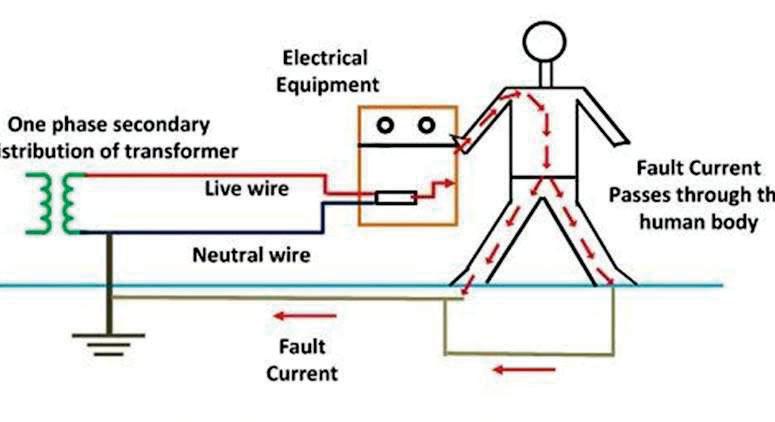
When the neutral of any system is not connected to earth, it is known as an electrical system without earthing, as depicted in Figure 1.
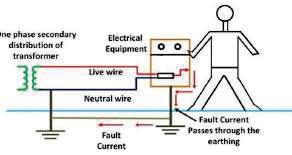
Mostly, the galvanised iron is used for the earthing. Earthing provides a simple path for leakage and fault currents in the system. The short-circuit current of the equipment flows to ground, which is assumed to have zero potential. Thus, protects the system equipment and personnel working with it from damage and shock from current, as shown in Figure 2.
The system earth resistance should be such that, during any fault for which earthing is designed to ensure protection, the protective gear must operate to isolate the faulty section, for example, by a circuit breaker or fuses.
Types of electrical earthing (Figure 3)
The electrical equipment mainly consists of two non-current-carrying parts. These parts are neutral to the electrical equipment's system or frame/support structure. Earthing can be classified into two types:
- Neutral (system) earthing
- Equipment earthing
Equipment earthing: Such a type of earthing is provided to the electrical equipment. The non-current-carrying part of the equipment, such as its metallic frame, is connected to earth via a conducting wire, as shown in Figure 3. If any fault occurs in the apparatus, the short-circuit current passes to earth through the wire. Thus, protect the system from damage.
 Classification of earthing system

Dit verhaal komt uit de January 2026-editie van EPR Magazine (Electrical & Power Review).
Abonneer u op Magzter GOLD voor toegang tot duizenden zorgvuldig samengestelde premiumverhalen en meer dan 9000 tijdschriften en kranten.
Bent u al abonnee? Aanmelden
MEER VERHALEN VAN EPR Magazine (Electrical & Power Review)
EPR Magazine (Electrical & Power Review)
Low-voltage earthing systems and bonding
Earthing is the connection of a conductive part to the local earth. The connection to the local earth can be intentional, unintentional, or accidental, and permanent or temporary.

5 mins
January 2026

EPR Magazine (Electrical & Power Review)
AEW achieves milestone of 50 lakh+ smart meter deployments
Allied Engineering Works has achieved the milestone of 50 lakh+ smart meter deployments under RDSS. Ashutosh Goel, shares more insights with EPR. Let us hear him.
3 mins
January 2026

EPR Magazine (Electrical & Power Review)
Industry adopts XLPE-based EHV cables for better performance
Polycab has entered a transition phase in its product offerings, aligning with industry trends. Anurag Agarwal shares more with EPR.
2 mins
January 2026

EPR Magazine (Electrical & Power Review)
V Cables offers high-conductivity products, durable insulation for consistent power delivery
The addition of renewables has brought economic benefits for the power industry. Puttaraju Gowda from V Cables shares insights with EPR.
2 mins
January 2026

EPR Magazine (Electrical & Power Review)
NBC Bearings intensifies anti-counterfeiting drive with major raids in Delhi and Bengaluru
Over ₹2 crore in fake bearings and production gear were recovered.
2 mins
January 2026

EPR Magazine (Electrical & Power Review)
K-LITE illuminating landscapes with high-quality architectural luminaires
Operating through state-of-the-art manufacturing facilities, K-LITE focuses on sustainable and energy-efficient LED technology.
1 mins
January 2026

EPR Magazine (Electrical & Power Review)
Renewables at scale demand deeper investments
The growing penetration of renewables into the power ecosystem has raised concerns about grid stability, but has benefited the renewable industry as a whole. The concerns can be addressed through collective efforts by stakeholders and through increasing investment in the sector. Akshay Hirandani from Serentica Renewables expresses his opinion.
2 mins
January 2026
EPR Magazine (Electrical & Power Review)
Integrating AI and sustainable energy for urban power
The integration of Artificial Intelligence (AI) with renewable energy is emerging as a defining force in shaping the future of urban power infrastructure.
1 mins
January 2026

EPR Magazine (Electrical & Power Review)
AMI to energies next phase of power sector revolution in India
Advanced Metering Infrastructure is much more than the replacement of conventional meters with smart meters. It is an integrated system comprising smart meters, communication networks (cellular, RF or PLC), headend systems (HES), meter data management systems (MDMS), and consumer-facing digital platforms.
2 mins
January 2026

EPR Magazine (Electrical & Power Review)
IT ALL BEGAN WITH SMART METERS
Smart metering frameworks, renewable energy integration and data-driven grid management are redefining city power networks.
7 mins
January 2026
Listen
Translate
Change font size