Poging GOUD - Vrij
STRANDED ON MARS
Scientific American
|December 2025
NASA spent years and billions of dollars collecting Martian samples to bring home. Now it might just leave them there
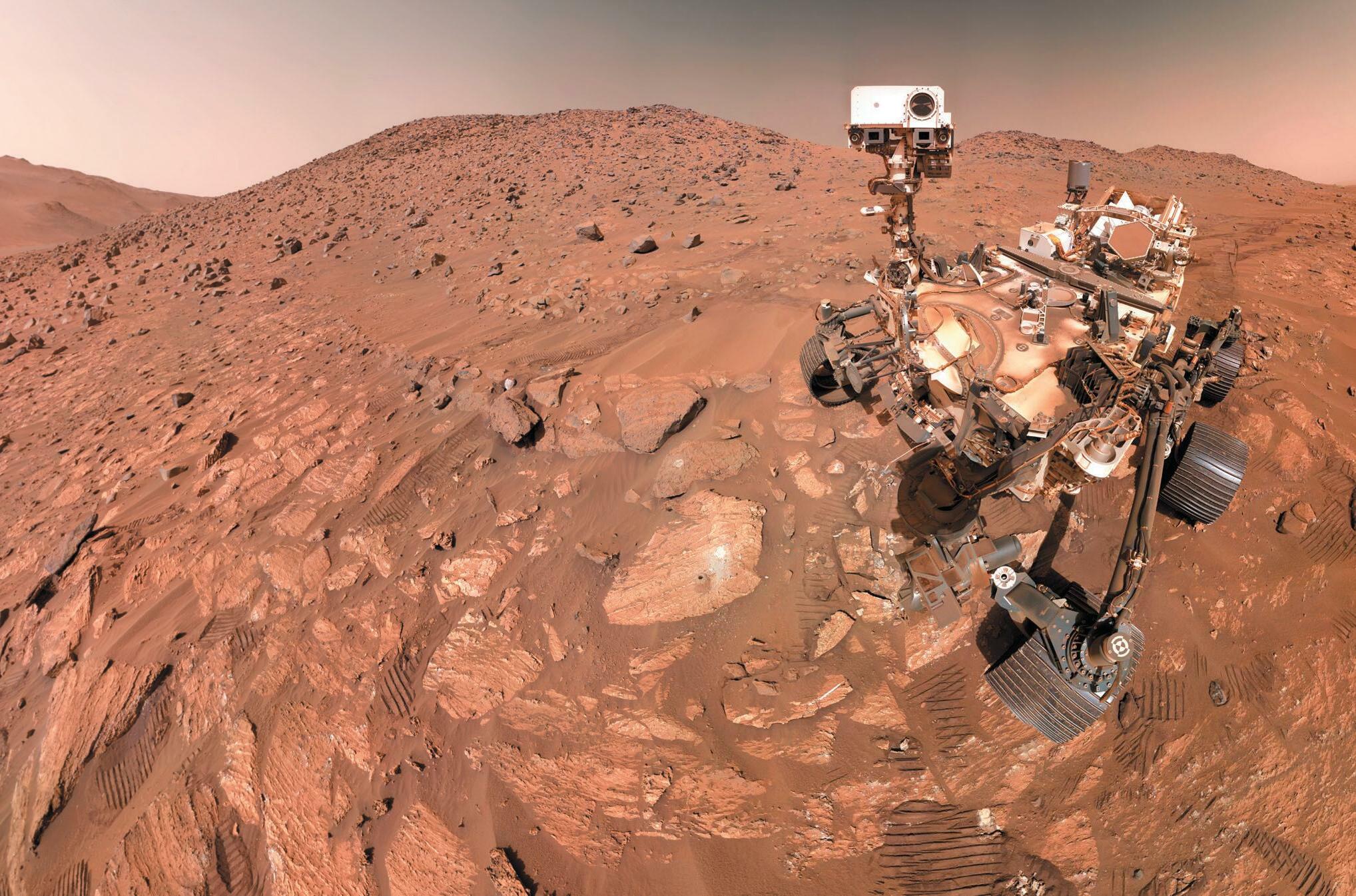
NASA's Perseverance Mars rover took this selfie on Mars in July 2024. The rover stands next to a rock named Cheyava Falls, which scientists say may hold clues about whether the planet ever hosted microbial life.
RIGHT NOW ONE OF THE MOST advanced planetary explorers ever built is scouring the surface of Mars. Supported by a team of hundreds of scientists back on Earth, the Perseverance rover has traveled nearly the distance of a marathon to answer some of the biggest questions about our neighboring world: What was the planet like eons ago? Was it ever habitable? Did it host life?
One rock visited by Perseverance, called Cheyava Falls, is speckled with iron-rich minerals that might be able to answer these questions, scientists announced in September. On Earth the presence of these minerals usually means microbes that used iron in the chemical reactions essential to their metabolism once lived there. Does the same hold true on Mars? A piece of Cheyava Falls is safely tucked inside the rover's storage cache. If it can be shipped to Earth, analysis with the full range of laboratory equipment here could tell us the answer.
But Cheyava Falls's ride to our planet might have fallen through. The Perseverance rover is the first phase of a multistep mission to bring bits of Mars to Earth known as Mars Sample Return (MSR), and the next step is dangling by a thread. The Trump administration has proposed canceling the return portion of the endeavor. The mission's fate, as of press time, rests with the U.S. Congress.
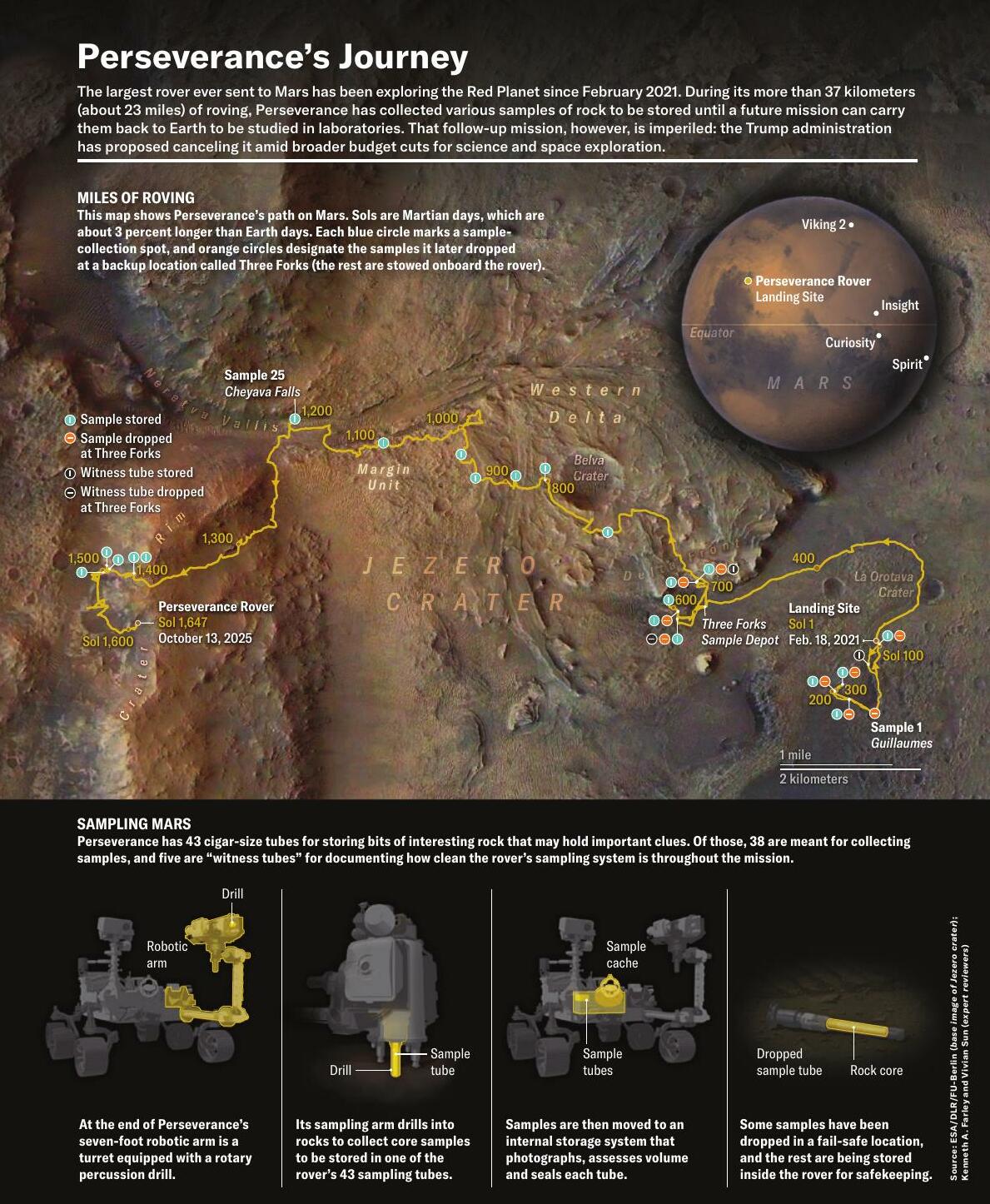 The situation has dismayed scientists who have longed to get their hands on Martian rocks. Now that Perseverance has scooped up prized samples, scientists are faced with the prospect of leaving them on Mars to languish.

Dit verhaal komt uit de December 2025-editie van Scientific American.
Abonneer u op Magzter GOLD voor toegang tot duizenden zorgvuldig samengestelde premiumverhalen en meer dan 9000 tijdschriften en kranten.
Bent u al abonnee? Aanmelden
MEER VERHALEN VAN Scientific American
Scientific American
Earthquake Life
Yellowstone quakes spark bursts of microbial growth underground

2 mins
March 2026
Scientific American
Sailing the Sun
By designing vertical panels that move in a gale, two Swedish inventors are unlocking a solar future for the windswept north
9 mins
March 2026
Scientific American
Covered in Bees
Ancient bees burrowed deep into discarded mammal jawbones
2 mins
March 2026
Scientific American
Fire Starters
Ancient humans were making fire 350,000 years earlier than thought
3 mins
March 2026
Scientific American
Relativity Revealed
Physicists have observed a bizarre prediction of special relativity for the first time
8 mins
March 2026

Scientific American
Everything You Wanted to Know about Polyamory (but Were Afraid to Ask
The practice is not a faddish excuse to sleep around, research shows. And it has deep roots in American culture
14 mins
March 2026

Scientific American
Let the Rivers Run
An investigation into the rights of nature
4 mins
March 2026

Scientific American
Hidden Proof
\"Effective zero knowledge\" beats long-standing cryptographic impossibilities
2 mins
March 2026
Scientific American
The Universe's Weirdest Optical Illusions
Sometimes the farther away an object is, the bigger it seems to be
4 mins
March 2026

Scientific American
Living in the COPILOT SOCIETY
The promise and peril of artificial intelligence everywhere
2 mins
March 2026
Listen
Translate
Change font size