Poging GOUD - Vrij
INESCAPABLE THREAT
Down To Earth
|December 16, 2024
Chemical pollution is the most underrated and underreported risk of the 21st century that threatens all species and regions

THE ORCAS or killer whales are the masters of the oceans. With no known natural predators, this formidable creature has been roaming across the world since it evolved from a small, deer-like land animal about 50 million years ago-much before the appearance of the first humans. But this resilient top predator is now teetering on the edge of extinction because of chemical contaminants released by human activities.
Scientists from Canada, Denmark, Norway, Iceland, US and Greenland have conducted a 10-year-long research on orcas of the North Atlantic Ocean. Even though the ranges of the studied individuals were far from human habitations, the scientists have found in the orcas' blubbers (fat layer under the skin) high levels of persistent organic pollutants (POPS)-toxic chemicals used in industrial and agricultural processes. One category of the POPs, the scientists write in Environmental Science and Technology in 2023, are polychlorinated biphenyls (PCBs). Used as coolants and lubricants in electrical components, they were banned in the US and Canada 50 years ago; yet PCBS were present at 10 times the threshold value considered safe for immune systems and fertility rate of orcas.
The blubber samples also contained several other categories of POPs, whose "production, use, and/or release" were to be reduced or eliminated under international environmental treaty Stockholm Convention on Persistent Organic Pollutants, signed in 2001.
The fact is these "persistent" pollutants do not break down easily. Thus they remain in the environment for decades, travel over great distances through water and wind and eventually work their way through the food chain by accumulating in the body fat of species.
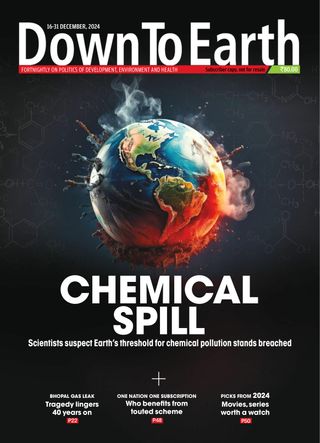

Dit verhaal komt uit de December 16, 2024-editie van Down To Earth.
Abonneer u op Magzter GOLD voor toegang tot duizenden zorgvuldig samengestelde premiumverhalen en meer dan 9000 tijdschriften en kranten.
Bent u al abonnee? Aanmelden
MEER VERHALEN VAN Down To Earth

Down To Earth
THE GREAT PIVOT
China's moves to transition to clean energy offer critical lessons to India

4 mins
March 01, 2026

Down To Earth
COAL V CORRIDOR
A proposal to mine coal along a corridor that links two tiger reserves in central India is a step away from getting final clearance. The move could affect movement and genetic diversity of tiger populations in the region
8 mins
March 01, 2026

Down To Earth
India's challenging AI predicament
Hobbled by lack of innovation and AI skills in its crucial technology sector, India is focusing on a ruinous plan to host data centres
4 mins
March 01, 2026
Down To Earth
China to implement zero tariffs across Africa
CHINA ON February 14 announced that it will implement zero tariffs for imports from all the 53 African nations it has diplomatic relations with, starting from May 1.
1 min
March 01, 2026
Down To Earth
Poverty, sans the threshold
MEASUREMENT OF poverty is a fundamental exercise, needed to direct development programmes.
2 mins
March 01, 2026

Down To Earth
A bridge across forever
For two decades, a Chhattisgarh village remains stuck in a loop of building temporary river crossings to access markets and sell forest produce
4 mins
March 01, 2026
Down To Earth
Liveable cities need a new model
CRY FOR my Delhi. This is my city—my family records many generations who have lived here.
3 mins
March 01, 2026

Down To Earth
Real impacts of the changing seasons
This refers to the article \"1,500 days, and an alarm for new climate\" (1-15 December, 2025).
1 mins
March 01, 2026

Down To Earth
‘It’s a systematic effort by US to dismantle climate policy’
The US, the world's largest historical emitter of greenhouse gases, has overturned its “endangerment finding”, the legal foundation for regulating emissions under the Clean Air Act since 2009.
4 mins
March 01, 2026
Down To Earth
Amazon turned carbon source in 2023 drought
EXTREME DROUGHT and a prolonged heatwave in 2023 pushed parts of the Amazon rainforest from acting as a carbon sink to becoming a carbon source for three months, according to a February 13 study published in the journal AGU Advances of the American Geophysical Union.
1 min
March 01, 2026
Listen
Translate
Change font size