試す 金 - 無料
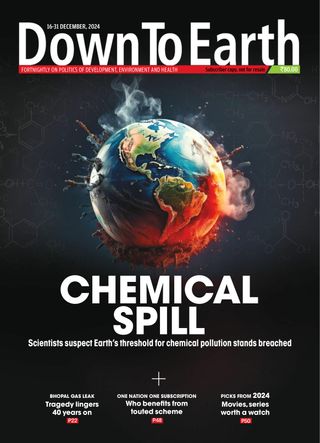
INESCAPABLE THREAT
Down To Earth
|December 16, 2024
Chemical pollution is the most underrated and underreported risk of the 21st century that threatens all species and regions

THE ORCAS or killer whales are the masters of the oceans. With no known natural predators, this formidable creature has been roaming across the world since it evolved from a small, deer-like land animal about 50 million years ago-much before the appearance of the first humans. But this resilient top predator is now teetering on the edge of extinction because of chemical contaminants released by human activities.
Scientists from Canada, Denmark, Norway, Iceland, US and Greenland have conducted a 10-year-long research on orcas of the North Atlantic Ocean. Even though the ranges of the studied individuals were far from human habitations, the scientists have found in the orcas' blubbers (fat layer under the skin) high levels of persistent organic pollutants (POPS)-toxic chemicals used in industrial and agricultural processes. One category of the POPs, the scientists write in Environmental Science and Technology in 2023, are polychlorinated biphenyls (PCBs). Used as coolants and lubricants in electrical components, they were banned in the US and Canada 50 years ago; yet PCBS were present at 10 times the threshold value considered safe for immune systems and fertility rate of orcas.
The blubber samples also contained several other categories of POPs, whose "production, use, and/or release" were to be reduced or eliminated under international environmental treaty Stockholm Convention on Persistent Organic Pollutants, signed in 2001.
The fact is these "persistent" pollutants do not break down easily. Thus they remain in the environment for decades, travel over great distances through water and wind and eventually work their way through the food chain by accumulating in the body fat of species.

このストーリーは、Down To Earth の December 16, 2024 版からのものです。
Magzter GOLD を購読すると、厳選された何千ものプレミアム記事や、10,000 以上の雑誌や新聞にアクセスできます。
すでに購読者ですか? サインイン
Down To Earth からのその他のストーリー

Down To Earth
THINK TWICE BEFORE FELLING SAL TREES
Many trees considered to be affected by sal borer in the 1990s are still alive today

1 mins
February 16, 2026

Down To Earth
EDGE OF SURVIVAL
Caste divides deny marginalised communities land, resources and essential aid, leaving them more vulnerable to climate disasters
6 mins
February 16, 2026

Down To Earth
A WISH LIST?
Union Budget for 2026-27 conveys the impression of a roll-call of intentions and ambitious proposals, with little detail on their formulation
6 mins
February 16, 2026
Down To Earth
Break down the gender wall
THE RULING National Democratic Alliance (NDA) government has been heavily invested in the goal to make India a developed economy by 2047.
2 mins
February 16, 2026

Down To Earth
MENSTRUAL HEALTH, NOW A FUNDAMENTAL RIGHT
In a landmark judgement, the Supreme Court has recognised menstrual health and hygiene as a fundamental right under Article 21 of the Constitution of India, which guarantees the right to life and dignity.
8 mins
February 16, 2026

Down To Earth
Of devolution and new disasters
The 16th Finance Commission pushes for changes in view of new fiscal and climatic conditions
11 mins
February 16, 2026
Down To Earth
Rising risks of plastics
NEGATIVE IMPACTS on human health due to emissions linked to the plastic lifecycle could double by 2040, according to a study published in The Lancet Planetary Health in January.
1 min
February 16, 2026

Down To Earth
GAP BETWEEN EPIDEMICS NARROWING
A watershed-based and landscape-level approach is needed to address forest degradation
2 mins
February 16, 2026
Down To Earth
WAITING TO STRIKE
Sal heartwood borer is considered the biggest threat to forestry in India, especially to the sal tree, where it lives and breeds.
11 mins
February 16, 2026

Down To Earth
A SPRING DELIGHT
Mustard flowers are not meant only for the eyes. Invite them to your plate once in a while
3 mins
February 16, 2026
Listen
Translate
Change font size