Poging GOUD - Vrij
Dubious distinction
Down To Earth
|March 01, 2025
How Madhya Pradesh displaced Punjab as the country's leading state in stubble burning
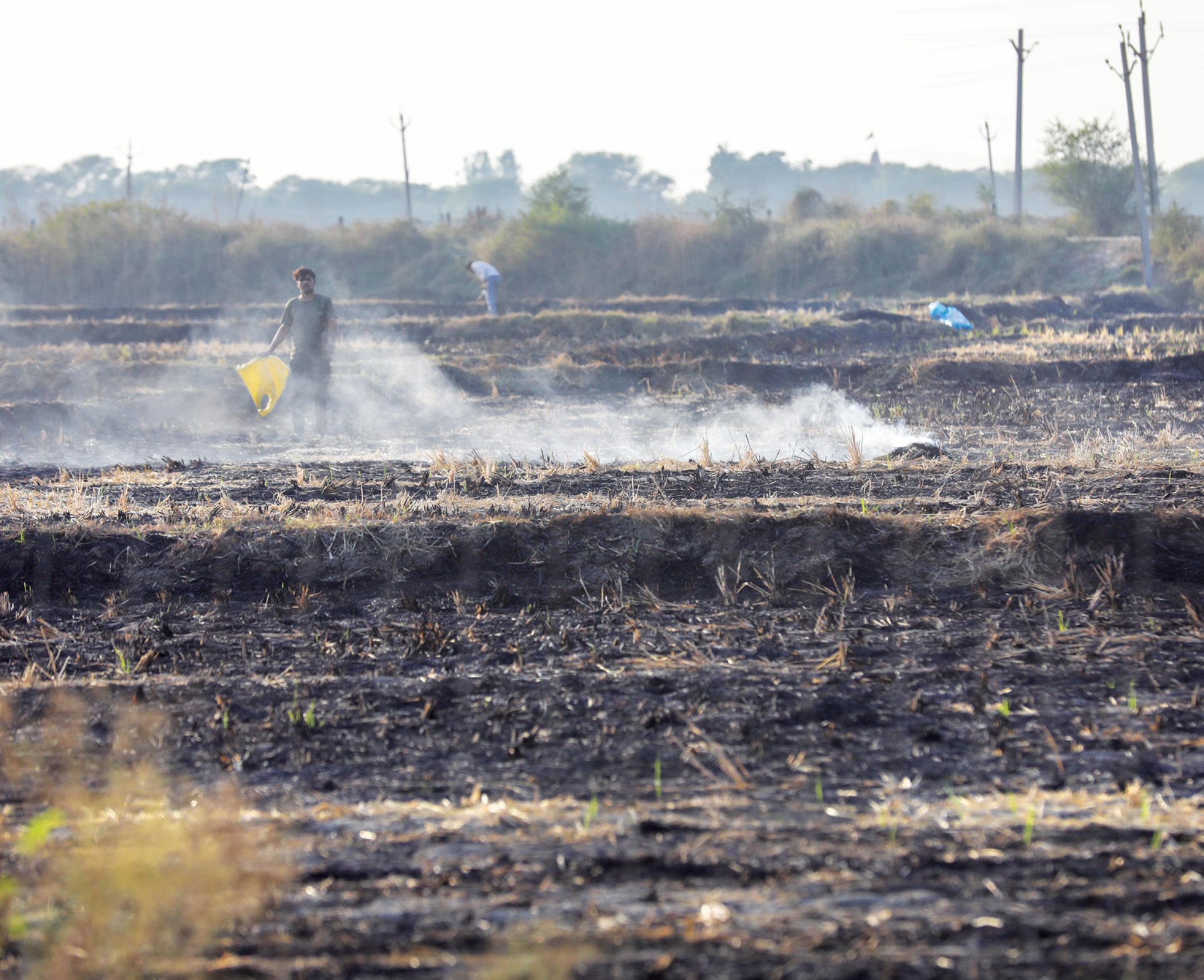
HARIOM YADAV has seen a clear and rapid change in the farming pattern of his village. “About 70 per cent of farmlands in Silpuri are under paddy. This was not the case a few years ago,” says the 50-year-old farmer from Madhya Pradesh’s Sheopur district. The popularity of paddy has brought with it a known side effect—stubble burning. Last year, the district topped the country in stubble-burning incidents. The trend was same across the state.
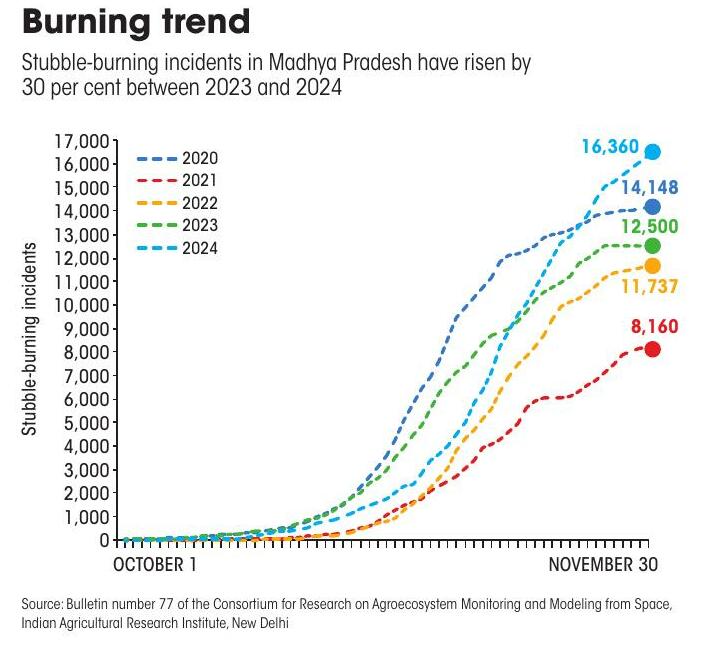
Between September 15 and November 30 last year, Madhya Pradesh recorded 16,360 incidents Of stubble fire—the highest in the country—as per a bulletin released by the Consortium for Research on Agroecosystem Monitoring and Modelling from Space (CREAMS) on November 30, 2024 (see ‘Burning trend’). CREAMS is under the Indian Agricultural Research Institute (IARI), New Delhi, and uses remote-sensing satellite technology to capture stubble-burning incidents in six states where the practice is prevalent—Punjab, Haryana, Uttar Pradesh, Madhya Pradesh, Delhi and Rajasthan. The CREAMS data shows that Madhya Pradesh had 44 per cent of the 37,602 stubble-burning cases reported from the six states in 2024.
Historically, Punjab has reported most paddy stubble burning cases. But in 2024 it had 10,909 stubble burning cases—nearly 5,000 less than Madhya Pradesh. CREAMS data also shows that Madhya Pradesh had five districts with more than 1,000 cases of stubble burning—Sheopur, Jabalpur, Hoshangabad, Gwalior and Datia (see ‘Fire incidents’ on p48), while Punjab had only two—Sangrur (1,725 incidents) and Ferozepur (1,342 incidents). With 2,508 cases, Sheopur saw the most stubble fire incidents in the country.

Dit verhaal komt uit de March 01, 2025-editie van Down To Earth.
Abonneer u op Magzter GOLD voor toegang tot duizenden zorgvuldig samengestelde premiumverhalen en meer dan 9000 tijdschriften en kranten.
Bent u al abonnee? Aanmelden
MEER VERHALEN VAN Down To Earth

Down To Earth
THE GREAT PIVOT
China's moves to transition to clean energy offer critical lessons to India

4 mins
March 01, 2026

Down To Earth
COAL V CORRIDOR
A proposal to mine coal along a corridor that links two tiger reserves in central India is a step away from getting final clearance. The move could affect movement and genetic diversity of tiger populations in the region
8 mins
March 01, 2026

Down To Earth
India's challenging AI predicament
Hobbled by lack of innovation and AI skills in its crucial technology sector, India is focusing on a ruinous plan to host data centres
4 mins
March 01, 2026
Down To Earth
China to implement zero tariffs across Africa
CHINA ON February 14 announced that it will implement zero tariffs for imports from all the 53 African nations it has diplomatic relations with, starting from May 1.
1 min
March 01, 2026
Down To Earth
Poverty, sans the threshold
MEASUREMENT OF poverty is a fundamental exercise, needed to direct development programmes.
2 mins
March 01, 2026

Down To Earth
A bridge across forever
For two decades, a Chhattisgarh village remains stuck in a loop of building temporary river crossings to access markets and sell forest produce
4 mins
March 01, 2026
Down To Earth
Liveable cities need a new model
CRY FOR my Delhi. This is my city—my family records many generations who have lived here.
3 mins
March 01, 2026

Down To Earth
Real impacts of the changing seasons
This refers to the article \"1,500 days, and an alarm for new climate\" (1-15 December, 2025).
1 mins
March 01, 2026

Down To Earth
‘It’s a systematic effort by US to dismantle climate policy’
The US, the world's largest historical emitter of greenhouse gases, has overturned its “endangerment finding”, the legal foundation for regulating emissions under the Clean Air Act since 2009.
4 mins
March 01, 2026
Down To Earth
Amazon turned carbon source in 2023 drought
EXTREME DROUGHT and a prolonged heatwave in 2023 pushed parts of the Amazon rainforest from acting as a carbon sink to becoming a carbon source for three months, according to a February 13 study published in the journal AGU Advances of the American Geophysical Union.
1 min
March 01, 2026
Listen
Translate
Change font size