
Mit Magzter GOLD unbegrenztes Potenzial nutzen
Erhalten Sie unbegrenzten Zugriff auf über 9.000 Zeitschriften, Zeitungen und Premium-Artikel für nur
Versuchen GOLD - Frei
Dubious distinction
Down To Earth
|March 01, 2025
How Madhya Pradesh displaced Punjab as the country's leading state in stubble burning
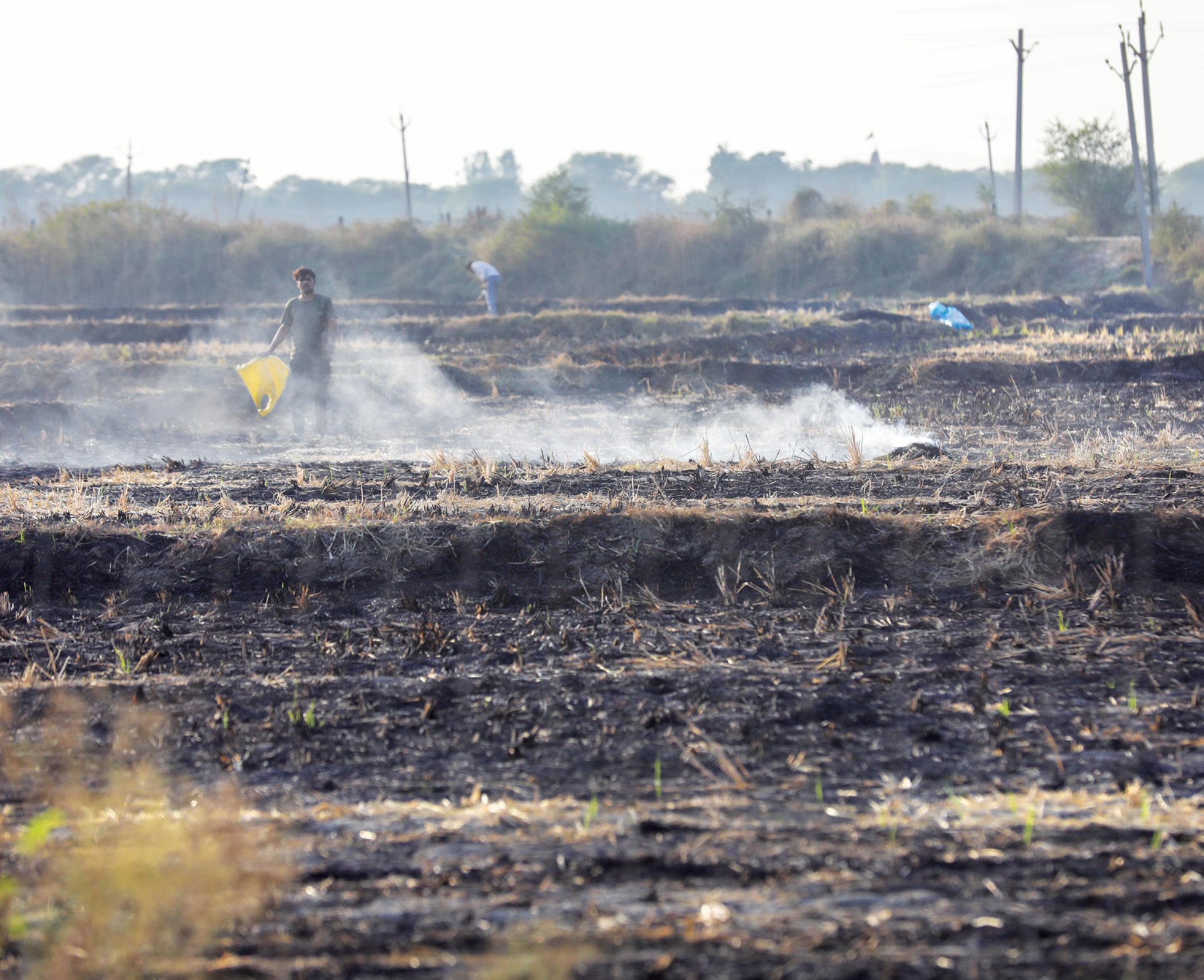
HARIOM YADAV has seen a clear and rapid change in the farming pattern of his village. “About 70 per cent of farmlands in Silpuri are under paddy. This was not the case a few years ago,” says the 50-year-old farmer from Madhya Pradesh’s Sheopur district. The popularity of paddy has brought with it a known side effect—stubble burning. Last year, the district topped the country in stubble-burning incidents. The trend was same across the state.
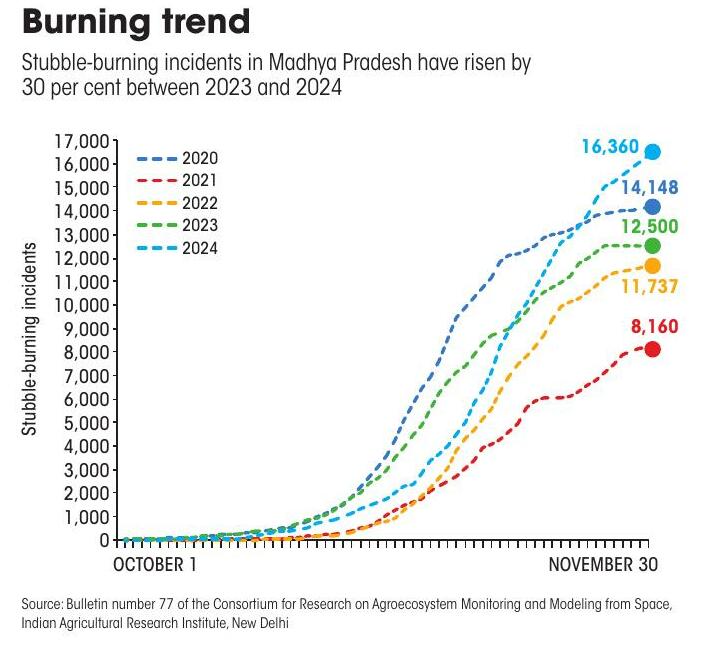
Between September 15 and November 30 last year, Madhya Pradesh recorded 16,360 incidents Of stubble fire—the highest in the country—as per a bulletin released by the Consortium for Research on Agroecosystem Monitoring and Modelling from Space (CREAMS) on November 30, 2024 (see ‘Burning trend’). CREAMS is under the Indian Agricultural Research Institute (IARI), New Delhi, and uses remote-sensing satellite technology to capture stubble-burning incidents in six states where the practice is prevalent—Punjab, Haryana, Uttar Pradesh, Madhya Pradesh, Delhi and Rajasthan. The CREAMS data shows that Madhya Pradesh had 44 per cent of the 37,602 stubble-burning cases reported from the six states in 2024.
Historically, Punjab has reported most paddy stubble burning cases. But in 2024 it had 10,909 stubble burning cases—nearly 5,000 less than Madhya Pradesh. CREAMS data also shows that Madhya Pradesh had five districts with more than 1,000 cases of stubble burning—Sheopur, Jabalpur, Hoshangabad, Gwalior and Datia (see ‘Fire incidents’ on p48), while Punjab had only two—Sangrur (1,725 incidents) and Ferozepur (1,342 incidents). With 2,508 cases, Sheopur saw the most stubble fire incidents in the country.

Diese Geschichte stammt aus der March 01, 2025-Ausgabe von Down To Earth.
Abonnieren Sie Magzter GOLD, um auf Tausende kuratierter Premium-Geschichten und über 9.000 Zeitschriften und Zeitungen zuzugreifen.
Sie sind bereits Abonnent? Anmelden
WEITERE GESCHICHTEN VON Down To Earth

Down To Earth
THINK TWICE BEFORE FELLING SAL TREES
Many trees considered to be affected by sal borer in the 1990s are still alive today

1 mins
February 16, 2026

Down To Earth
EDGE OF SURVIVAL
Caste divides deny marginalised communities land, resources and essential aid, leaving them more vulnerable to climate disasters
6 mins
February 16, 2026

Down To Earth
A WISH LIST?
Union Budget for 2026-27 conveys the impression of a roll-call of intentions and ambitious proposals, with little detail on their formulation
6 mins
February 16, 2026
Down To Earth
Break down the gender wall
THE RULING National Democratic Alliance (NDA) government has been heavily invested in the goal to make India a developed economy by 2047.
2 mins
February 16, 2026

Down To Earth
MENSTRUAL HEALTH, NOW A FUNDAMENTAL RIGHT
In a landmark judgement, the Supreme Court has recognised menstrual health and hygiene as a fundamental right under Article 21 of the Constitution of India, which guarantees the right to life and dignity.
8 mins
February 16, 2026

Down To Earth
Of devolution and new disasters
The 16th Finance Commission pushes for changes in view of new fiscal and climatic conditions
11 mins
February 16, 2026
Down To Earth
Rising risks of plastics
NEGATIVE IMPACTS on human health due to emissions linked to the plastic lifecycle could double by 2040, according to a study published in The Lancet Planetary Health in January.
1 min
February 16, 2026

Down To Earth
GAP BETWEEN EPIDEMICS NARROWING
A watershed-based and landscape-level approach is needed to address forest degradation
2 mins
February 16, 2026
Down To Earth
WAITING TO STRIKE
Sal heartwood borer is considered the biggest threat to forestry in India, especially to the sal tree, where it lives and breeds.
11 mins
February 16, 2026
Down To Earth
A SPRING DELIGHT
Mustard flowers are not meant only for the eyes. Invite them to your plate once in a while
3 mins
February 16, 2026
Listen
Translate
Change font size