
Ga onbeperkt met Magzter GOLD
Krijg onbeperkte toegang tot meer dan 9000 tijdschriften, kranten en Premium-verhalen voor slechts
Poging GOUD - Vrij
Collective denial
Down To Earth
|October 16, 2025
A decade on from the Paris Agreement, countries are planning more fossil fuel production than before, putting global climate ambitions at increasing risk
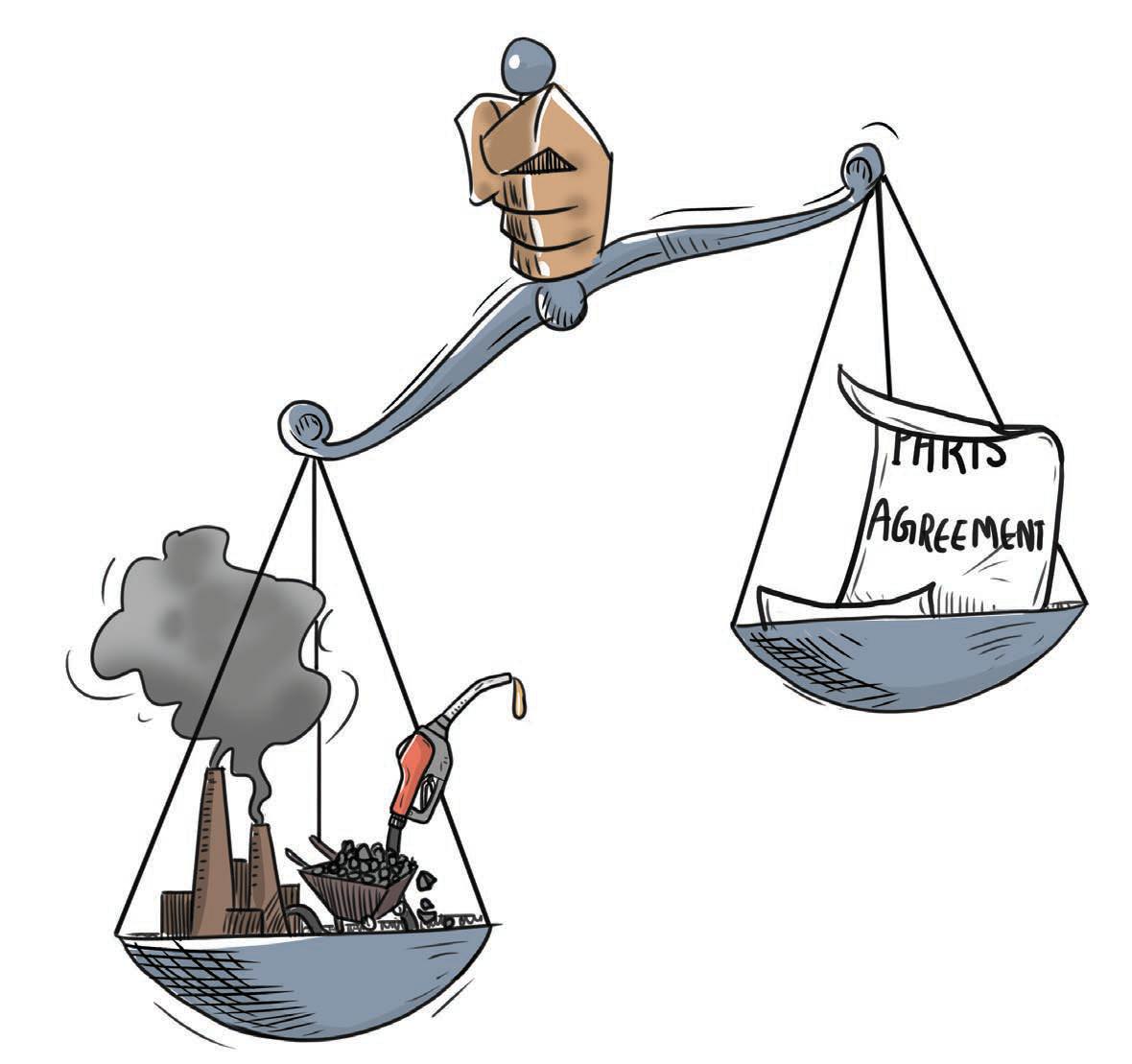
IN DECEMBER 2015, under the Paris Agreement, the world agreed to reduce emissions to limit global warming to well below 2°C, and ideally to 1.5°C, compared to pre-industrial levels. Stronger commitments were expected over time through a five-year review process. A decade later, the situation remains stark. Countries are in aggregate planning even more fossil fuel production than before, putting global climate ambitions at increasing risk.
Governments plan to produce more than double—120 per cent— the volume of fossil fuels in 2030 than would be consistent with limiting global warming to 1.5°C, steering the world further from the Paris goals than the last assessment in 2023, states the “Production Gap Report 2025”, released on September 22, ahead of the 30th UN Climate Change Conference (COP30) to be held in Belém, Brazil, in November. This is the fifth edition of the UN-backed report, which tracks the misalignment between governments’ planned fossil fuel production and global production levels consistent with limiting global warming to 1.5°C or 2°C.
The findings reveal a widening chasm between countries’ climate commitments and their energy strategies. Governments now plan higher levels of coal production through 2035, gas production through 2050, and oil well beyond mid-century compared to projections made just two years ago. Coal remains the most misaligned, with global output in 2030 projected to be 500 per cent higher than what is needed to stay on the 1.5°C pathway and 330 per cent above the 2°C benchmark. Oil and gas gaps are also stark, with planned 2030 production exceeding Paris-aligned limits by 31 per cent and 92 per cent. In other words, aggregate planned coal production for 2030 is 7 per cent higher than estimated in the 2023 Production Gap Report analysis; planned gas production is 5 per cent higher.


Dit verhaal komt uit de October 16, 2025-editie van Down To Earth.
Abonneer u op Magzter GOLD voor toegang tot duizenden zorgvuldig samengestelde premiumverhalen en meer dan 9000 tijdschriften en kranten.
Bent u al abonnee? Aanmelden
MEER VERHALEN VAN Down To Earth

Down To Earth
THINK TWICE BEFORE FELLING SAL TREES
Many trees considered to be affected by sal borer in the 1990s are still alive today

1 mins
February 16, 2026

Down To Earth
EDGE OF SURVIVAL
Caste divides deny marginalised communities land, resources and essential aid, leaving them more vulnerable to climate disasters
6 mins
February 16, 2026

Down To Earth
A WISH LIST?
Union Budget for 2026-27 conveys the impression of a roll-call of intentions and ambitious proposals, with little detail on their formulation
6 mins
February 16, 2026
Down To Earth
Break down the gender wall
THE RULING National Democratic Alliance (NDA) government has been heavily invested in the goal to make India a developed economy by 2047.
2 mins
February 16, 2026

Down To Earth
MENSTRUAL HEALTH, NOW A FUNDAMENTAL RIGHT
In a landmark judgement, the Supreme Court has recognised menstrual health and hygiene as a fundamental right under Article 21 of the Constitution of India, which guarantees the right to life and dignity.
8 mins
February 16, 2026

Down To Earth
Of devolution and new disasters
The 16th Finance Commission pushes for changes in view of new fiscal and climatic conditions
11 mins
February 16, 2026
Down To Earth
Rising risks of plastics
NEGATIVE IMPACTS on human health due to emissions linked to the plastic lifecycle could double by 2040, according to a study published in The Lancet Planetary Health in January.
1 min
February 16, 2026

Down To Earth
GAP BETWEEN EPIDEMICS NARROWING
A watershed-based and landscape-level approach is needed to address forest degradation
2 mins
February 16, 2026

Down To Earth
WAITING TO STRIKE
Sal heartwood borer is considered the biggest threat to forestry in India, especially to the sal tree, where it lives and breeds.
11 mins
February 16, 2026

Down To Earth
A SPRING DELIGHT
Mustard flowers are not meant only for the eyes. Invite them to your plate once in a while
3 mins
February 16, 2026
Listen
Translate
Change font size