Essayer OR - Gratuit
Collective denial
Down To Earth
|October 16, 2025
A decade on from the Paris Agreement, countries are planning more fossil fuel production than before, putting global climate ambitions at increasing risk
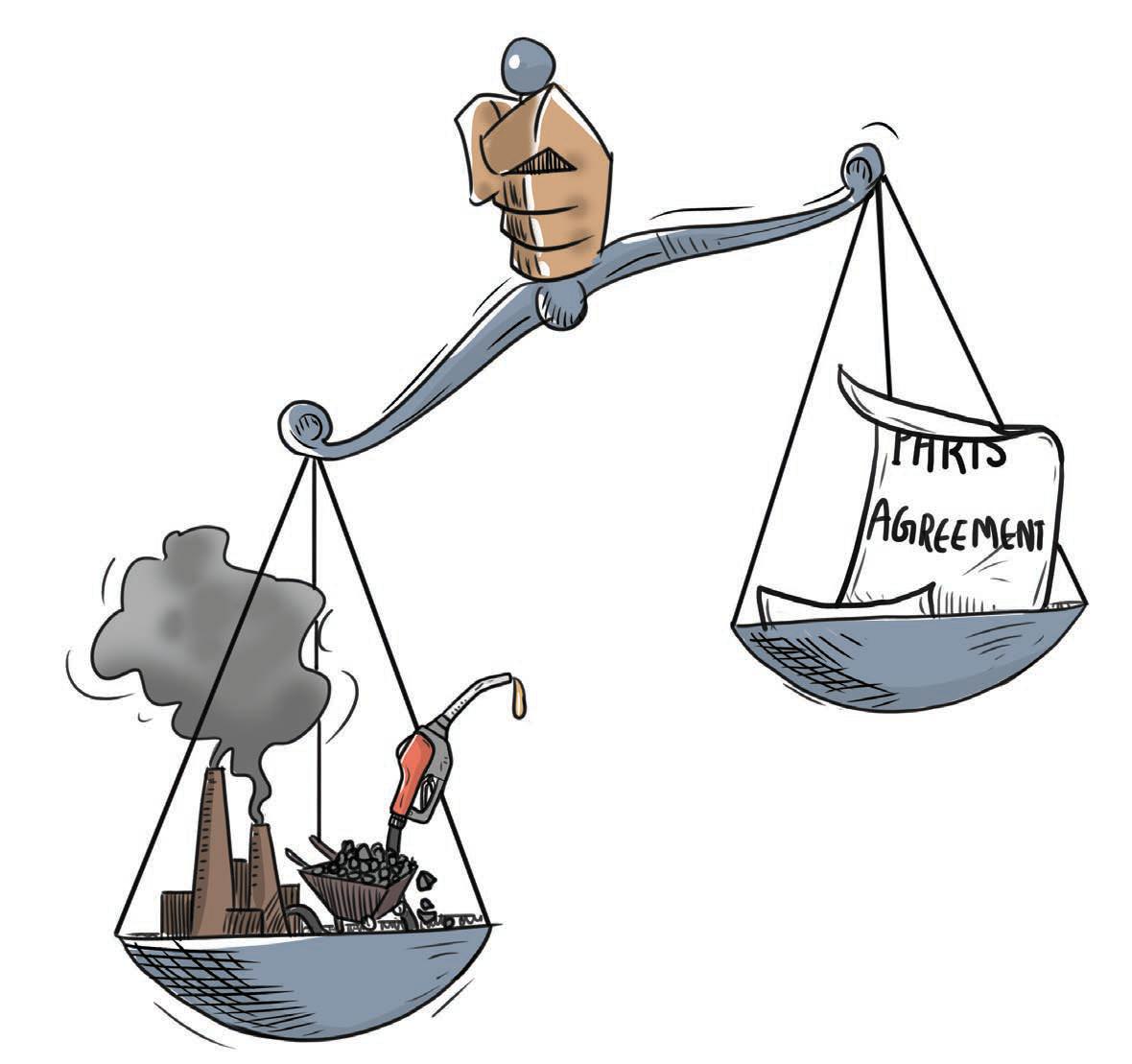
IN DECEMBER 2015, under the Paris Agreement, the world agreed to reduce emissions to limit global warming to well below 2°C, and ideally to 1.5°C, compared to pre-industrial levels. Stronger commitments were expected over time through a five-year review process. A decade later, the situation remains stark. Countries are in aggregate planning even more fossil fuel production than before, putting global climate ambitions at increasing risk.
Governments plan to produce more than double—120 per cent— the volume of fossil fuels in 2030 than would be consistent with limiting global warming to 1.5°C, steering the world further from the Paris goals than the last assessment in 2023, states the “Production Gap Report 2025”, released on September 22, ahead of the 30th UN Climate Change Conference (COP30) to be held in Belém, Brazil, in November. This is the fifth edition of the UN-backed report, which tracks the misalignment between governments’ planned fossil fuel production and global production levels consistent with limiting global warming to 1.5°C or 2°C.
The findings reveal a widening chasm between countries’ climate commitments and their energy strategies. Governments now plan higher levels of coal production through 2035, gas production through 2050, and oil well beyond mid-century compared to projections made just two years ago. Coal remains the most misaligned, with global output in 2030 projected to be 500 per cent higher than what is needed to stay on the 1.5°C pathway and 330 per cent above the 2°C benchmark. Oil and gas gaps are also stark, with planned 2030 production exceeding Paris-aligned limits by 31 per cent and 92 per cent. In other words, aggregate planned coal production for 2030 is 7 per cent higher than estimated in the 2023 Production Gap Report analysis; planned gas production is 5 per cent higher.


Cette histoire est tirée de l'édition October 16, 2025 de Down To Earth.
Abonnez-vous à Magzter GOLD pour accéder à des milliers d'histoires premium sélectionnées et à plus de 9 000 magazines et journaux.
Déjà abonné ? Se connecter
PLUS D'HISTOIRES DE Down To Earth

Down To Earth
THE GREAT PIVOT
China's moves to transition to clean energy offer critical lessons to India

4 mins
March 01, 2026

Down To Earth
COAL V CORRIDOR
A proposal to mine coal along a corridor that links two tiger reserves in central India is a step away from getting final clearance. The move could affect movement and genetic diversity of tiger populations in the region
8 mins
March 01, 2026

Down To Earth
India's challenging AI predicament
Hobbled by lack of innovation and AI skills in its crucial technology sector, India is focusing on a ruinous plan to host data centres
4 mins
March 01, 2026
Down To Earth
China to implement zero tariffs across Africa
CHINA ON February 14 announced that it will implement zero tariffs for imports from all the 53 African nations it has diplomatic relations with, starting from May 1.
1 min
March 01, 2026
Down To Earth
Poverty, sans the threshold
MEASUREMENT OF poverty is a fundamental exercise, needed to direct development programmes.
2 mins
March 01, 2026

Down To Earth
A bridge across forever
For two decades, a Chhattisgarh village remains stuck in a loop of building temporary river crossings to access markets and sell forest produce
4 mins
March 01, 2026
Down To Earth
Liveable cities need a new model
CRY FOR my Delhi. This is my city—my family records many generations who have lived here.
3 mins
March 01, 2026

Down To Earth
Real impacts of the changing seasons
This refers to the article \"1,500 days, and an alarm for new climate\" (1-15 December, 2025).
1 mins
March 01, 2026

Down To Earth
‘It’s a systematic effort by US to dismantle climate policy’
The US, the world's largest historical emitter of greenhouse gases, has overturned its “endangerment finding”, the legal foundation for regulating emissions under the Clean Air Act since 2009.
4 mins
March 01, 2026
Down To Earth
Amazon turned carbon source in 2023 drought
EXTREME DROUGHT and a prolonged heatwave in 2023 pushed parts of the Amazon rainforest from acting as a carbon sink to becoming a carbon source for three months, according to a February 13 study published in the journal AGU Advances of the American Geophysical Union.
1 min
March 01, 2026
Listen
Translate
Change font size