Poging GOUD - Vrij
BREAKING NEW GROUND
Down To Earth
|April 16, 2024
Soil health is typically measured by its nutrient content, by presence of elements like nitrogen and phosphorus. No country in the world measures it in terms of soil biodiversity-a counting of underground faunal populations and microorganisms.

However, things have changed a bit over the past two decades. Scientists increasingly associate soil biodiversity with improved yields and plant health. Research also indicates that a soil high in microbial activity is better at carbon sequestration and in preventing runoff during floods. Given soil's link to food security, as well as to climate mitigation and adaptation, scientists are now developing new diagnostic tools to measure soil health. Since the tools and the processes of measuring soil biodiversity are quite expensive and labour-intensive, countries are working to make them accessible to all. A report by Rohini Krishnamurthy
BENEATH OUR FEET lies a world teeming with life, often overlooked in its significance. Soils, far from being mere dirt, are alive, breathing entities that play a crucial role in sustaining life above and below ground. They serve as the backbone of agriculture and store water, playing an indispensable role in our ecosystem. Their importance will only grow in the future because the world, according to the UN Food and Agriculture Organization (FAO), will have to increase its food production by 60 per cent by 2050 to feed an ever-increasing population.
Yet, amid their critical role, soils face unprecedented threats. Human activities such as overexploitation and improper land-use practices are rapidly degrading and eroding these vital ecosystems. Already, about 33 per cent of global soils are degraded and 90 per cent could meet this fate by 2050, warns FAO. It also does not help that soil is a finite resource, taking up to 1,000 years to produce a mere 2-3 centimetres.
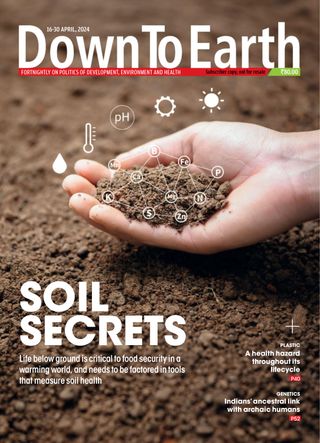

Dit verhaal komt uit de April 16, 2024-editie van Down To Earth.
Abonneer u op Magzter GOLD voor toegang tot duizenden zorgvuldig samengestelde premiumverhalen en meer dan 9000 tijdschriften en kranten.
Bent u al abonnee? Aanmelden
MEER VERHALEN VAN Down To Earth

Down To Earth
THE GREAT PIVOT
China's moves to transition to clean energy offer critical lessons to India

4 mins
March 01, 2026

Down To Earth
COAL V CORRIDOR
A proposal to mine coal along a corridor that links two tiger reserves in central India is a step away from getting final clearance. The move could affect movement and genetic diversity of tiger populations in the region
8 mins
March 01, 2026

Down To Earth
India's challenging AI predicament
Hobbled by lack of innovation and AI skills in its crucial technology sector, India is focusing on a ruinous plan to host data centres
4 mins
March 01, 2026
Down To Earth
China to implement zero tariffs across Africa
CHINA ON February 14 announced that it will implement zero tariffs for imports from all the 53 African nations it has diplomatic relations with, starting from May 1.
1 min
March 01, 2026
Down To Earth
Poverty, sans the threshold
MEASUREMENT OF poverty is a fundamental exercise, needed to direct development programmes.
2 mins
March 01, 2026
Down To Earth
A bridge across forever
For two decades, a Chhattisgarh village remains stuck in a loop of building temporary river crossings to access markets and sell forest produce
4 mins
March 01, 2026
Down To Earth
Liveable cities need a new model
CRY FOR my Delhi. This is my city—my family records many generations who have lived here.
3 mins
March 01, 2026
Down To Earth
Real impacts of the changing seasons
This refers to the article \"1,500 days, and an alarm for new climate\" (1-15 December, 2025).
1 mins
March 01, 2026

Down To Earth
‘It’s a systematic effort by US to dismantle climate policy’
The US, the world's largest historical emitter of greenhouse gases, has overturned its “endangerment finding”, the legal foundation for regulating emissions under the Clean Air Act since 2009.
4 mins
March 01, 2026
Down To Earth
Amazon turned carbon source in 2023 drought
EXTREME DROUGHT and a prolonged heatwave in 2023 pushed parts of the Amazon rainforest from acting as a carbon sink to becoming a carbon source for three months, according to a February 13 study published in the journal AGU Advances of the American Geophysical Union.
1 min
March 01, 2026
Listen
Translate
Change font size