Versuchen GOLD - Frei
BREAKING NEW GROUND
Down To Earth
|April 16, 2024
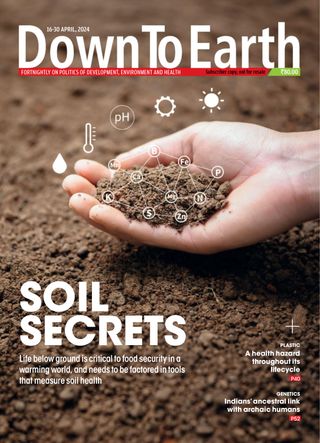
Soil health is typically measured by its nutrient content, by presence of elements like nitrogen and phosphorus. No country in the world measures it in terms of soil biodiversity-a counting of underground faunal populations and microorganisms.

However, things have changed a bit over the past two decades. Scientists increasingly associate soil biodiversity with improved yields and plant health. Research also indicates that a soil high in microbial activity is better at carbon sequestration and in preventing runoff during floods. Given soil's link to food security, as well as to climate mitigation and adaptation, scientists are now developing new diagnostic tools to measure soil health. Since the tools and the processes of measuring soil biodiversity are quite expensive and labour-intensive, countries are working to make them accessible to all. A report by Rohini Krishnamurthy
BENEATH OUR FEET lies a world teeming with life, often overlooked in its significance. Soils, far from being mere dirt, are alive, breathing entities that play a crucial role in sustaining life above and below ground. They serve as the backbone of agriculture and store water, playing an indispensable role in our ecosystem. Their importance will only grow in the future because the world, according to the UN Food and Agriculture Organization (FAO), will have to increase its food production by 60 per cent by 2050 to feed an ever-increasing population.
Yet, amid their critical role, soils face unprecedented threats. Human activities such as overexploitation and improper land-use practices are rapidly degrading and eroding these vital ecosystems. Already, about 33 per cent of global soils are degraded and 90 per cent could meet this fate by 2050, warns FAO. It also does not help that soil is a finite resource, taking up to 1,000 years to produce a mere 2-3 centimetres.

Diese Geschichte stammt aus der April 16, 2024-Ausgabe von Down To Earth.
Abonnieren Sie Magzter GOLD, um auf Tausende kuratierter Premium-Geschichten und über 9.000 Zeitschriften und Zeitungen zuzugreifen.
Sie sind bereits Abonnent? Anmelden
WEITERE GESCHICHTEN VON Down To Earth
Down To Earth
Popular distrust
THE WORLD seems to be going through a period of stasis despite facing an unfathomable polycrisis.

2 mins
February 01, 2026
Down To Earth
CONSERVE OR PERISH
Periyar Tiger Reserve has rewritten Indian conservation by turning poachers into protectors and conflict into coexistence
5 mins
February 01, 2026

Down To Earth
'Rivers need to run free'
From Tibet to West Bengal, the Brahmaputra is the pulse of communities and ecosystems along its course. But what are the risks the river faces through human interventions, particularly dams, discusses journalist, author and filmmaker SANJOY HAZARIKA in his new book, River Traveller.
4 mins
February 01, 2026

Down To Earth
India is facing up to its innovation lag
There are signs now that India is acknowledging the superior strides made by China in a frontier technology like Al
4 mins
February 01, 2026

Down To Earth
Competing concerns
What are the repercussions of the EU-Mercosur pact that have made European farmers protest against the free trade agreement?
4 mins
February 01, 2026

Down To Earth
From fryer to flight
Sustainable fuel made from used cooking oil can play a pivotal role in helping India achieve its aviation emission reduction goals. Measures to collect this oil must be revamped
4 mins
February 01, 2026

Down To Earth
ACCESS OPEN
An amendment to India's nodal forest conservation law opens up forests across India to commercial exploitation by the paper industry
6 mins
February 01, 2026
Down To Earth
DRINK FROM TAP CAN BE A REALITY
As cities across India struggle to supply safe piped water, Odisha offers a success story
2 mins
February 01, 2026

Down To Earth
GREAT DRYING
The Earth is hotter than at any point in the past 100,000 years, with 2023-25 becoming the warmest three-year period on record and also breaching the 1.5°C threshold for the first time. One fallout is dwindling freshwater.
22 mins
February 01, 2026

Down To Earth
Green redemption
Restoration of grasslands of Kerala's Pampadum Shola National Park, once dominated by invasive Australian wattles, see a return of streams and native species
1 mins
February 01, 2026
Listen
Translate
Change font size