Poging GOUD - Vrij
Smart scopes: from backyard to big science
BBC Sky at Night Magazine
|December 2025
Home-based stargazers are helping scientists crack some of the Universe's big mysteries - and you can join them. Charlotte Daniels shows us how
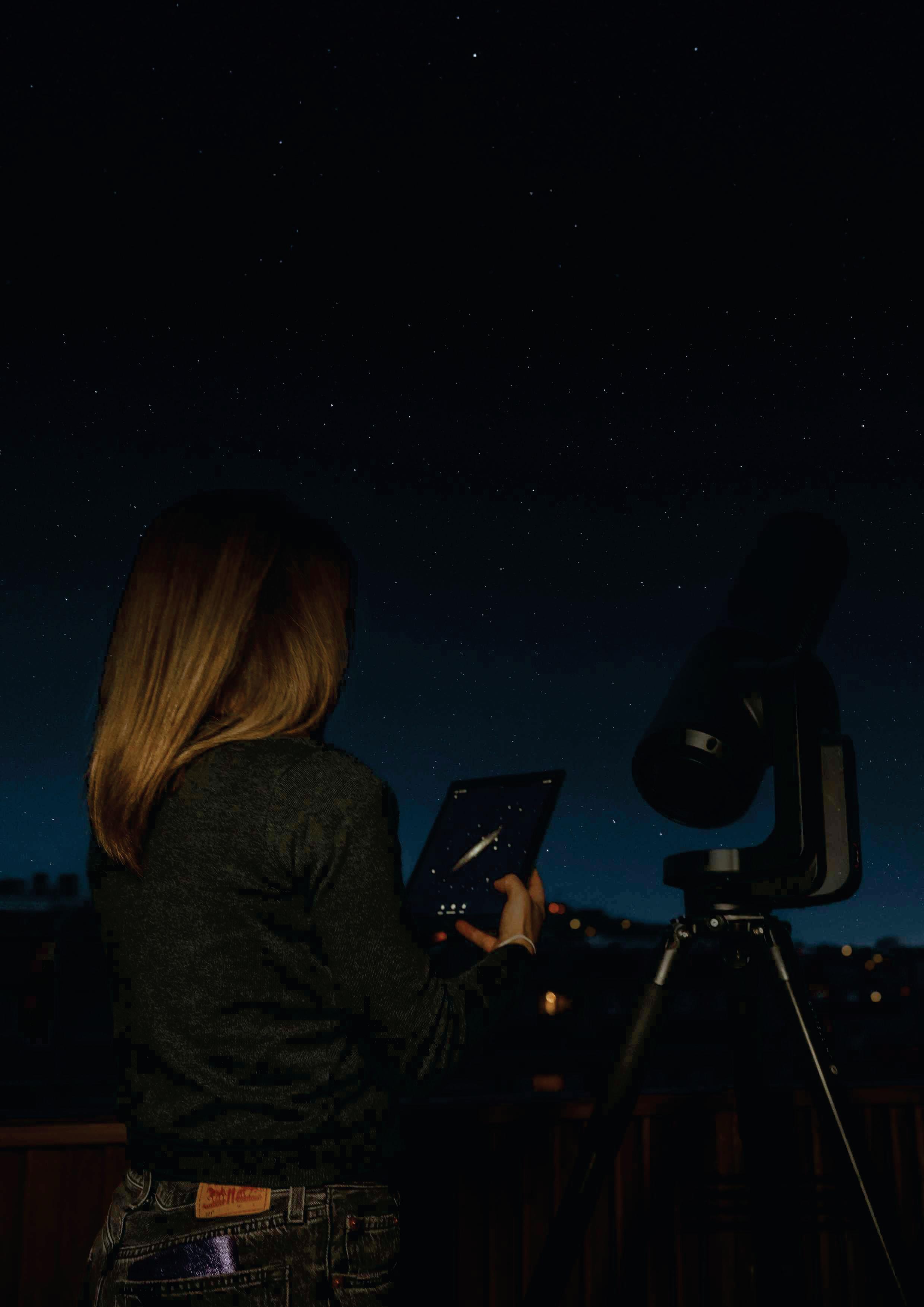
The rise of smart telescopes has opened up astrophotography to a whole new audience, providing an accessible and rewarding route into what can seem like a complex hobby. But these high-tech telescopes are doing something else too: they're getting ordinary citizens involved with helping astronomy professionals to study the cosmos.
In 2020, the SETI Institute joined forces with telescope maker Unistellar to develop the Unistellar Network, a community of over 25,000 Unistellar users worldwide who, across several astronomical programmes, share observations from their smart telescopes with scientists.
Almost six years on, citizen scientists in the Unistellar Network have made significant contributions that have been recognised in research papers. In 2022, 34 citizen scientists captured data to determine the rotation period of near-Earth asteroid 7335 during a close approach, while others helped observe NASA's attempt to deflect an asteroid, the DART mission. They also observed interstellar comet 3I/ATLAS almost immediately after its detection in July 2025, and asteroid 2025 RL2 was captured as it passed only half a lunar distance away in September 2025, despite being just 17–37 metres (55–121ft) wide.
At the heart of the network is the Unistellar smartphone app and the Slack messaging platform, where lead astronomers for each programme moderate a designated channel and bring trends to the attention of users. Here, processed observation data is uploaded in the form of videos and reports, and important upcoming missions are highlighted.
 So how does it all work, and how can you take part? Join us as we explore the network, with our Unistellar Odyssey Pro smart telescope at the ready, and discover how you can turn your stargazing into scientific discovery.
Defend the planet

Dit verhaal komt uit de December 2025-editie van BBC Sky at Night Magazine.
Abonneer u op Magzter GOLD voor toegang tot duizenden zorgvuldig samengestelde premiumverhalen en meer dan 9000 tijdschriften en kranten.
Bent u al abonnee? Aanmelden
MEER VERHALEN VAN BBC Sky at Night Magazine
BBC Sky at Night Magazine
MOONWATCH
January's top lunar feature to observe

2 mins
January 2026
BBC Sky at Night Magazine
Speed up your processing workflow
How to use Photoshop's Actions tool to drastically cut your processing time
3 mins
January 2026
BBC Sky at Night Magazine
Chasing Canada's polar lights
With solar maximum peaking and a new Moon promising dark skies, Jamie Carter travels to Churchill, Manitoba to hunt the Northern Lights - and dodge polar bears – in Canada's far north
7 mins
January 2026

BBC Sky at Night Magazine
Beyond Pluto: The search for the hidden planets
Could one – or even two - undiscovered planets lurk at the edges of our Solar System? Nicky Jenner explores how close we are to finding the elusive 'Planet 9'
6 mins
January 2026
BBC Sky at Night Magazine
Jupiter moon events
Jupiter is a magnificent planet to observe.
2 mins
January 2026

BBC Sky at Night Magazine
What samples from space have taught us
Alastair Gunn explains what scientists have learnt in the 20 years since the first unmanned mission brought materials back from alien worlds
3 mins
January 2026
BBC Sky at Night Magazine
The Milky Way as you've never seen it before
This is the largest low-frequency radio colour image of our Galaxy ever assembled
1 min
January 2026
BBC Sky at Night Magazine
Merger of ‘impossibly' massive black holes explained
Scientists discover how enormous, fast-spinning black holes can exist after all
1 mins
January 2026
BBC Sky at Night Magazine
Lunar occultation of the Pleiades
BEST TIME TO SEE: 27 January from 20:30 UT
1 min
January 2026
BBC Sky at Night Magazine
The Universe's expansion may be slowing down
New study suggests current theories of dark energy could be wrong
1 mins
January 2026
Listen
Translate
Change font size