
Mit Magzter GOLD unbegrenztes Potenzial nutzen
Erhalten Sie unbegrenzten Zugriff auf über 9.000 Zeitschriften, Zeitungen und Premium-Artikel für nur
Versuchen GOLD - Frei
Smart scopes: from backyard to big science
BBC Sky at Night Magazine
|December 2025
Home-based stargazers are helping scientists crack some of the Universe's big mysteries - and you can join them. Charlotte Daniels shows us how
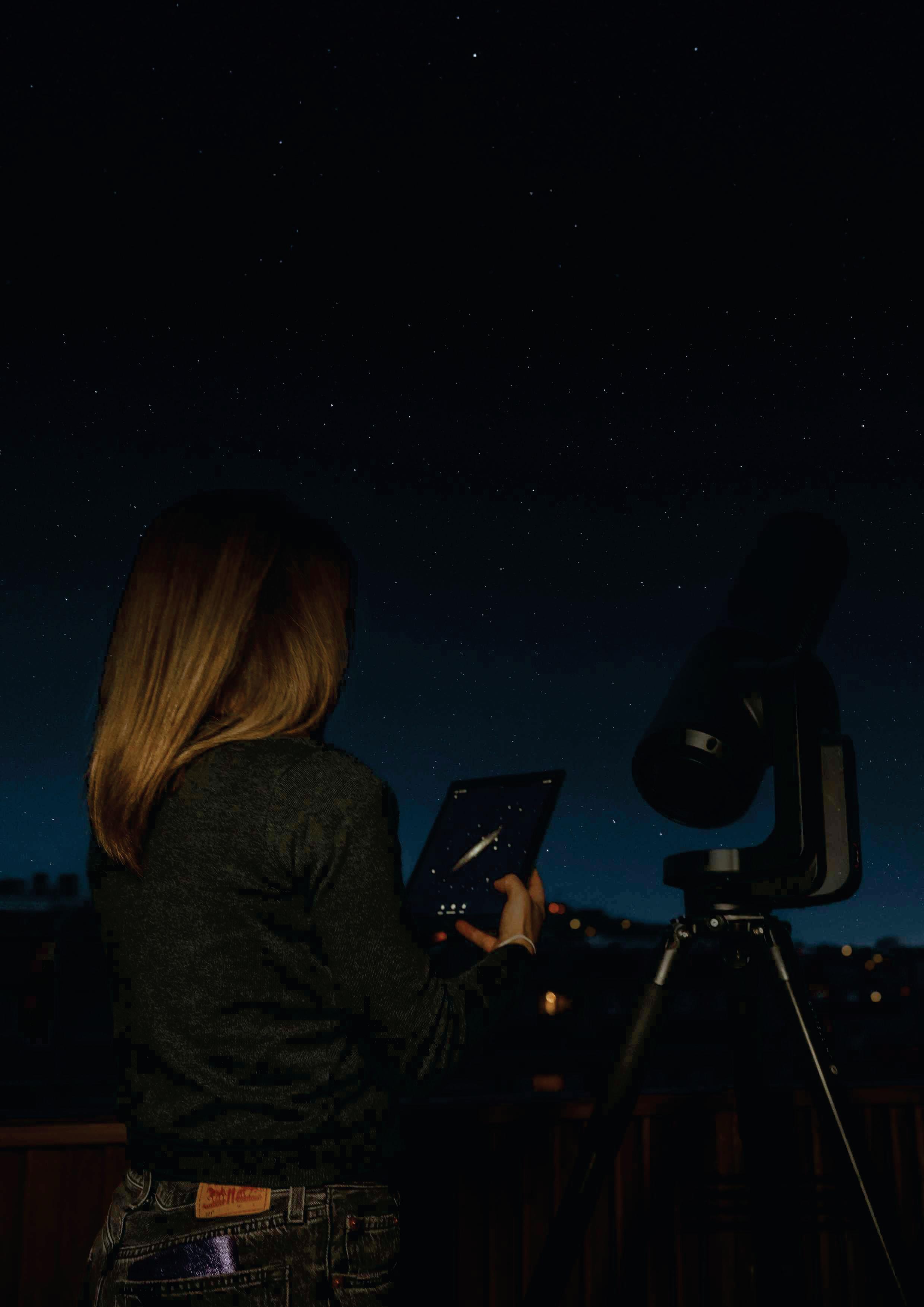
The rise of smart telescopes has opened up astrophotography to a whole new audience, providing an accessible and rewarding route into what can seem like a complex hobby. But these high-tech telescopes are doing something else too: they're getting ordinary citizens involved with helping astronomy professionals to study the cosmos.
In 2020, the SETI Institute joined forces with telescope maker Unistellar to develop the Unistellar Network, a community of over 25,000 Unistellar users worldwide who, across several astronomical programmes, share observations from their smart telescopes with scientists.
Almost six years on, citizen scientists in the Unistellar Network have made significant contributions that have been recognised in research papers. In 2022, 34 citizen scientists captured data to determine the rotation period of near-Earth asteroid 7335 during a close approach, while others helped observe NASA's attempt to deflect an asteroid, the DART mission. They also observed interstellar comet 3I/ATLAS almost immediately after its detection in July 2025, and asteroid 2025 RL2 was captured as it passed only half a lunar distance away in September 2025, despite being just 17–37 metres (55–121ft) wide.
At the heart of the network is the Unistellar smartphone app and the Slack messaging platform, where lead astronomers for each programme moderate a designated channel and bring trends to the attention of users. Here, processed observation data is uploaded in the form of videos and reports, and important upcoming missions are highlighted.
 So how does it all work, and how can you take part? Join us as we explore the network, with our Unistellar Odyssey Pro smart telescope at the ready, and discover how you can turn your stargazing into scientific discovery.
Defend the planet
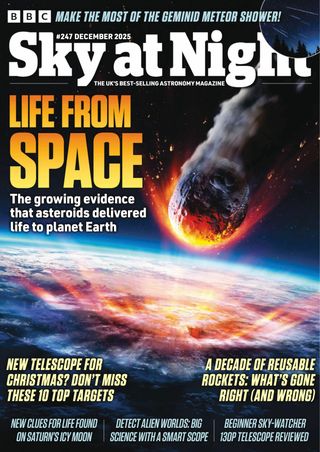

Diese Geschichte stammt aus der December 2025-Ausgabe von BBC Sky at Night Magazine.
Abonnieren Sie Magzter GOLD, um auf Tausende kuratierter Premium-Geschichten und über 9.000 Zeitschriften und Zeitungen zuzugreifen.
Sie sind bereits Abonnent? Anmelden
WEITERE GESCHICHTEN VON BBC Sky at Night Magazine
BBC Sky at Night Magazine
The Giant Leap: Why Space is the Next Frontier in the Evolution of Life
“Earth is the cradle of humanity, but one cannot live in the cradle forever,” wrote Konstantin Tsiolkovsky in 1911.

1 mins
February 2026
BBC Sky at Night Magazine
Tele Vue Nagler Type-7 series eyepieces
These premium optics were inspired by Apollo - and deliver a giant leap to your views
4 mins
February 2026
BBC Sky at Night Magazine
Once Upon a Time in Space
While the Space Race of the Cold War years was ultimately a geopolitical contest between the USA and the Soviet Union, the rivalry sparked rapid innovation and inspired multiple generations to look skyward.
1 mins
February 2026
BBC Sky at Night Magazine
The Multiverse: When One Universe Isn't Enough
The concept of a 'multiverse' – the idea that our Universe may be just one of many – is widespread in science fiction and a common thread of online discussions.
1 mins
February 2026
BBC Sky at Night Magazine
Q&A WITH A GAMMA RAY SPECIALIST
In 2025, astronomers detected a blast from space that lasted seven hours. Now they're uncovering the strange processes behind the exceptional outburst
3 mins
February 2026
BBC Sky at Night Magazine
Astronomy Photographer of the Year
The world-leading astrophotography competition returns. Could your image take the top prize of £10,000?
2 mins
February 2026
BBC Sky at Night Magazine
MOONWATCH
February's top lunar feature to observe
2 mins
February 2026

BBC Sky at Night Magazine
NOVAStar Scarlet A62Q 62mm f/8.4 quadruplet achromatic refractor
Well-built and capable, this beginner scope punches well above its bargain price
4 mins
February 2026
BBC Sky at Night Magazine
STAR OF THE MONTH
Rasalas, Leo the Lion's metal-rich crown
1 min
February 2026
BBC Sky at Night Magazine
Comet 24P/Schaumasse
Having reached perihelion on 8 January, comet 24P/ Schaumasse is now fading. Starting the month at a small-telescope-friendly mag. +10.5, it dims throughout February to below 12th magnitude.
1 min
February 2026
Listen
Translate
Change font size