
Ga onbeperkt met Magzter GOLD
Krijg onbeperkte toegang tot meer dan 9000 tijdschriften, kranten en Premium-verhalen voor slechts
Poging GOUD - Vrij
Stuck In Place
The Atlantic
|March 2025
Why Americans stopped moving houses-and why that's a very big problem

The idea that people should be able to choose their own communities instead of being stuck where they are born―is a distinctly American innovation. It is the foundation for the country's prosperity and democracy, and it just may be America's most profound contribution to the world.
No society has ever been as mobile as the United States once was. No society has even come close. In the 19th century, the heyday of American mobility, roughly a third of all Americans changed addresses each year. European visitors were astonished, and more than slightly appalled. The American "is devoured with a passion for locomotion," the French writer Michel Chevalier observed in 1835; "he cannot stay in one place." Americans moved far more often, over longer distances, and to greater advantage than did people in the lands from which they had come. They understood this as the key to their national character, the thing that made their country distinctive. "We are a migratory people and we flourish best when we make an occasional change of base," one 19th-century newspaper explained. "We have cut loose from the old styles of human vegetation, the former method, of sticking like an oyster to one spot through numberless succeeding generations," wrote another.
As the 19th century turned into the 20th, as two world wars passed, as the Baby Boom began, Americans kept on moving. And as Americans moved around, they moved up. They broke away from stultifying social hierarchies, depleted farmland, declining towns, dead-end jobs. If the first move didn't work out, they could always see a more promising destination beckoning them onward.
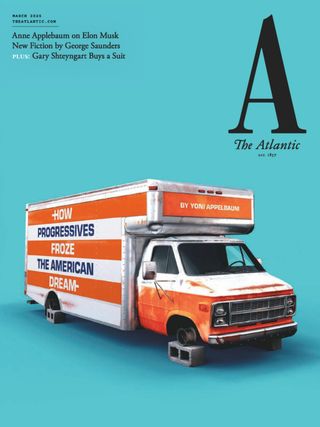

Dit verhaal komt uit de March 2025-editie van The Atlantic.
Abonneer u op Magzter GOLD voor toegang tot duizenden zorgvuldig samengestelde premiumverhalen en meer dan 9000 tijdschriften en kranten.
Bent u al abonnee? Aanmelden
MEER VERHALEN VAN The Atlantic

The Atlantic
What Dante Is Trying to Tell Us
A colloquial translation of Paradiso might make people actually read it.

10 mins
February 2026

The Atlantic
Sense of an Ending
Julian Barnes says goodbye to the novel
9 mins
February 2026

The Atlantic
IS THIS WHAT PATRIOTISM LOOKS LIKE?
Why an ex—police officer assaulted a fellow cop on January 6
37 mins
February 2026
The Atlantic
THE PURGED
DONALD TRUMP'S DESTRUCTION OF THE CIVIL SERVICE IS A TRAGEDY NOT JUST FOR THE ROUGHLY 300,000 WORKERS WHO HAVE BEEN DISCARDED, BUT FOR AN ENTIRE NATION.
8 mins
February 2026

The Atlantic
GROUNDED
THE SPACE PROGRAM ENNOBLED AMERICAN CULTURE AND ADVANCED AMERICAN SCIENCE. DONALD TRUMP HAS CHOSEN TO END THAT ERA OF AMBITION.
17 mins
February 2026

The Atlantic
The New History of Fighting Slavery
What we learn by tracing rebellions from Africa to the Americas
10 mins
February 2026

The Atlantic
MICAELA WHITE
By the beginning of 2025, there was a famine in Sudan, which meant that it was only a matter of time before the U.S.government dispatched Micaela White to the scene. She was America's fixer of choice.
2 mins
February 2026

The Atlantic
WHAT JEFFREY EPSTEIN DIDN'T UNDERSTAND ABOUT LOLITA
Everything.
5 mins
February 2026

The Atlantic
Who Gets to Be Indian- And Who Decides?
The very American story of Chief Buffalo Child Long Lance
22 mins
February 2026

The Atlantic
I'm Not From the Government but I'm Here to Help
The Trump administration is trying to eliminate federal services? Fine. I'll do everything myself.
24 mins
February 2026
Listen
Translate
Change font size