Poging GOUD - Vrij
Bhutto's Nehru Story
Outlook
|December 01, 2024
Nehru's principle of "compromise and argument" remains the only workable formula for South Asian leaders

SIXTY years ago, Zulfikar Ali Bhutto, one of South Asia’s most brilliantly devilish minds, penned an assessment of Jawaharlal Nehru. Titled ‘India after Nehru’, Bhutto had the document confidentially printed at the State Bank of Pakistan Press, Karachi. Only 500 copies were made. Since Bhutto was a minister at the time in Field Marshal Ayub Khan’s government and what he had to say about India’s first prime minister was not quite palatable to the Pakistani establishment, he found himself constrained to withdraw as many copies as could be retrieved. However, the very efficient Indian diplomats in Karachi had managed to secure a copy, and a copy of that copy somehow found its way into the Haksar Papers.
This 60-year-old assessment, made by India’s most trenchant critic, makes rewarding reading, particularly in the current season of demonising Nehru. Bhutto’s is a masterly overview of India’s struggles as an independent nation-state and Nehru’s role and contribution in imposing a governing order in a land, which for centuries had succumbed to the outsiders’ armies and firmans (orders). Bhutto’s unsentimentally prescient judgement reads:
“...The myth and image of Nehru were greater than the man. Although he committed aggression, alienated his neighbours, suppressed his opponents, made mock convenience of his ethics, he was Nehru the redeemer of 400 million people, a valiant fighter who led his people to freedom and, for the first time in 600 years, gave them a place in the sun.”
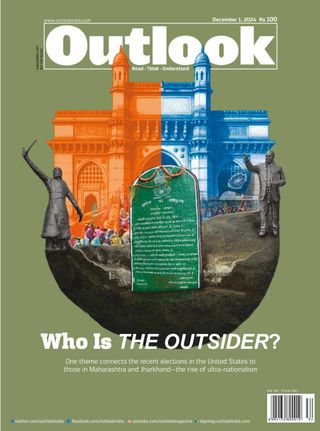

Dit verhaal komt uit de December 01, 2024-editie van Outlook.
Abonneer u op Magzter GOLD voor toegang tot duizenden zorgvuldig samengestelde premiumverhalen en meer dan 9000 tijdschriften en kranten.
Bent u al abonnee? Aanmelden
MEER VERHALEN VAN Outlook
Outlook
Goapocalypse
THE mortal remains of an arterial road skims my home on its way to downtown Anjuna, once a quiet beach village 'discovered' by the hippies, explored by backpackers, only to be jackbooted by mass tourism and finally consumed by real estate sharks.

2 mins
January 21, 2026

Outlook
A Country Penned by Writers
TO enter the country of writers, one does not need any visa or passport; one can cross the borders anywhere at any time to land themselves in the country of writers.
8 mins
January 21, 2026
Outlook
Visualising Fictional Landscapes
The moment is suspended in the silence before the first mark is made.
1 mins
January 21, 2026
Outlook
Only the Upper, No Lower Caste in MALGUDI
EVERY English teacher would recognise the pleasures, the guilt and the conflict that is the world of teaching literature in a university.
5 mins
January 21, 2026
Outlook
The Labour of Historical Fiction
I don’t know if I can pinpoint when the idea to write fiction took root in my mind, but five years into working as an oral historian of the 1947 Partition, the landscape of what would become my first novel had grown too insistent to ignore.
6 mins
January 21, 2026
Outlook
Conjuring a Landscape
A novel rarely begins with a plot.
6 mins
January 21, 2026
Outlook
The City that Remembered Us...
IN the After-Nation, the greatest crime was remembering.
1 min
January 21, 2026
Outlook
Imagined Spaces
I was talking with the Kudiyattam artist Kapila Venu recently about the magic of eyes.
5 mins
January 21, 2026
Outlook
Known and Unknown
IN an era where the gaze upon landscape has commodified into picture postcards with pristine beauty—rolling hills, serene rivers, untouched forests—the true essence of the earth demands a radical shift.
2 mins
January 21, 2026

Outlook
A Dot in Soot
A splinter in the mouth. Like a dream. A forgotten dream.
2 mins
January 21, 2026
Listen
Translate
Change font size