
Ga onbeperkt met Magzter GOLD
Krijg onbeperkte toegang tot meer dan 9000 tijdschriften, kranten en Premium-verhalen voor slechts
Can India get out of the middle income trap?
BUSINESS ECONOMICS
|June 01 - 30, 2024
In the mid-1980s, international financial institutions moved away from calling their member countries as poor and rich countries, or as developed and less developed countries.

The World Bank began classifying its member countries based on per capita gross national income (GNI) at constant prices (taking away the influence of changes in price level) for the purpose of concessional lending The GNI is defined, as total income earned by a nation’s people and businesses, including investment income, regardless of where it was earned. It also covers money received from abroad such as foreign investment, inward remittances and economic development aid. There are four categories based on ranges of average per capita GNI as follows:
(i) Low income
(ii) Low middle income
(iii) Upper middle income
(iv) High income
These classifications and income limits are updated every three years. The latest announcements categorizing the World Bank member countries are of July 2023 for FY 2024 in US dollars.
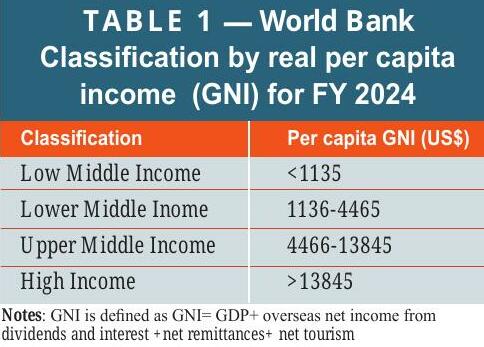 Table 1 shows the ranges of the four categories.
 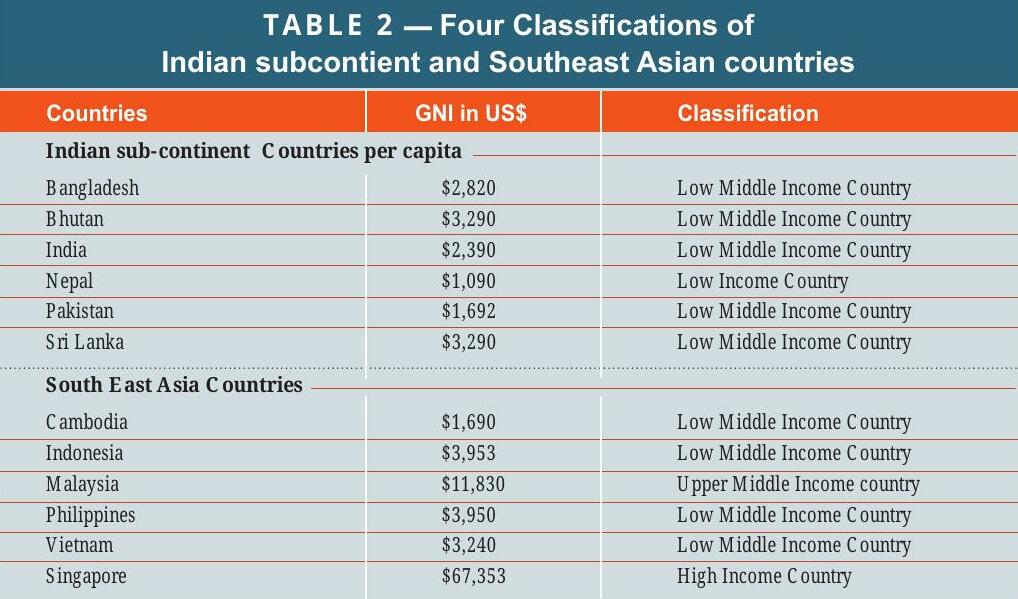 Table 2 shows average per capita GNI for India as well as other Indian subcontinent neighbors and Southeast Asian countries.
 Nepal is classified as the only low-income country in the Indian subcontinent. All other five subcontinent countries are low middle income countries. In Southeast Asia, no country is in the low-income category. All other countries are low middle income countries except Malaysia. Malaysia is in the upper middle country, with a current per capita income (GNI) of $11,830. Singapore in South East Asia, is the only country, which is generally known as developed or advanced country at a high average per capita income ($67,353).

Dit verhaal komt uit de June 01 - 30, 2024-editie van BUSINESS ECONOMICS.
Abonneer u op Magzter GOLD voor toegang tot duizenden zorgvuldig samengestelde premiumverhalen en meer dan 9000 tijdschriften en kranten.
Bent u al abonnee? Aanmelden
MEER VERHALEN VAN BUSINESS ECONOMICS

BUSINESS ECONOMICS
Rupee has weakened
The rupee has weakened significantly over the past year, falling from 84.7 to 89.7 against the US dollar. Its depreciation has been even sharper against the euro (9.4 per cent) and the British pound (14.3 per cent). It has also lost value against the Japanese yen and the Chinese yuan. In nominal terms, therefore, the rupee has depreciated against all major global currencies.

1 mins
December 1 - 31, 2025

BUSINESS ECONOMICS
Foundations of Indian Yoga Philosophy
Yoga, in very simple terms, means union.
4 mins
December 1 - 31, 2025

BUSINESS ECONOMICS
The New Indian Professional: Work, Wealth & Wellness in 2026 Changing aspirations, consumption patterns, and lifestyle expectations
As 2025 draws to a close, a new archetype is emerging across India's corporate and entrepreneurial landscape.
4 mins
December 1 - 31, 2025
BUSINESS ECONOMICS
Where Rhythm Meets Divinity: A Three-Day Odyssey of Indian Classical Art
An Artistic Journey Through Dance, Melody & Tradition (27-29 November 2025)
3 mins
December 1 - 31, 2025
BUSINESS ECONOMICS
Bharat Electronics Ltd
BEL is a public sector undertaking (PSU) under the Indian government's Ministry of Defence.
2 mins
December 1 - 31, 2025

BUSINESS ECONOMICS
A New Crisis: Impact of US Tariff hikes on UP's Industries
Long-established industrial centres such as Kanpur, Moradabad, Bhadohi and Firozabad are currently facing severe disruptions due to the imposition of steep US tariffs.
2 mins
December 1 - 31, 2025

BUSINESS ECONOMICS
Nobel Prize in Physiology or Medicine 2025 Significance of the Laureates' Work in the Medical World
Mary E. Brunkow, Fred Ramsdell, and Shimon Sakaguchi have been awarded the 2025 Nobel Prize in Physiology or Medicine for their pioneering discoveries on peripheral immune tolerance—the mechanisms that prevent the immune system from attacking the body’s own tissues.
2 mins
December 1 - 31, 2025

BUSINESS ECONOMICS
The RBI's Balancing Act: Strategy and Execution in 2025
In 2025, the Reserve Bank of India (RBI) has adopted a cautious yet steady monetary policy, distinguishing itself from the more aggressive actions of several global central banks.
3 mins
December 1 - 31, 2025

BUSINESS ECONOMICS
From stagnation to surge: 10 reasons the Indian market rallied hard
The Indian stock market spent most of 2025 moving sideways in a narrow and frustrating band.
5 mins
December 1 - 31, 2025

BUSINESS ECONOMICS
Uttar Pradesh witnesses renovations of pilgrimage sites propelling multi-dimensional growth
Last month, Prime Minister Narendra Modi ceremonially hoisted the saffron flag, the Dharma Dhwaj, atop the Ram Temple in Ayodhya, marking the completion of the temple's construction.
3 mins
December 1 - 31, 2025
Listen
Translate
Change font size