Essayer OR - Gratuit
Can India get out of the middle income trap?
BUSINESS ECONOMICS
|June 01 - 30, 2024
In the mid-1980s, international financial institutions moved away from calling their member countries as poor and rich countries, or as developed and less developed countries.

The World Bank began classifying its member countries based on per capita gross national income (GNI) at constant prices (taking away the influence of changes in price level) for the purpose of concessional lending The GNI is defined, as total income earned by a nation’s people and businesses, including investment income, regardless of where it was earned. It also covers money received from abroad such as foreign investment, inward remittances and economic development aid. There are four categories based on ranges of average per capita GNI as follows:
(i) Low income
(ii) Low middle income
(iii) Upper middle income
(iv) High income
These classifications and income limits are updated every three years. The latest announcements categorizing the World Bank member countries are of July 2023 for FY 2024 in US dollars.
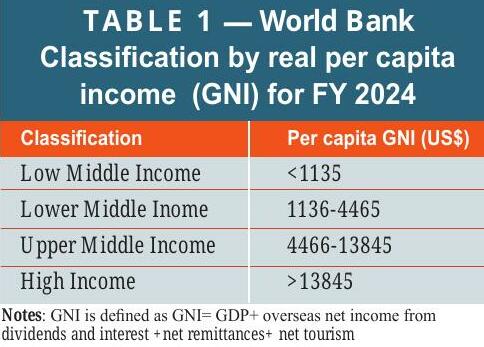 Table 1 shows the ranges of the four categories.
 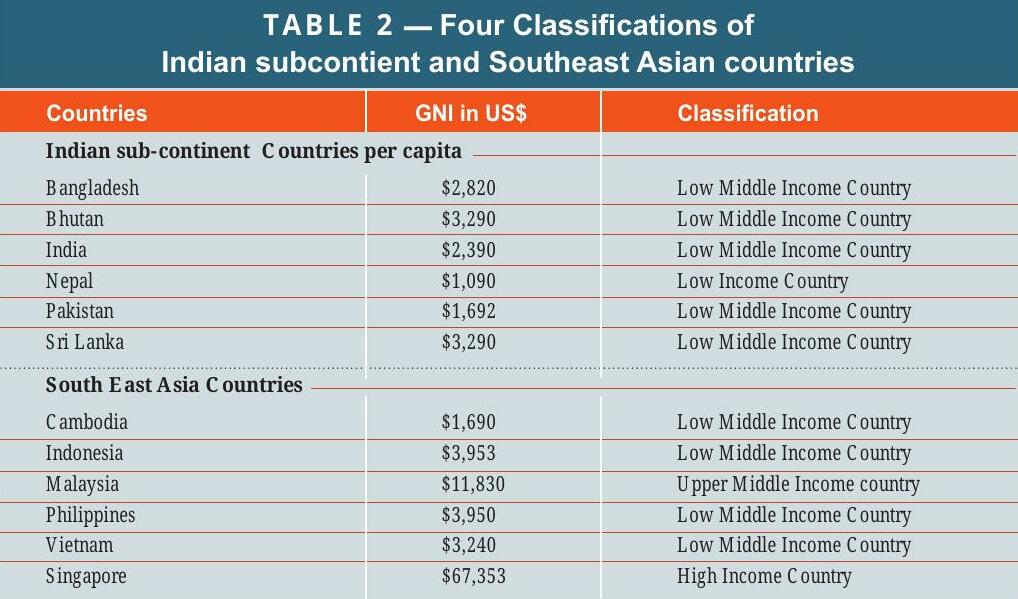 Table 2 shows average per capita GNI for India as well as other Indian subcontinent neighbors and Southeast Asian countries.
 Nepal is classified as the only low-income country in the Indian subcontinent. All other five subcontinent countries are low middle income countries. In Southeast Asia, no country is in the low-income category. All other countries are low middle income countries except Malaysia. Malaysia is in the upper middle country, with a current per capita income (GNI) of $11,830. Singapore in South East Asia, is the only country, which is generally known as developed or advanced country at a high average per capita income ($67,353).

Cette histoire est tirée de l'édition June 01 - 30, 2024 de BUSINESS ECONOMICS.
Abonnez-vous à Magzter GOLD pour accéder à des milliers d'histoires premium sélectionnées et à plus de 9 000 magazines et journaux.
Déjà abonné ? Se connecter
PLUS D'HISTOIRES DE BUSINESS ECONOMICS

BUSINESS ECONOMICS
Why I Uphold Sanatana Dharma?
I am a follower of the Sanatana Dharma -a Sanatanist.

8 mins
March 1-31, 2026

BUSINESS ECONOMICS
Tamil Nadu's Interim Budget 2026-27 An Analysis
On 17 February 2026, Finance Minister Thangam Thennarasu presented the Tamil Nadu Interim Budget for 2026-27.
2 mins
March 1-31, 2026
BUSINESS ECONOMICS
Storm signals in job sector
Arise in the unemployment rate from 4.8% to 5% may appear to be statistical noise.
1 mins
March 1-31, 2026

BUSINESS ECONOMICS
WB Budget 2026-27 and the 16th Finance Commission's Financial Devolution to States
West Bengal’s Finance Minister Chandrima Bhattacharya presented the State Budget for 2026-27 on 12 February 2026. The total expenditure, or size of the Budget for FY 2026-27, has been pegged at ₹3.89 lakh crore. This is about 14% higher than the revised estimate for 2024-25.
3 mins
March 1-31, 2026

BUSINESS ECONOMICS
The global damage to 'Make in India'
The AI Impact Summit, 2026 held in Delhi was a huge opportunity for India to project country's technical skills globally.
2 mins
March 1-31, 2026
BUSINESS ECONOMICS
Indian Railway Finance Corporation
The Indian Railway Finance Corporation is referred to as IRFC.
3 mins
March 1-31, 2026

BUSINESS ECONOMICS
India's Orange Economy : Creativity as the Next Growth Engine
In India's economic lexicon, a vibrant new term is capturing the imagination of policymakers, entrepreneurs, creators and investors alike - The Orange Economy.
3 mins
March 1-31, 2026

BUSINESS ECONOMICS
Why Even Good Intentions Are Failing Global Policy
Across the world, leaders are acting under the pressure of constant crisis.
6 mins
March 1-31, 2026

BUSINESS ECONOMICS
Manufacturing: FM's focus is in the right direction but lessons from the past are crucial
Manufacturing has been a major focus of the annual Budget presented on February 1 by Nirmala Sitharaman. India has long aimed to raise manufacturing’s share in GDP to around 25%, from about 16-17% a few years ago.
2 mins
March 1-31, 2026

BUSINESS ECONOMICS
Budget proposals on Agriculture: Emphasis on high-value products and technology
The Union Budget 2026-27 places significant emphasis on high-value agricultural products and the adoption of advanced technology.
3 mins
March 1-31, 2026
Listen
Translate
Change font size