
Ga onbeperkt met Magzter GOLD
Krijg onbeperkte toegang tot meer dan 9000 tijdschriften, kranten en Premium-verhalen voor slechts
Poging GOUD - Vrij
The science behind the art
Down To Earth
|February 16, 2021
Cooking is an art, most would say. However, at its root, cooking is a form of chemical engineering, writes Krish Ashok in his recent book, Masala Lab: The Science of Indian Cooking. Understanding the science behind food preparation can arm the chef with techniques to augment flavours. Here’s a crash course on the physics and chemistry of food.

ALDEHYDES OF CORIANDER
Some people do not like to garnish their food with chopped coriander leaves—this is because aldehydes in the herb taste like soap to those with certain sensitive genes. However, such people can consume coriander chutneys because enzymatic reactions break down the problematic chemical during preparation. This shows that keeping one aspect of the ingredient front and centre can sometimes make the dish unpalatable. One way to overcome this is ensuring its ingredients are not individually detectable but are rather enhanced as a whole with seasoning. For example, a pinch of salt can enhance the sweetness of kheer and mute the sourness of raita. Perhaps this is why humans consume salt in almost every dish. However, processed food manufacturers avoid iodised salt because it leaves a metallic taste when cooked at high temperatures. For such dishes, pink or black salt should be used.
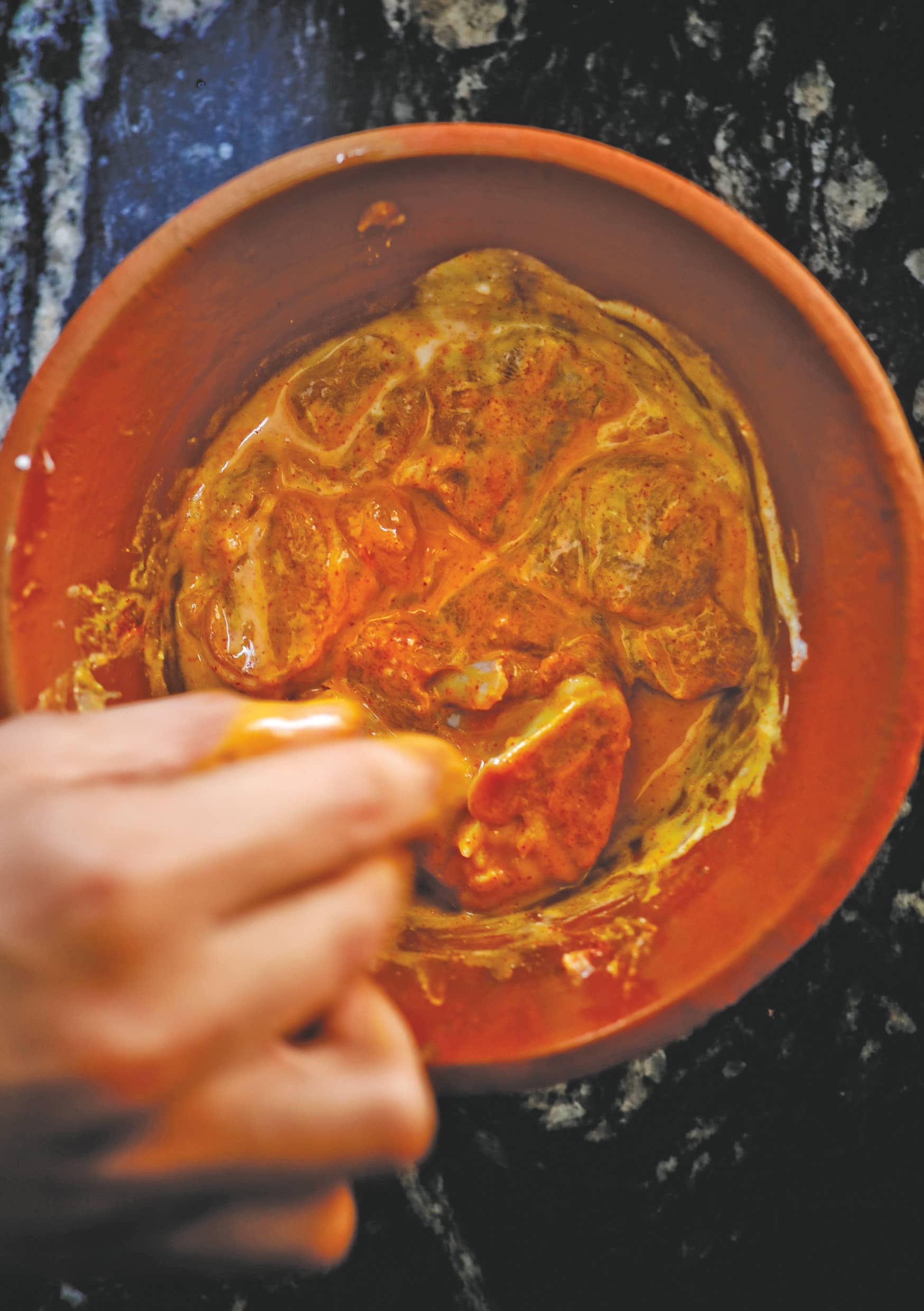
SALT WATER FOR SOFT, FLAVOURFUL MEAT
The secret to cooking meat well is to keep it soft. For this, the best way is to let it sit in saltwater for some time. This prevents the loss of water from the muscle. Spices can also be added to the brine to infuse more flavour. This is a better way of tenderising the meat than marination, as the latter merely forms a layer of flavour over the tissue. The second step is to cook the meat at temperatures well below the boiling point (below 65 o C), to ensure that the proteins bind loosely and retain moisture.

Dit verhaal komt uit de February 16, 2021-editie van Down To Earth.
Abonneer u op Magzter GOLD voor toegang tot duizenden zorgvuldig samengestelde premiumverhalen en meer dan 9000 tijdschriften en kranten.
Bent u al abonnee? Aanmelden
MEER VERHALEN VAN Down To Earth

Down To Earth
GREAT NICOBAR DILEMMA
In the fragile ecosystem of Nicobar, strategic development must align with constitutional commitment to protect environment, indigenous dignity

3 mins
March 16, 2026
Down To Earth
CATCH BY THE ROOTS
Sabai grass could be a game-changer for the marginalised economies of West Bengal's dry uplands. All it needs is an efficient market strategy
4 mins
March 16, 2026

Down To Earth
POWERING TRANSITION
India's renewable ambitions are rising rapidly, with half of its installed power capacity now coming from non-fossil sources. Yet the gap between capacity and generation remains wide. The experiences of two pioneering states, Karnataka and Tamil Nadu, which together generate over a fifth of the country's renewable energy, offer crucial lessons for accelerating the transition, reports PUJA DAS from Bengaluru, Chennai, Mumbai and New Delhi
16 mins
March 16, 2026

Down To Earth
At core of survival
Water scarcity defines life in a village inside Sariska Tiger Reserve's critical habitat, as debates over its relocation drag on
5 mins
March 16, 2026

Down To Earth
What's on your plate
An upcoming digital tool can help people learn about the origin of their meals and make climate-positive food choices
2 mins
March 16, 2026

Down To Earth
'Bad environment can never be good economics'
The Supreme Court of India and even the high courts were once very active and took a proactive role in protecting the environment; unfortunately, that is no longer true
4 mins
March 16, 2026
Down To Earth
Things fall apart
IN THE past year, the world has counted more missiles and bombs than hours.
2 mins
March 16, 2026

Down To Earth
Universities in crisis, innovation is stifled
Political control and skewed policies have led to unrest in academia, stifling creativity and meaningful research
4 mins
March 16, 2026

Down To Earth
SPARK IN THE GAME
The Reserve Bank of India's restored recognition of Default Loss Guarantees re-enables credit flow into last-mile electric mobility
3 mins
March 16, 2026

Down To Earth
Ushering in new eras
An appraisal of the state of biodiversity conservation, pollution reduction and climate adaptation regimes in India
3 mins
March 16, 2026
Translate
Change font size