
Ga onbeperkt met Magzter GOLD
Krijg onbeperkte toegang tot meer dan 9000 tijdschriften, kranten en Premium-verhalen voor slechts
Poging GOUD - Vrij
The Wake Up Call
Down To Earth
|October 16, 2018
THE UNITED Nations Intergovernmental Panel on Climate Change (IPCC) consists of scientists who can by no stretch of the imagination be called radical or activists.

These are conventional scientists working in conventional research institutions—mostly from the rich world. When they issue an urgent warning about the dire and catastrophic impacts of climate change if the global temperatures exceed 2°C above pre-industrial levels, then we must take it very seriously.
Also because, what IPCC says in its just released report on 1.5oC is probably an underestimate of the kind of dangers that await a warmed world—many scientists say the report has not taken into account the spiral of events, called tipping point, which will be unleashed as temperatures rise. The news is not good. It’s time we understood this and stopped questioning the science of climate change.
IPCC has revised its previous findings; it now says the impacts of global warming will be greater than what was previously anticipated at a temperature rise of 1.5°C. It should not surprise us. The world—particularly the poor world—is already seeing devastating impacts when the temperature increase is 1.2°C. Climate change is in our face. We don’t need science to tell us anymore that it will happen. What IPCC tells us is that the situation will get much worse, and that we must not allow the temperature to increase by 2°C.
The question then is only one: What can and must the world do to keep the temperature rise to below 1.5°C? IPCC estimates that to stay below this temperature guardrail, the world has to cut net anthropogenic CO2 emissions by 45 per cent over the 2010 levels by 2030, and reach net zero by 2050.
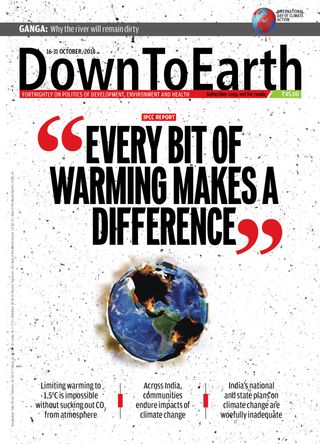

Dit verhaal komt uit de October 16, 2018-editie van Down To Earth.
Abonneer u op Magzter GOLD voor toegang tot duizenden zorgvuldig samengestelde premiumverhalen en meer dan 9000 tijdschriften en kranten.
Bent u al abonnee? Aanmelden
MEER VERHALEN VAN Down To Earth
Down To Earth
THINK TWICE BEFORE FELLING SAL TREES
Many trees considered to be affected by sal borer in the 1990s are still alive today

1 mins
February 16, 2026

Down To Earth
EDGE OF SURVIVAL
Caste divides deny marginalised communities land, resources and essential aid, leaving them more vulnerable to climate disasters
6 mins
February 16, 2026
Down To Earth
A WISH LIST?
Union Budget for 2026-27 conveys the impression of a roll-call of intentions and ambitious proposals, with little detail on their formulation
6 mins
February 16, 2026
Down To Earth
Break down the gender wall
THE RULING National Democratic Alliance (NDA) government has been heavily invested in the goal to make India a developed economy by 2047.
2 mins
February 16, 2026

Down To Earth
MENSTRUAL HEALTH, NOW A FUNDAMENTAL RIGHT
In a landmark judgement, the Supreme Court has recognised menstrual health and hygiene as a fundamental right under Article 21 of the Constitution of India, which guarantees the right to life and dignity.
8 mins
February 16, 2026

Down To Earth
Of devolution and new disasters
The 16th Finance Commission pushes for changes in view of new fiscal and climatic conditions
11 mins
February 16, 2026
Down To Earth
Rising risks of plastics
NEGATIVE IMPACTS on human health due to emissions linked to the plastic lifecycle could double by 2040, according to a study published in The Lancet Planetary Health in January.
1 min
February 16, 2026
Down To Earth
GAP BETWEEN EPIDEMICS NARROWING
A watershed-based and landscape-level approach is needed to address forest degradation
2 mins
February 16, 2026
Down To Earth
WAITING TO STRIKE
Sal heartwood borer is considered the biggest threat to forestry in India, especially to the sal tree, where it lives and breeds.
11 mins
February 16, 2026
Down To Earth
A SPRING DELIGHT
Mustard flowers are not meant only for the eyes. Invite them to your plate once in a while
3 mins
February 16, 2026
Translate
Change font size