Poging GOUD - Vrij
It Is Everybody's Business
Down To Earth
|September 01, 2019
Private sector is vital to restore land and sustain life

WE TAKE for granted the abundance of productive land, assuming that damaged land will heal itself. Left alone for a very long time, it would. Eventually. But that’s not our reality.
Four recent independent assessments show that degraded land is not recovering fast enough and that the drivers and impacts are no longer limited to the locals. They are global. That puts the onus of restoration on everyone who rightfully consumes that which is not produced locally. The private sector must be engaged as governments cannot do it alone. Nor should communities have to pick up their slack.
The rising global momentum and demand for environmental action makes this an ideal moment to change how we plan and manage land. The benefits of doing so are far-reaching and global.
To understand my claim, let me explain first what the science is telling us.
Over 1.3 billion people in the world are directly affected by land degradation, but more than 3.2 billion are impacted indirectly. That is nearly half of the global population, and well over the 2 billion people who live in the world’s dryland areas. Drylands were the primary target of the United Nations Convention to Combat Desertification (UNCCD) when it was negotiated 25 years ago. These lands face the greatest risk of degradation (referred to as desertification) compared to other types of land systems.
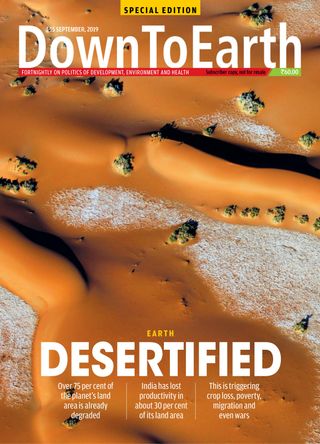

Dit verhaal komt uit de September 01, 2019-editie van Down To Earth.
Abonneer u op Magzter GOLD voor toegang tot duizenden zorgvuldig samengestelde premiumverhalen en meer dan 9000 tijdschriften en kranten.
Bent u al abonnee? Aanmelden
MEER VERHALEN VAN Down To Earth

Down To Earth
JINALI MODY - ENTREPRENEUR
In September 2025, UN Environment Programme announced Mumbai-based Jinali Mody, founder of material-science startup Banofi Leather, as a Young Champion of the Earth.

2 mins
January 01, 2026

Down To Earth
IT'S AN ENDLESS BATTLE
A decade spent tackling waste still feels vanishingly small
2 mins
January 01, 2026

Down To Earth
'NUMB, AND UNABLE TO ACT
As disasters grow more frequent, I find myself wondering how long I can continue living here, waiting for the next storm
2 mins
January 01, 2026

Down To Earth
SAJANA SAJEEVAN - CRICKETER
In April 2024, Sajana Sajeevan got her maiden call up to the national women's cricket team on the back of a 12-year domestic career that began in the paddy fields of Wayanad, Kerala.
4 mins
January 01, 2026

Down To Earth
NILA MADHAB PANDA - FILMMAKER
Few storytellers bring dramatic despair of ecological loss to the big screen like Nila Madhab Panda. The national-award winning filmmaker often makes nature his central character, be it in his 2017 film Kadvi Hawa or in the 2023 web series The Jengaburu Curse.
4 mins
January 01, 2026

Down To Earth
CHETAN SINGH SOLANKI: SCIENTIST | SOCIAL ENTREPRENEUR
For the past five years, Chetan Singh Solanki has been on a singular journey.
2 mins
January 01, 2026

Down To Earth
ʻLIVING SLOWLY, RELUCTANTLY
The pleasures and burdens of attempting a sustainable life in a fast-moving world
2 mins
January 01, 2026

Down To Earth
KIRAN RAO
Filmmaker and producer Kiran Rao has mastered the art of mainstreaming social commentary, as seen in her early films like Dhobi Ghat and more recently in Laapataa Ladies and Humans in the Loop.
4 mins
January 01, 2026

Down To Earth
I SEE THE RISE OF DEFENDERS
When a species disappears from a land, the loss extends far beyond the species itself.
2 mins
January 01, 2026

Down To Earth
MANISH MEHROTRA - CHEF | RESTAURATEUR
Manish Mehrotra is globally recognised for his innovative approach to preserving India's culinary heritage.
4 mins
January 01, 2026
Translate
Change font size