Essayer OR - Gratuit
It Is Everybody's Business
Down To Earth
|September 01, 2019
Private sector is vital to restore land and sustain life

WE TAKE for granted the abundance of productive land, assuming that damaged land will heal itself. Left alone for a very long time, it would. Eventually. But that’s not our reality.
Four recent independent assessments show that degraded land is not recovering fast enough and that the drivers and impacts are no longer limited to the locals. They are global. That puts the onus of restoration on everyone who rightfully consumes that which is not produced locally. The private sector must be engaged as governments cannot do it alone. Nor should communities have to pick up their slack.
The rising global momentum and demand for environmental action makes this an ideal moment to change how we plan and manage land. The benefits of doing so are far-reaching and global.
To understand my claim, let me explain first what the science is telling us.
Over 1.3 billion people in the world are directly affected by land degradation, but more than 3.2 billion are impacted indirectly. That is nearly half of the global population, and well over the 2 billion people who live in the world’s dryland areas. Drylands were the primary target of the United Nations Convention to Combat Desertification (UNCCD) when it was negotiated 25 years ago. These lands face the greatest risk of degradation (referred to as desertification) compared to other types of land systems.
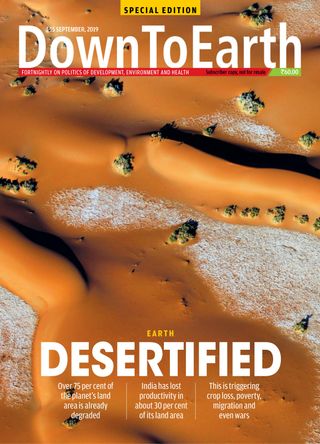

Cette histoire est tirée de l'édition September 01, 2019 de Down To Earth.
Abonnez-vous à Magzter GOLD pour accéder à des milliers d'histoires premium sélectionnées et à plus de 9 000 magazines et journaux.
Déjà abonné ? Se connecter
PLUS D'HISTOIRES DE Down To Earth

Down To Earth
THINK TWICE BEFORE FELLING SAL TREES
Many trees considered to be affected by sal borer in the 1990s are still alive today

1 mins
February 16, 2026

Down To Earth
EDGE OF SURVIVAL
Caste divides deny marginalised communities land, resources and essential aid, leaving them more vulnerable to climate disasters
6 mins
February 16, 2026

Down To Earth
A WISH LIST?
Union Budget for 2026-27 conveys the impression of a roll-call of intentions and ambitious proposals, with little detail on their formulation
6 mins
February 16, 2026
Down To Earth
Break down the gender wall
THE RULING National Democratic Alliance (NDA) government has been heavily invested in the goal to make India a developed economy by 2047.
2 mins
February 16, 2026

Down To Earth
MENSTRUAL HEALTH, NOW A FUNDAMENTAL RIGHT
In a landmark judgement, the Supreme Court has recognised menstrual health and hygiene as a fundamental right under Article 21 of the Constitution of India, which guarantees the right to life and dignity.
8 mins
February 16, 2026

Down To Earth
Of devolution and new disasters
The 16th Finance Commission pushes for changes in view of new fiscal and climatic conditions
11 mins
February 16, 2026
Down To Earth
Rising risks of plastics
NEGATIVE IMPACTS on human health due to emissions linked to the plastic lifecycle could double by 2040, according to a study published in The Lancet Planetary Health in January.
1 min
February 16, 2026

Down To Earth
GAP BETWEEN EPIDEMICS NARROWING
A watershed-based and landscape-level approach is needed to address forest degradation
2 mins
February 16, 2026
Down To Earth
WAITING TO STRIKE
Sal heartwood borer is considered the biggest threat to forestry in India, especially to the sal tree, where it lives and breeds.
11 mins
February 16, 2026

Down To Earth
A SPRING DELIGHT
Mustard flowers are not meant only for the eyes. Invite them to your plate once in a while
3 mins
February 16, 2026
Translate
Change font size