
Ga onbeperkt met Magzter GOLD
Krijg onbeperkte toegang tot meer dan 9000 tijdschriften, kranten en Premium-verhalen voor slechts
Poging GOUD - Vrij
619,097
Down To Earth
|September 01, 2020
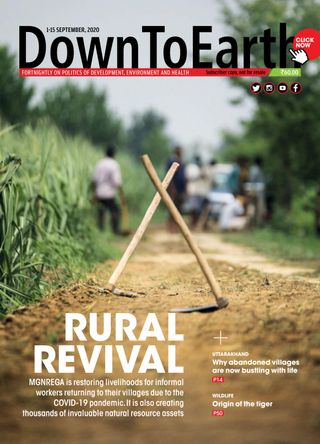
This is the number of assets created across rural India in the four months since the COVID-19 lockdown to tap natural resources. This is also the potential of the Mahatma Gandhi National Rural Employment Guarantee Act, 2005 (MGNREGA), a programme envisaged to alleviate poverty among the rural people by using their only capital—labour. So, what has helped the program that over the years got mired in controversies make a comeback? Down To Earth travels to districts that witnessed reverse migration on a large scale to understand this transition. They find a script that can change the rural-urban dynamics forever. Demand for MGNREGA works shows an unprecedented spike—more than 30 million households have asked for employment for three consecutive months. Governments are harnessing the surplus labour to create assets that will ensure livelihood even after people are weaned off the wage support. People too are using this opportunity to pick up the pieces of their lives in villages they had once left.

HAS THE next batch of work been sanctioned?” asks Ram Ratan from a distance, sitting amid the sweating crowd waiting in silence on a humid July afternoon at the panchayat office of Dhurala village in Haryana’s Kurukshetra district. As always, he is dressed in neatly ironed trousers, shirt and sandals. With a post-graduate degree in psychology, he is among the most qualified youths in the village. The official responds, “Yes. We are in talks with the irrigation department about cleaning and de-silting a canal and with the Indian Railways about clearing the tracks.” The news pacifies the crowd, including Ratan, waiting eagerly for more work under the country’s largest public wage programme, the Mahatma Gandhi National Rural Employment Guarantee Act, 2005, popularly known by its acronym MGNREGA. The programme, implemented in 691 of the country’s 739 districts, is in fact dubbed the world’s largest state-sponsored job-scheme to eradicate poverty.
As per its preamble, MGNREGA aims to enhance the livelihood security of rural households by guaranteeing them “100 days of unskilled manual work” every financial year. At least 75 per cent of the total works must be related to water conservation, the Act mandates.

Dit verhaal komt uit de September 01, 2020-editie van Down To Earth.
Abonneer u op Magzter GOLD voor toegang tot duizenden zorgvuldig samengestelde premiumverhalen en meer dan 9000 tijdschriften en kranten.
Bent u al abonnee? Aanmelden
MEER VERHALEN VAN Down To Earth

Down To Earth
THINK TWICE BEFORE FELLING SAL TREES
Many trees considered to be affected by sal borer in the 1990s are still alive today

1 mins
February 16, 2026

Down To Earth
EDGE OF SURVIVAL
Caste divides deny marginalised communities land, resources and essential aid, leaving them more vulnerable to climate disasters
6 mins
February 16, 2026

Down To Earth
A WISH LIST?
Union Budget for 2026-27 conveys the impression of a roll-call of intentions and ambitious proposals, with little detail on their formulation
6 mins
February 16, 2026
Down To Earth
Break down the gender wall
THE RULING National Democratic Alliance (NDA) government has been heavily invested in the goal to make India a developed economy by 2047.
2 mins
February 16, 2026

Down To Earth
MENSTRUAL HEALTH, NOW A FUNDAMENTAL RIGHT
In a landmark judgement, the Supreme Court has recognised menstrual health and hygiene as a fundamental right under Article 21 of the Constitution of India, which guarantees the right to life and dignity.
8 mins
February 16, 2026

Down To Earth
Of devolution and new disasters
The 16th Finance Commission pushes for changes in view of new fiscal and climatic conditions
11 mins
February 16, 2026
Down To Earth
Rising risks of plastics
NEGATIVE IMPACTS on human health due to emissions linked to the plastic lifecycle could double by 2040, according to a study published in The Lancet Planetary Health in January.
1 min
February 16, 2026
Down To Earth
GAP BETWEEN EPIDEMICS NARROWING
A watershed-based and landscape-level approach is needed to address forest degradation
2 mins
February 16, 2026
Down To Earth
WAITING TO STRIKE
Sal heartwood borer is considered the biggest threat to forestry in India, especially to the sal tree, where it lives and breeds.
11 mins
February 16, 2026

Down To Earth
A SPRING DELIGHT
Mustard flowers are not meant only for the eyes. Invite them to your plate once in a while
3 mins
February 16, 2026
Translate
Change font size