
Ga onbeperkt met Magzter GOLD
Krijg onbeperkte toegang tot meer dan 9000 tijdschriften, kranten en Premium-verhalen voor slechts
Poging GOUD - Vrij
Through The Victim Lens
Outlook
|December 11, 2017
A Muslim photographer recalls December 6, 1992, when he was at Babri Masjid

It was a feverish night. In a small hotel room in Faizabad, I tossed and turned on my bed all night. Sleep had deserted me. My mind was crowded with thoughts of the previous day, December 6, 1992, which had left me heartbroken. I felt deep within me that the demolition of the medieval-era mosque had struck at independent India’s soul, and changed it irrevocably. The demolition of any place of worship, whether it’s a temple, a church or a mosque, would have had the same devastating effect on me. And I had witnessed a mosque being razed to the ground in a hate-filled atmosphere. We had also seen the beginnings of the aftermath: burning tyres strewn around, the rising smoke and the militant kar sevaks ready to beat up photographers.
As I lay there on my bed, I heard the azaan, the call to prayer, breaking the day. It was a startling note in that darkness, that of one brave Muslim calling out to the faithful.
This was not my first visit to Ayodhya. I had gone there twice before to photograph the kar seva (voluntary service for temple construction) in 1990 and 1991. In October 1990, BJP leader L.K. Advani’s rath yatra was stopped in Bihar and Advani was arrested, but the kar sevaks journeyed on to Ayodhya. A few of them broke through the heavily guarded cordon and one managed to climb the disputed Babri Masjid and place a saffron flag atop the masjid.
I was working as a photographer for Malayala Manorama and The Week at that time and, in 42 years as a photographer, I have never been injured except that once. A few kar sevaks were throwing bricks at the Provincial Armed Constabulary (PAC) stationed there and one brick hit me on my back and the horrible pain festered for many months. A few died in the police firing that ensued.
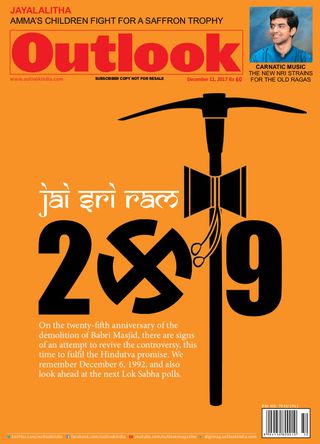

Dit verhaal komt uit de December 11, 2017-editie van Outlook.
Abonneer u op Magzter GOLD voor toegang tot duizenden zorgvuldig samengestelde premiumverhalen en meer dan 9000 tijdschriften en kranten.
Bent u al abonnee? Aanmelden
MEER VERHALEN VAN Outlook
Outlook
'Why GDP Growth Doesn't Always Translate Into Votes'
The recent election results have once again shown that economic growth alone does not guarantee electoral victory.

3 mins
June 06, 2026
Outlook
Lights, Camera, Othering
The establishment of Israel has been accompanied by a national cinema devoted to negating and erasing the Palestinian Other
5 mins
June 06, 2026

Outlook
Goodbye to All That
Booker-winning British author Julian Barnes' Departure(s) is a unique hybrid work: playful, philosophical, whimsical
4 mins
June 06, 2026
Outlook
Collapse of Trust
As the NEET-UG 2026 paper leak forced the cancellation of India’s biggest medical entrance exam, more than 22 lakh aspirants find themselves trapped in uncertainty
11 mins
June 06, 2026
Outlook
NO LONGER A TWELFTH MAN
Bihar cricket, which has languished in the shadows for long, is all set to improve its strike rate, thanks to Vaibhav Sooryavanshi, the new Bihari kid on the block
5 mins
June 06, 2026
Outlook
BLAZE OF GLORY
The challenges of being a celebrity cricketer at a young age can be tough to handle
5 mins
June 06, 2026
Outlook
THE SWASHBUCKLERS
A new generation of fearless stars is emerging and finding its feet at the very top of an extremely competitive cricketing environment
5 mins
June 06, 2026
Outlook
THE TEEN TORNAD
At the age of 15, Vaibhav Sooryavanshi is already a cricketing legend
10 mins
June 06, 2026
Outlook
A Journey to Remember
The prerecorded message crackled over the din in the compartment: ‘Welcome to the Shatabdi Express.
4 mins
June 06, 2026

Outlook
Crossing Borders
Ruth Martin is the translator of German-Iranian author Shida Bazyar’s novel The Nights are Quiet in Tehran (originally written in German), which has been shortlisted for the 2026 International Booker Prize.
4 mins
June 06, 2026
Translate
Change font size