
Magzter GOLDで無制限に
10,000以上の雑誌、新聞、プレミアム記事に無制限にアクセスできます。
試す 金 - 無料
Through The Victim Lens
Outlook
|December 11, 2017
A Muslim photographer recalls December 6, 1992, when he was at Babri Masjid

It was a feverish night. In a small hotel room in Faizabad, I tossed and turned on my bed all night. Sleep had deserted me. My mind was crowded with thoughts of the previous day, December 6, 1992, which had left me heartbroken. I felt deep within me that the demolition of the medieval-era mosque had struck at independent India’s soul, and changed it irrevocably. The demolition of any place of worship, whether it’s a temple, a church or a mosque, would have had the same devastating effect on me. And I had witnessed a mosque being razed to the ground in a hate-filled atmosphere. We had also seen the beginnings of the aftermath: burning tyres strewn around, the rising smoke and the militant kar sevaks ready to beat up photographers.
As I lay there on my bed, I heard the azaan, the call to prayer, breaking the day. It was a startling note in that darkness, that of one brave Muslim calling out to the faithful.
This was not my first visit to Ayodhya. I had gone there twice before to photograph the kar seva (voluntary service for temple construction) in 1990 and 1991. In October 1990, BJP leader L.K. Advani’s rath yatra was stopped in Bihar and Advani was arrested, but the kar sevaks journeyed on to Ayodhya. A few of them broke through the heavily guarded cordon and one managed to climb the disputed Babri Masjid and place a saffron flag atop the masjid.
I was working as a photographer for Malayala Manorama and The Week at that time and, in 42 years as a photographer, I have never been injured except that once. A few kar sevaks were throwing bricks at the Provincial Armed Constabulary (PAC) stationed there and one brick hit me on my back and the horrible pain festered for many months. A few died in the police firing that ensued.
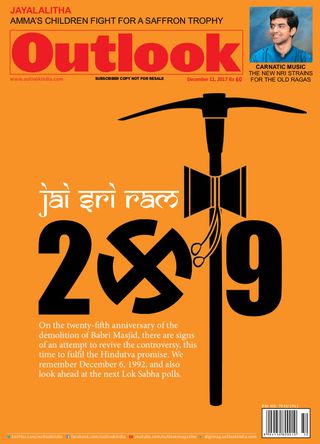

このストーリーは、Outlook の December 11, 2017 版からのものです。
Magzter GOLD を購読すると、厳選された何千ものプレミアム記事や、10,000 以上の雑誌や新聞にアクセスできます。
すでに購読者ですか? サインイン
Outlook からのその他のストーリー
Outlook
Joy Words Club
Lit fests are defined by their audience. Organisers, speakers, curators are all replaceable but not the readers, not the audience

4 mins
February 01, 2026

Outlook
The Sting of the Bar
India today has more than 4.3 lakh undertrial prisoners. A significant number of them are linked to political cases
8 mins
February 01, 2026
Outlook
The Dispossessed
The systematic creation of criminal and security legislations view Adivasis as an inherently suspect class of criminals and terrorists
8 mins
February 01, 2026

Outlook
The Hypocrisy of Liberals
Favour of the self-proclaimed 'liberals' is lost the minute religion intervenes
5 mins
February 01, 2026
Outlook
Inside the Phansi Yard
Death row intensifies the structured brutalities of the penal system and reminds us why the struggle against the death penalty must also include the fact of prison violence
9 mins
February 01, 2026
Outlook
The Detention Legacy
Since Independence, a number of laws have been enacted that allow preventive detention which have been widely used by all regimes against their political opponents
7 mins
February 01, 2026
Outlook
“This Could Happen to You
The Bhima Koregaon case is not only about those who were imprisoned. It is also about the fate of democracy itself
8 mins
February 01, 2026
Outlook
"I Remember Swinging Between Hope and Despair"
HOPE and despair are basic human emotions and I believe that all human beings, now and then, swing between these two ends of the spectrum in life.
2 mins
February 01, 2026

Outlook
Think Ink
In 2026-the 'year of analog'-how will our relationship with literary festivals evolve?
6 mins
February 01, 2026
Outlook
Who Stole My Youth?
A Delhi district court granted Mohammad Iqbal bail in the riots case within three months. On March 18, 2025, he was discharged in the Babbu murder case, even as the riots trial continues
6 mins
February 01, 2026
Translate
Change font size