Poging GOUD - Vrij
Ayodhya In The Time Of Jawaharlal
Outlook
|December 10, 2018
It’s still a puzzle why India’s first prime minister failed to act decisively when the Babri Masjid was effectively converted into a temple in 1949.

On the night of December 22-23, 1949, Lord Ram’s idols miraculously appeared inside the Babri mosque in Ayodhya in Uttar Pradesh’s Faizabad district. Those were tumultuous times for Hindutva activists, who had been facing extraordinary trials and tribulations since Independence and Partition. Less than six weeks earlier, on november 15, 1949, Nathu Ram Godse and Narayan Apte, Mahatma Gandhi’s assassins, had been hanged at the Ambala Central Jail. Before their execution, the two prisoners recited the 11th and 15th chapters of the Bhagavad Gita and the first four lines of the RSS prayer. While climbing the gallows, they are reported to have shouted “Akhand Bharat amar rahe” and “vande mataram”! The bodies were cremated in the jail by prison authorities according to Hindu Sanatanist rites as per their last wishes. Requests by family members to be present at the cremation had been turned down. Godse and Apte had also expressed their wish to have their ashes immersed in the river Indus, an indivisible part of Bharat mata.
The appearance of the idols brought a sense of closure to Hindutva activists, who had faced an extremely challenging environment in the 22 months since Gandhi’s murder. Prominent RSS leaders had been arrested. The government saw the RSS as the volunteer arm of the Hindu Mahasabha, even though ties between the two organisations had been tenuous.
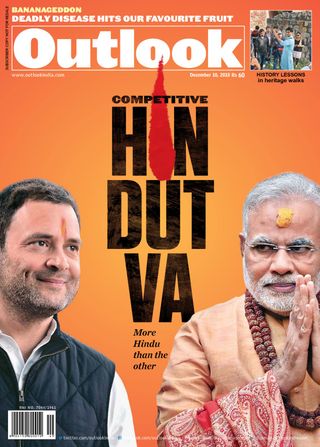

Dit verhaal komt uit de December 10, 2018-editie van Outlook.
Abonneer u op Magzter GOLD voor toegang tot duizenden zorgvuldig samengestelde premiumverhalen en meer dan 9000 tijdschriften en kranten.
Bent u al abonnee? Aanmelden
MEER VERHALEN VAN Outlook

Outlook
'Why GDP Growth Doesn't Always Translate Into Votes'
The recent election results have once again shown that economic growth alone does not guarantee electoral victory.

3 mins
June 06, 2026

Outlook
Lights, Camera, Othering
The establishment of Israel has been accompanied by a national cinema devoted to negating and erasing the Palestinian Other
5 mins
June 06, 2026

Outlook
Goodbye to All That
Booker-winning British author Julian Barnes' Departure(s) is a unique hybrid work: playful, philosophical, whimsical
4 mins
June 06, 2026

Outlook
Collapse of Trust
As the NEET-UG 2026 paper leak forced the cancellation of India’s biggest medical entrance exam, more than 22 lakh aspirants find themselves trapped in uncertainty
11 mins
June 06, 2026

Outlook
NO LONGER A TWELFTH MAN
Bihar cricket, which has languished in the shadows for long, is all set to improve its strike rate, thanks to Vaibhav Sooryavanshi, the new Bihari kid on the block
5 mins
June 06, 2026

Outlook
BLAZE OF GLORY
The challenges of being a celebrity cricketer at a young age can be tough to handle
5 mins
June 06, 2026

Outlook
THE SWASHBUCKLERS
A new generation of fearless stars is emerging and finding its feet at the very top of an extremely competitive cricketing environment
5 mins
June 06, 2026

Outlook
THE TEEN TORNAD
At the age of 15, Vaibhav Sooryavanshi is already a cricketing legend
10 mins
June 06, 2026
Outlook
A Journey to Remember
The prerecorded message crackled over the din in the compartment: ‘Welcome to the Shatabdi Express.
4 mins
June 06, 2026

Outlook
Crossing Borders
Ruth Martin is the translator of German-Iranian author Shida Bazyar’s novel The Nights are Quiet in Tehran (originally written in German), which has been shortlisted for the 2026 International Booker Prize.
4 mins
June 06, 2026
Translate
Change font size