
Gå ubegrenset med Magzter GOLD
Få ubegrenset tilgang til over 9000 magasiner, aviser og premiumhistorier for bare
Prøve GULL - Gratis
Zero Trust, Powered by Al
PCQuest
|September 2025
Zero Trust stalls when it relies on static rules. Add AI and the model wakes up: it learns behavior, scores risk in real time, grants just-enough and just-in-time access, and enforces policy at the edge with sub-second decisions while keeping users moving
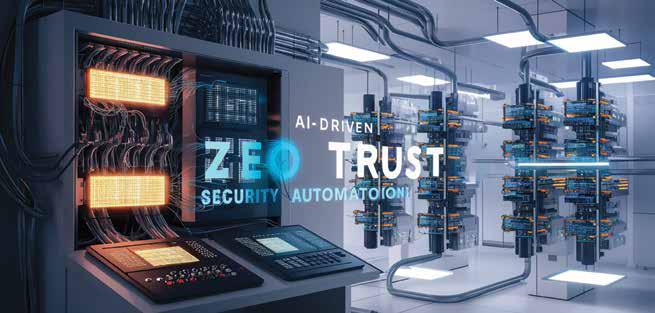
Zero Trust is simple in theory: never trust, always verify. In practice, classic rollouts tripped over rigid policies, complex rule sets, and user friction. Enterprises move quickly and threats move quicker. The turning point arrives when Al animates the framework. With Al, Zero Trust shifts from a onetime checkpoint to a continuous, context-aware system that evaluates trust as people work and enforces policy at the speed of operations.
Dynamic trust, not static checks
In an Al-first model, a trust score is computed and updated in real time. It is not a binary yes or no. It reflects what the user is doing, where they are doing it, and the current health of the device in use.
The foundation is user and entity behavior analytics. Models learn what normal looks like for each person and device: usual login patterns, locations, applications, and data touched. When behavior drifts, risk rises. A midnight attempt to open a sensitive database from an unfamiliar location raises the score even if credentials are valid.
That score drives adaptive authentication. Low-risk actions glide through. Higher-risk steps call for additional proof, such as multi-factor prompts or a temporary block. Device posture is folded in continuously. If a laptop’s patch level slips or processes behave oddly mid-session, access contracts or ends. Trust is not granted once and forgotten. It is recalculated as the session unfolds.
Policy at the speed of operations
Scoring risk only matters if policy follows instantly. This is where automation and orchestration carry the model.

Denne historien er fra September 2025-utgaven av PCQuest.
Abonner på Magzter GOLD for å få tilgang til tusenvis av kuraterte premiumhistorier og over 9000 magasiner og aviser.
Allerede abonnent? Logg på
FLERE HISTORIER FRA PCQuest

PCQuest
When Software Drives the Machine Need for Enterprise-Grade Software
Cars used to fail because of broken parts.Now they fail because of broken code. As vehicles become rolling computers, enterprise-grade software, ruthless testing, and fail-safe architecture decide one thing: whether a car keeps moving safely at 100 km/h

2 mins
March 2026

PCQuest
AI on the ground Practical use cases of AI in large enterprise operations
AI isn't a side project anymore, it's the quiet operator inside global giants. It reads invoices, senses machine fatigue, tailors every customer moment, flags risk in real time, and feeds leaders sharper instincts. Scale just got smarter
3 mins
March 2026

PCQuest
From AI experiments in 2025 to enterprise scale in 2026: Why data foundations will decide the winners
Everyone's betting big on Al, but most are burning cash instead of building value. The hidden culprit? Dirty data, clunky processes, and missing context. What if fixing your foundation, not your algorithms, was the real AI game-changer?
4 mins
March 2026

PCQuest
How automation at the periphery is accelerating digital transformation
Digital transformation is not tearing down the core anymore. It is happening at the edges. With AI and automation layered onto existing systems, companies are cutting costs, boosting productivity by up to 40%, and scaling smarter without risking operational chaos
2 mins
March 2026

PCQuest
When AI moves from chips to racks
AI performance is no longer just about faster chips. It is about how racks, power, networking, and orchestration work together. As agentic AI grows, infrastructure must become predictable, open, and built for scale from day one
4 mins
March 2026

PCQuest
Designing enterprise AI systems that stay fair
In 2026, bias is no longer treated as a communications issue or a public relations headache.
6 mins
March 2026

PCQuest
HALO smart sensor
What if bathrooms, locker rooms, and isolated spaces could become safer without adding cameras?
2 mins
March 2026

PCQuest
Building enterprise AI that doesn't discriminate
Bias in enterprise AI is not a side issue. It starts in data pipelines, training systems, product design, and engineering workflows. As AI scales, fairness, transparency, and accessibility are becoming core software requirements
4 mins
March 2026

PCQuest
Bias travels faster than code
Bias in enterprise AI is not a surface issue. It enters through data, features, model training, APIs, and UI logic, then spreads across the stack. The technical response is shifting from audits to architecture, observability, and deployment controls
6 mins
March 2026

PCQuest
How hospitals can use AI without risking patient data
With the fast pace of adoption of Artificial Intelligence (AI) and digital health systems in Indian hospitals, issues related to the security of patient data are also increasing at an equal rate.
2 mins
March 2026
Listen
Translate
Change font size