Prøve GULL - Gratis
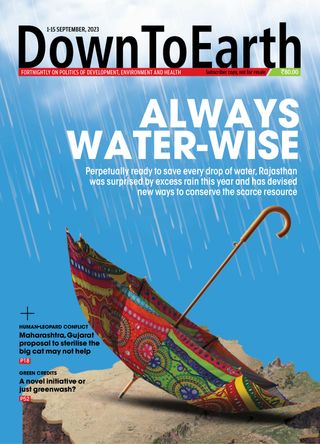
RAINY RAJASTHAN
Down To Earth
|September 01, 2023
The harsh deserts of Rajasthan bear testimony to human adaptability and ingenuity. They receive just 300 mm of annual rain, making Rajasthan India's driest state. Yet they are home to a third of the state's population and, by some estimates, the most populous deserts in the world.
-

This is because of a singular ability of the local people-devising ingenious ways to harvest every drop of rainwater, whenever, wherever it falls. Their competence and wisdom were put to test this year, when western Rajasthan-the region where the deserts are received heavy rainfall in May, much before the formal onset of monsoon in the region on June 26. By then western Rajasthan had received over 70 per cent of its annual rain and by August, the entire state stood second in the country in terms of excess rainfall received. How did the water-starved region react to this excess?
ANIL ASHWANI SHARMA travels to eight villages in Beawar, Pali, Barmer and Jaisalmer districts to find that the people are busy doing just one thing: capturing water. Tens of thousands of traditional water harvesting structures are already brimming with water, and hundreds of new ones are being built to store the scarce resource. Agriculture is experiencing a boom, with massive fallow areas under cultivation. People have devoted water structures to regenerate grazing lands for fodder, planning for the future. In many desert villages, farmers have made preparations for a second crop in the coming winter season.
PRADEEP KUMAR MISHRA in Delhi analyses the potential of water harvesting in the region, as the changing climate could result in more wet days. This estimate suggests that even by harvesting half of the rain received between May and July, the communities would store a humongous 28 billion litres-sufficient to meet their domestic water needs for years. This is the story of a changing climate, and the adaptability of traditional knowledge to such situations.
BEAWAR I SENDRA
Entire catchment revived

Denne historien er fra September 01, 2023-utgaven av Down To Earth.
Abonner på Magzter GOLD for å få tilgang til tusenvis av kuraterte premiumhistorier og over 9000 magasiner og aviser.
Allerede abonnent? Logg på
FLERE HISTORIER FRA Down To Earth

Down To Earth
BEYOND COLLATERAL DAMAGE
Recent geopolitical conflicts are urging a reconsideration of what constitutes environmental harm in war and the limits of existing legal frameworks

3 mins
April 01, 2026

Down To Earth
Masterstroke
Residents of a small Kerala town reject an inadequate state-led development blueprint and create their own master plan that prioritises protection of historic water systems and urban commons
4 mins
April 01, 2026

Down To Earth
Rethinking E20
It is pertinent to explore potential of ethanol as high-value industrial feedstock
4 mins
April 01, 2026
Down To Earth
Food in the age of climate change
WHEN WE eat, we contribute to climate change. But food is also about livelihoods, about nutrition and about nature.
3 mins
April 01, 2026

Down To Earth
FADING WINTER
India's winters are warming, becoming shorter, shifting and spilling beyond their traditional bounds. The consequences are already evident in meltwater availability, forest-fire intensity and changes in flowering cycles and insect behaviour.
20 mins
April 01, 2026

Down To Earth
War on Iran strikes India's pharmaceuticals sector
Shortages of critical raw materials and rising input costs for the drug industry will have global consequences
4 mins
April 01, 2026

Down To Earth
POWER IN AN AGE OF INSECURITY
Energy transition is no longer solely about emission reduction but also about energy security
3 mins
April 01, 2026
Down To Earth
Re-discovery of fuelwood
THE WEST Asia conflict has made visible a multi-billion dollar energy market in India.
2 mins
April 01, 2026

Down To Earth
A CASE THAT RESHAPED INDIA'S ENVIRONMENT
The case of MC Mehta v Union of India stands as proof that a proactive judiciary can accelerate action even when the executive drags its feet
4 mins
April 01, 2026
Down To Earth
FOREVER DEPENDENT
India depends on global fertiliser supply chains for 70 per cent of its needs, leaving its food security exposed to geopolitical disruptions
6 mins
April 01, 2026
Translate
Change font size