
Mit Magzter GOLD unbegrenztes Potenzial nutzen
Erhalten Sie unbegrenzten Zugriff auf über 9.000 Zeitschriften, Zeitungen und Premium-Artikel für nur
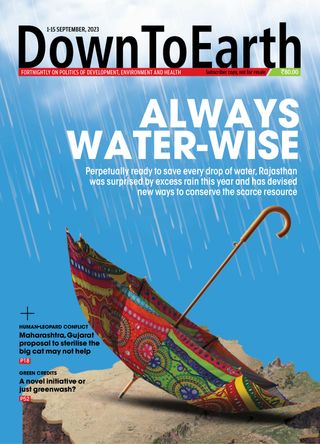
RAINY RAJASTHAN
Down To Earth
|September 01, 2023
The harsh deserts of Rajasthan bear testimony to human adaptability and ingenuity. They receive just 300 mm of annual rain, making Rajasthan India's driest state. Yet they are home to a third of the state's population and, by some estimates, the most populous deserts in the world.
-

This is because of a singular ability of the local people-devising ingenious ways to harvest every drop of rainwater, whenever, wherever it falls. Their competence and wisdom were put to test this year, when western Rajasthan-the region where the deserts are received heavy rainfall in May, much before the formal onset of monsoon in the region on June 26. By then western Rajasthan had received over 70 per cent of its annual rain and by August, the entire state stood second in the country in terms of excess rainfall received. How did the water-starved region react to this excess?
ANIL ASHWANI SHARMA travels to eight villages in Beawar, Pali, Barmer and Jaisalmer districts to find that the people are busy doing just one thing: capturing water. Tens of thousands of traditional water harvesting structures are already brimming with water, and hundreds of new ones are being built to store the scarce resource. Agriculture is experiencing a boom, with massive fallow areas under cultivation. People have devoted water structures to regenerate grazing lands for fodder, planning for the future. In many desert villages, farmers have made preparations for a second crop in the coming winter season.
PRADEEP KUMAR MISHRA in Delhi analyses the potential of water harvesting in the region, as the changing climate could result in more wet days. This estimate suggests that even by harvesting half of the rain received between May and July, the communities would store a humongous 28 billion litres-sufficient to meet their domestic water needs for years. This is the story of a changing climate, and the adaptability of traditional knowledge to such situations.
BEAWAR I SENDRA
Entire catchment revived

Diese Geschichte stammt aus der September 01, 2023-Ausgabe von Down To Earth.
Abonnieren Sie Magzter GOLD, um auf Tausende kuratierter Premium-Geschichten und über 9.000 Zeitschriften und Zeitungen zuzugreifen.
Sie sind bereits Abonnent? Anmelden
WEITERE GESCHICHTEN VON Down To Earth

Down To Earth
KING OF BIRDS
Revered for centuries, western tragopan now needs protection as its forests shrink, human pressures mount

3 mins
December 16, 2025

Down To Earth
WHISKERS ALL AQUIVER
Climate change threatens creatures that have weathered extreme environments for thousands of years
2 mins
December 16, 2025

Down To Earth
GOLDEN SPIRIT
Survival of the shy primate is closely tied to the health of Western Ghats
3 mins
December 16, 2025

Down To Earth
RINGED EYES IN THE CANOPY
Rapid habitat destruction forces arboreal langur to alter habits
2 mins
December 16, 2025

Down To Earth
HANGING BY THE CLIFF
The Himalaya's rarest wild goat is on the brink of local extinction
2 mins
December 16, 2025

Down To Earth
ANGEL OF THE BEAS
Conservation reserves, citizen science, and habitat protection give the Indus River dolphin a fighting chance in India
2 mins
December 16, 2025

Down To Earth
UNDER MOONLIT SCRUB
Survival of this hidden guardian tells us whether our scrublands still breathe
2 mins
December 16, 2025

Down To Earth
SYMBOL OF SILENT VALLEY
Lion-tailed macaque remains vulnerable despite past victories
2 mins
December 16, 2025

Down To Earth
THE APE IN OUR STORIES
India's only non-human ape species is a cultural icon threatened by forest fragmentation
2 mins
December 16, 2025

Down To Earth
SENTINEL OF THE HIGH COLD DESERT
The bird's evocative call may not continue to roll across the cold desert valley for long
3 mins
December 16, 2025
Translate
Change font size