Prøve GULL - Gratis
Fading history of Novartis v Union of India
Down To Earth
|April 01, 2023
The 2013 landmark Supreme Court judgement offers critical lessons on the intent behind crucial aspects of India's key patent law

EXACTLY TEN years ago, the Supreme Court of India delivered a landmark judgement on a crucial case involving under the patent protection for pharmaceuticals country's new intellectual property rights regime. It was a case that had riveted the world since the outcome had major implications for the pharma industry and for patients. It was the first test of the country's patent law, which had been amended to comply with World Trade Organization (WTO) rules, and specifically of a particular part of the law, Section 3d, which delineated what was not patentable in India. This section deals with patents for derivatives of known substances and new uses of a known substance, a hugely contested domain.
The legal challenge had come from Swiss drug giant Novartis which had filed a special leave petition (SLP) in the apex court; its final attempt to get a patent for a new form of its anti-cancer medicine Glivec after several courts had rejected the claim. The claim was for a beta crystalline version of its base compound imatinib mesylate, which had been patented much earlier. A division bench of the Supreme Court rejected the SLP and Justice Aftab Alam, who wrote the carefully nuanced judgement, laid down the fundamental reasoning for the law and its application. While the court considered the counter arguments-generic companies, patient groups and lobbyists had also filed SLPS-it was not unduly swayed by the argument for access to the medicine.
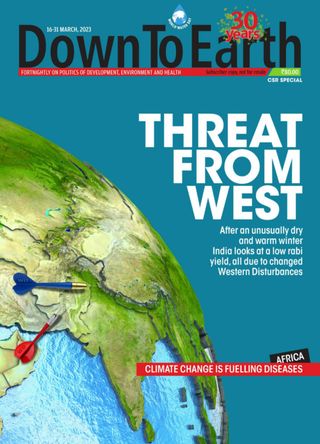

Denne historien er fra April 01, 2023-utgaven av Down To Earth.
Abonner på Magzter GOLD for å få tilgang til tusenvis av kuraterte premiumhistorier og over 9000 magasiner og aviser.
Allerede abonnent? Logg på
FLERE HISTORIER FRA Down To Earth

Down To Earth
THINK TWICE BEFORE FELLING SAL TREES
Many trees considered to be affected by sal borer in the 1990s are still alive today

1 mins
February 16, 2026

Down To Earth
EDGE OF SURVIVAL
Caste divides deny marginalised communities land, resources and essential aid, leaving them more vulnerable to climate disasters
6 mins
February 16, 2026

Down To Earth
A WISH LIST?
Union Budget for 2026-27 conveys the impression of a roll-call of intentions and ambitious proposals, with little detail on their formulation
6 mins
February 16, 2026
Down To Earth
Break down the gender wall
THE RULING National Democratic Alliance (NDA) government has been heavily invested in the goal to make India a developed economy by 2047.
2 mins
February 16, 2026

Down To Earth
MENSTRUAL HEALTH, NOW A FUNDAMENTAL RIGHT
In a landmark judgement, the Supreme Court has recognised menstrual health and hygiene as a fundamental right under Article 21 of the Constitution of India, which guarantees the right to life and dignity.
8 mins
February 16, 2026

Down To Earth
Of devolution and new disasters
The 16th Finance Commission pushes for changes in view of new fiscal and climatic conditions
11 mins
February 16, 2026
Down To Earth
Rising risks of plastics
NEGATIVE IMPACTS on human health due to emissions linked to the plastic lifecycle could double by 2040, according to a study published in The Lancet Planetary Health in January.
1 min
February 16, 2026

Down To Earth
GAP BETWEEN EPIDEMICS NARROWING
A watershed-based and landscape-level approach is needed to address forest degradation
2 mins
February 16, 2026
Down To Earth
WAITING TO STRIKE
Sal heartwood borer is considered the biggest threat to forestry in India, especially to the sal tree, where it lives and breeds.
11 mins
February 16, 2026
Down To Earth
A SPRING DELIGHT
Mustard flowers are not meant only for the eyes. Invite them to your plate once in a while
3 mins
February 16, 2026
Translate
Change font size