Versuchen GOLD - Frei
Fading history of Novartis v Union of India
Down To Earth
|April 01, 2023
The 2013 landmark Supreme Court judgement offers critical lessons on the intent behind crucial aspects of India's key patent law

EXACTLY TEN years ago, the Supreme Court of India delivered a landmark judgement on a crucial case involving under the patent protection for pharmaceuticals country's new intellectual property rights regime. It was a case that had riveted the world since the outcome had major implications for the pharma industry and for patients. It was the first test of the country's patent law, which had been amended to comply with World Trade Organization (WTO) rules, and specifically of a particular part of the law, Section 3d, which delineated what was not patentable in India. This section deals with patents for derivatives of known substances and new uses of a known substance, a hugely contested domain.
The legal challenge had come from Swiss drug giant Novartis which had filed a special leave petition (SLP) in the apex court; its final attempt to get a patent for a new form of its anti-cancer medicine Glivec after several courts had rejected the claim. The claim was for a beta crystalline version of its base compound imatinib mesylate, which had been patented much earlier. A division bench of the Supreme Court rejected the SLP and Justice Aftab Alam, who wrote the carefully nuanced judgement, laid down the fundamental reasoning for the law and its application. While the court considered the counter arguments-generic companies, patient groups and lobbyists had also filed SLPS-it was not unduly swayed by the argument for access to the medicine.

Diese Geschichte stammt aus der April 01, 2023-Ausgabe von Down To Earth.
Abonnieren Sie Magzter GOLD, um auf Tausende kuratierter Premium-Geschichten und über 9.000 Zeitschriften und Zeitungen zuzugreifen.
Sie sind bereits Abonnent? Anmelden
WEITERE GESCHICHTEN VON Down To Earth

Down To Earth
Bitter pill
THE WEB SERIES PHARMA EXPOSES HARSH TRUTHS OF THE PHARMACEUTICAL INDUSTRY, WHERE PROFIT OFTEN BECOMES MORE IMPORTANT THAN HUMAN HEALTH

3 mins
January 16, 2026
Down To Earth
CHAOS IN-DEFINITION
The Aravallis are perhaps India's most litigated hill range. More than 4,000 court cases have failed to arrest their destruction. The latest dispute concerns a narrow legal definition of this geological antiquity, much of which has been obliterated by mining and urban sprawl. While the Supreme Court has stayed its own judgement accepting that definition, it must see the underlying reality and help reconcile development and national security with conservation.
19 mins
January 16, 2026
Down To Earth
BITS: INDIA
Indore has recorded 16 deaths and more than 1,600 hospitalisations between December 24 and January 6.
1 min
January 16, 2026

Down To Earth
GUARANTEE EXPIRES
India's rural employment guarantee law is replaced with a centrally controlled, budget-capped scheme. Is this an attack on the right to work?
3 mins
January 16, 2026
Down To Earth
BLOOM OR BANE
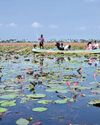
Surge of vibrant pink water lilies in Kuttanad, Kerala, provides socio-economic benefits, but the plant's ecological impacts must be understood
4 mins
January 16, 2026
Down To Earth
INVISIBLE EMPLOYER
Field and academic evidence shows sharp falls in casual agricultural employment at places where groundwater access declines
3 mins
January 16, 2026

Down To Earth
Schemed for erasure
Does the VB-G RAMG Act address structural weaknesses long observed in MGNREGA's implementation?
10 mins
January 16, 2026

Down To Earth
School of change
An open school in Panagar, Madhya Pradesh, aims to protect children of tribal settlements from falling into the trap of addiction
2 mins
January 16, 2026

Down To Earth
PULSE OF RESILIENCE
As a climate-ready crop, cowpea shows potential for widespread use in India
3 mins
January 16, 2026
Down To Earth
BITS GLOBAL
Britain recorded its hottest and sunniest year ever in 2025, the country's meteorological office said on January 2.
1 min
January 16, 2026
Translate
Change font size