
Gå ubegrenset med Magzter GOLD
Få ubegrenset tilgang til over 9000 magasiner, aviser og premiumhistorier for bare
Prøve GULL - Gratis
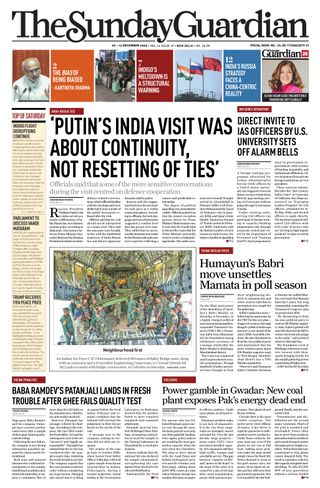
Power gamble in Gwadar: New coal plant exposes Pak's energy dead end
The Sunday Guardian
|December 07, 2025
For anyone who has followed Pakistan's power sector over the past 20 years, the latest push for new projects feels painfully familiar.
Once again, policymakers are reaching for more generation capacity when the real crisis lies elsewhere. The plan to move ahead with the Azad Patan and Kohala hydropower projects and the Gwadar coal-fired plant, adding about 2,100 MW, comes at a time when Pakistan already has surplus electricity on paper.
It reflects a pattern—build more plants, avoid hard reforms.
Pakistan's problem today is not lack of megawatts. It is the way those megawatts are managed, moved and paid for. Over the last decade, large projects—many under CPEC—have increased installed capacity. Yet consumers still face high tariffs, outages and unreliable service. This gap between "capacity on file" and "power in the home" is the heart of the crisis. It is caused by a mix of circular debt, weak transmission, power theft and poor governance. New plants do not fix any of these.
Circular debt is the most visible symptom. The power sector owes trillions of rupees. A key driver is capacity payments to independent power producers. Under these contracts, the state must pay even if the plants do not run at full load. Adding more projects under the same model simply raises the fixed bill. When demand is weak or the grid cannot carry the power, these plants sit underused but still earn their guaranteed payments. The cost is pushed onto the budget and, finally, onto the consumer's bill.

Denne historien er fra December 07, 2025-utgaven av The Sunday Guardian.
Abonner på Magzter GOLD for å få tilgang til tusenvis av kuraterte premiumhistorier og over 9000 magasiner og aviser.
Allerede abonnent? Logg på
FLERE HISTORIER FRA The Sunday Guardian
The Sunday Guardian
90 KILLED IN CHINA'S COAL MINE GAS EXPLOSION
Ninety miners were killed in a gas explosion in a coal mine in north China, official media in Beijing reported on Saturday, adding that 201 miners have so far been rescued.

1 min
May 24, 2026

The Sunday Guardian
India and the 'New West'
For India, fissures and fragmentation within the West introduce new strategic complexities. Over the last two decades, both the United States and Europe have emerged as key strategic partners across multiple domains, despite persistent conceptual and functional challenges.
5 mins
May 24, 2026

The Sunday Guardian
GLOBAL SURGE IN CONTAGIOUS DISEASES STRAINS HEALTH SYSTEMS
A current rash of contagious (communicable) disease outbreaks worldwide is a healthcare nightmare that the WHO, local governments and healthcare facilities are struggling to contain.
6 mins
May 24, 2026

The Sunday Guardian
Trump, Xi, and the logic of deference
Trump's deference toward Xi is not simply a sign of weakness; it is an encounter with structural reality—the undeniable fact that China has built leverage, across rare earths, manufacturing, trade, and now Iran, that no tariff can neutralize and no Supreme Court ruling can restore.
3 mins
May 24, 2026

The Sunday Guardian
Enemies of India's political stability: Internal or external?
Global pressures and domestic political conflicts are raising fresh concerns over Indian democracy.
4 mins
May 24, 2026
The Sunday Guardian
VanDyke case likely to be raised by Marco Rubio
The detention of US national Matthew VanDyke is expected to emerge as a sensitive issue during high-level India-United States engagements this week, with people familiar with developments indicating that the matter will feature during interactions involving U.S. Secretary of State Marco Rubio during his India visit.
1 mins
May 24, 2026
The Sunday Guardian
China couches global ambition in new diplomatic language
The Beijing summit between China and the US produced more terminology than outcomes.
6 mins
May 24, 2026
The Sunday Guardian
CHRISTIANITY: Freedom that cannot be purchased
\"For freedom Christ has set us free; stand firm therefore, and do not submit again to a yoke of slavery.\"- Galatians 5:1 Human beings long for freedom. Nations fight for it.
1 mins
May 24, 2026

The Sunday Guardian
THE FEMINIST IMAGINATION OF GIRISH KARNAD
The human need for social connection is strong, but isn’t found easily.
3 mins
May 24, 2026
The Sunday Guardian
TMC implodes after crushing electoral defeat
Three weeks after the Bharatiya Janata Party ended Mamata Banerjee’s 15-year rule in West Bengal by winning 207 of the state’s 294 Assembly seats, her Trinamool Congress is convulsing from within.
5 mins
May 24, 2026
Listen
Translate
Change font size