Prøve GULL - Gratis
THE LURE OF ULURU
Rock&Gem Magazine
|August 2025
In a classic example of understatement, most Australians simply call it “The Rock.” Rising 1,142 feet in awesome and solitary grandeur above the surrounding flat desert, it is one of the world’s best-known natural features. It’s also a sacred site representing 30,000 years of human habitation and an iconic image of Australia and that nation’s vast Outback. Previously called Ayers Rock, “The Rock” is today known as Uluru (ool-a-roo), a name of great antiquity that even predates the Ice Ages.
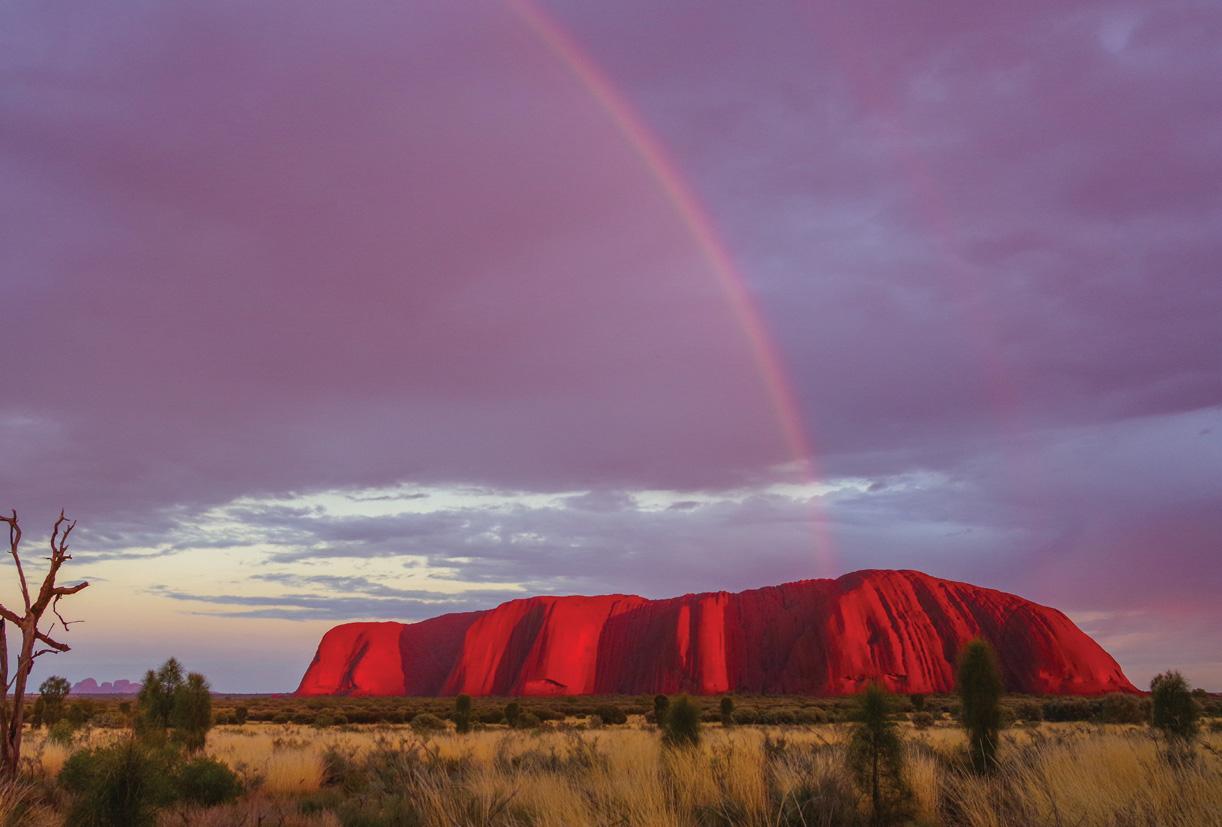
A rainbow, rare in the arid Outback, appears above Uluru at sunrise.
TECTONIC ORIGIN
Geologically speaking, Uluru is an inselberg (“island mountain” in German), a small, isolated mountain that rises abruptly from a level plain. Inselbergs consist of hard, resistant rocks that erode much more slowly than the surrounding rocks.
Uluru’s geological story began 550 million years ago with a major, tectonically driven mountain-building event called the Peter-mann Ranges Orogeny. The original mountains of the Petermann Ranges approached The scale of today’s Himalayas. But because trees and grasses did not yet exist when the Petermann Ranges were uplifted, erosion progressed rapidly.
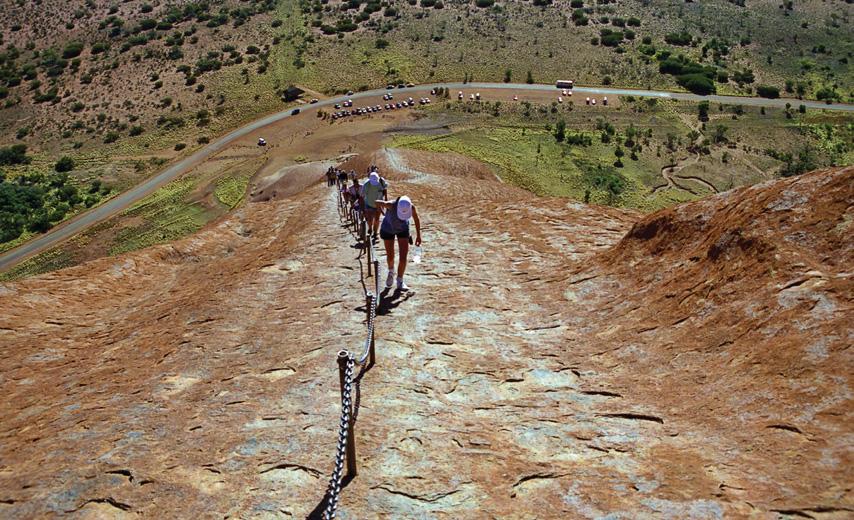 In this 2015 photograph, hikers head toward the summit of Uluru; climbing the monolith was banned in 2019, and the chain handhold was removed.
After enormous amounts of sediments from these eroded mountains created vast alluvial fans, a shallow sea covered the region, burying the fans beneath thick layers of marine sediments. Under great pressure, one thick, sandy stratum of an alluvial fan lithified into sandstone of unusual hardness and durability.
A later tectonic event, the Alice Springs Orogeny, raised the region above sea level, folded the buried sandstone, and tilted its alignment from horizontal to nearly vertical. The surface then eroded quickly, with the exception of that unusually hard and durable stratum that today rises above the flat desert floor as Uluru. Uluru consists of an arkose (potassium feldspar-rich) sandstone. When freshly broken, it is gray in color, although its surface is always rusty reddish-brown due to the presence of hematite (iron oxide).

Denne historien er fra August 2025-utgaven av Rock&Gem Magazine.
Abonner på Magzter GOLD for å få tilgang til tusenvis av kuraterte premiumhistorier og over 9000 magasiner og aviser.
Allerede abonnent? Logg på
FLERE HISTORIER FRA Rock&Gem Magazine

Rock&Gem Magazine
The Black Prince's Ruby and Other Cursed Gems
Submitted for your consideration: A collection of gems whose acquisition has often been synonymous with terrible loss but whose sparkle still holds fatal attraction. Meet some of the most cursed and feared - gems in history.

7 mins
October 2025
Rock&Gem Magazine
The Minerals of Transylvania
Whether you're in it for science, beauty, spooky stories, or all of it, Transylvania's minerals offer a little something for every rockhound. Deep in the heart of Romania, the Carpathian Mountains are known for gothic lore and vampire legends. In this land of Dracula, Transylvania's rugged geology, shaped by volcanic activity, has made it one of Europe's most mineral-rich areas.
2 mins
October 2025

Rock&Gem Magazine
Is Earth's Magnetic Field Linked to Atmospheric Oxygen?
The scientists making the observation were surprised. A time series analysis of geological records over the past 540 million years of Earth history seems to show a highly correlated link between oxygen levels in the Earth's atmosphere and the strength of the planet's magnetic field, and both seem to be slowly increasing in sync.
1 min
October 2025

Rock&Gem Magazine
The Best Archaeopteryx Yet
Archaeopteryx has been an icon in the world of paleontology ever since the first one was uncovered in 1861.
1 min
October 2025

Rock&Gem Magazine
Ancient Proteins Survive Much Longer than Expected and offer new insights into rhino evolution
In paleontology, the old days of pick-and-shovel and drawing evolutionary relationships based on anatomy alone may not be long gone, but they’re certainly being overshadowed by advances in the lab.
1 min
October 2025
Rock&Gem Magazine
PENNSYLVANIA'S FOSSIL FOREST
Some 300 million years ago, near the town of St. Clair, Pennsylvania, the land was covered by lush green forests with a wide variety of plants and trees.
3 mins
October 2025
Rock&Gem Magazine
From Waste to Rock in No Time Flat!
Ever wonder how long it takes for rock to form? It could be as little as minutes when molten lava hits ice-cold water beneath the sea to instantly form igneous basalt.
1 min
October 2025
Rock&Gem Magazine
Maribel CAVES & HOTEL...
Haunted Ruins With 'New Hope' For Caves
7 mins
October 2025

Rock&Gem Magazine
THE GEOLOGY OF GRAVESTONES
Along with black cats, witches and jack-o'-lanterns, cemeteries are iconic symbols of Halloween—and for good reason. Shrouded in mystery, superstition and folklore, they can elicit feelings of foreboding and fear.
4 mins
October 2025
Rock&Gem Magazine
Is Subduction “Infectious?”
Earth’s surface is composed of huge plates of relatively stable continental crust and oceanic crust that are constantly forming and recycling. Where they meet, subduction frequently occurs, with ocean crust plunging beneath continents. Thus oceans open and close, appear and disappear.
1 min
October 2025
Listen
Translate
Change font size