
Mit Magzter GOLD unbegrenztes Potenzial nutzen
Erhalten Sie unbegrenzten Zugriff auf über 9.000 Zeitschriften, Zeitungen und Premium-Artikel für nur
Versuchen GOLD - Frei
THE LURE OF ULURU
Rock&Gem Magazine
|August 2025
In a classic example of understatement, most Australians simply call it “The Rock.” Rising 1,142 feet in awesome and solitary grandeur above the surrounding flat desert, it is one of the world’s best-known natural features. It’s also a sacred site representing 30,000 years of human habitation and an iconic image of Australia and that nation’s vast Outback. Previously called Ayers Rock, “The Rock” is today known as Uluru (ool-a-roo), a name of great antiquity that even predates the Ice Ages.
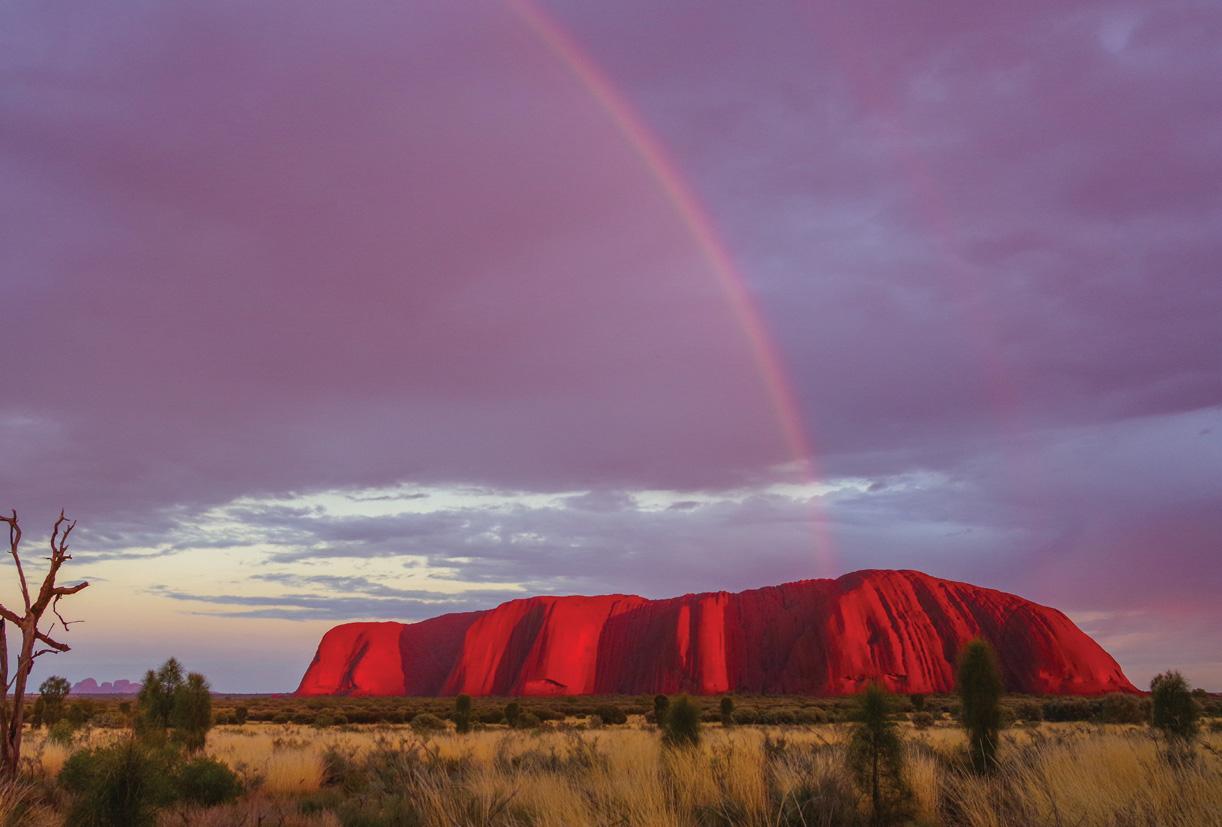
A rainbow, rare in the arid Outback, appears above Uluru at sunrise.
TECTONIC ORIGIN
Geologically speaking, Uluru is an inselberg (“island mountain” in German), a small, isolated mountain that rises abruptly from a level plain. Inselbergs consist of hard, resistant rocks that erode much more slowly than the surrounding rocks.
Uluru’s geological story began 550 million years ago with a major, tectonically driven mountain-building event called the Peter-mann Ranges Orogeny. The original mountains of the Petermann Ranges approached The scale of today’s Himalayas. But because trees and grasses did not yet exist when the Petermann Ranges were uplifted, erosion progressed rapidly.
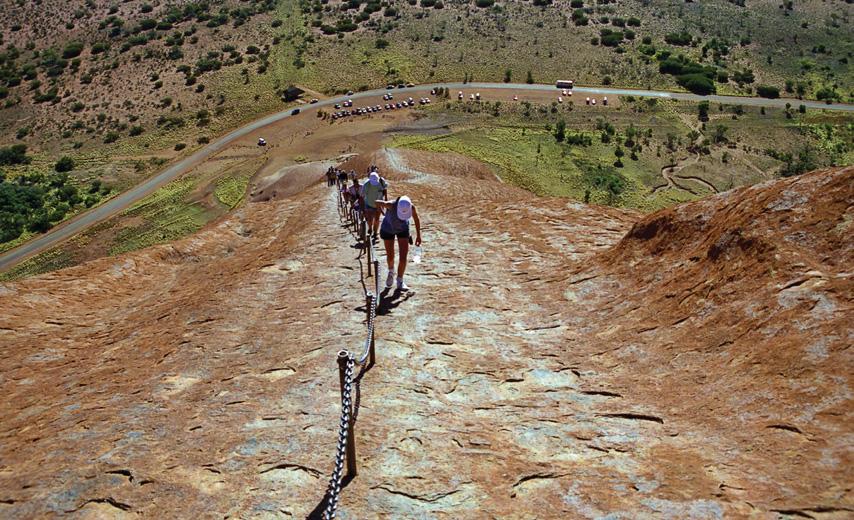 In this 2015 photograph, hikers head toward the summit of Uluru; climbing the monolith was banned in 2019, and the chain handhold was removed.
After enormous amounts of sediments from these eroded mountains created vast alluvial fans, a shallow sea covered the region, burying the fans beneath thick layers of marine sediments. Under great pressure, one thick, sandy stratum of an alluvial fan lithified into sandstone of unusual hardness and durability.
A later tectonic event, the Alice Springs Orogeny, raised the region above sea level, folded the buried sandstone, and tilted its alignment from horizontal to nearly vertical. The surface then eroded quickly, with the exception of that unusually hard and durable stratum that today rises above the flat desert floor as Uluru. Uluru consists of an arkose (potassium feldspar-rich) sandstone. When freshly broken, it is gray in color, although its surface is always rusty reddish-brown due to the presence of hematite (iron oxide).

Diese Geschichte stammt aus der August 2025-Ausgabe von Rock&Gem Magazine.
Abonnieren Sie Magzter GOLD, um auf Tausende kuratierter Premium-Geschichten und über 9.000 Zeitschriften und Zeitungen zuzugreifen.
Sie sind bereits Abonnent? Anmelden
WEITERE GESCHICHTEN VON Rock&Gem Magazine

Rock&Gem Magazine
THIS SUMMER, PICK STONY FLOWERS
Several rock and mineral formations look for all the world like flowers frozen in stone: chrysanthemum stones, flower agate, desert roses and poppy jasper.

6 mins
June 2026

Rock&Gem Magazine
An Ocean's Worth of Water in Earth's Deep Mantle
Water is key to life as we know it. When seeking life beyond our planet, Earth and planetary scientists always seek out planets and moons suspected to harbor liquid water either on the surface or beneath icy crusts.
1 min
June 2026

Rock&Gem Magazine
Hexagonal Diamonds?
Only available from the lab!
1 min
June 2026

Rock&Gem Magazine
While the World Drowns, Greenland Rises
With a mile-thick ice sheet covering 80% of its surface, Greenland accounts for a fifth of current sea level rise as that ice melts on an increasingly warm Earth.
1 min
June 2026
Rock&Gem Magazine
Argyle Diamonds
When the Argyle mine in Western Australia closed in 2020, it marked the end of one of the most remarkable chapters in modern mineral history.
2 mins
June 2026
Rock&Gem Magazine
CHANGING MINERAL MARKETS
As Rock & Gem celebrates its 55th anniversary—no small feat for a print magazine in the digital age—the hottest commodities on today’s mineral markets are lithium, the rare-earth elements and gold.
3 mins
June 2026

Rock&Gem Magazine
Grandpa's Agate Diggings
Finding Moss Agate on the Grande Ronde River
7 mins
June 2026

Rock&Gem Magazine
Does This Fossil Reveal a Whole New Kingdom of Life?
They would have looked strange in the so-called Rhynie chert landscape of the ancient Scottish Highlands 407 million years ago.
1 min
June 2026
Rock&Gem Magazine
From Maps to Satellites: Rockhounding's Tech Evolution
Rock and mineral collecting has come a long way, but the biggest changes have really occurred in just the past few decades.
5 mins
June 2026

Rock&Gem Magazine
BELLY of the DRAGON
A Rockhound's Guide
4 mins
June 2026
Listen
Translate
Change font size