Labradorite The Northern Lights in a Gemstone
Rock&Gem Magazine
|September 2023
The northern lights, those glowing curtains of cyan, green, gold and magenta that brighten the night skies in the northern latitudes, are among nature's most stunning displays of color.

The mineralogical phenomenon that best replicates this celestial splendor is labradorescence-the multicolored, subsurface, iridescent sheen that characterizes fine specimens of labradorite.
Labradorite's classic source-its geologic type locality, namesake, and the birthplace of its legends-is the remote coast of Labrador, the northern part of the Canadian province of Newfoundland and Labrador. Labrador is named for the Portuguese mariner João Fernandes Lavrador who, in 1498, braved the region's subarctic climate to explore its rugged, deeply indented coast.
"FIRESTONE"
In 1771, Moravian missionary Jens Haven founded the coastal settlement of Nain in northern Labrador. Intrigued by the brightly colored stones displayed by the indigenous Inuit, Haven sent specimens to Germany where they became known as "Labrador Stein," and to England where they were called "Labrador stone" and "firestone."
As the first new mineral reported from what would become Canada, Haven's specimens, with their eye-catching colors, attracted great scientific attention in Europe. In 1780, German geologist Abraham Gottlieb Werner, unable to determine the composition of Labrador Stein, erroneously described it as a distinct mineral species.
The first clue toward understanding the chemistry of "firestone" came in 1820, when researchers described the plagioclase feldspar minerals albite (sodium aluminum silicate) and anorthite (calcium aluminum silicate). Soon afterward, French mineralogist François-Sulpice Bedant determined that the Labrador specimens were a type of feldspar with characteristics of both anorthite and albite and named them "labradorite."
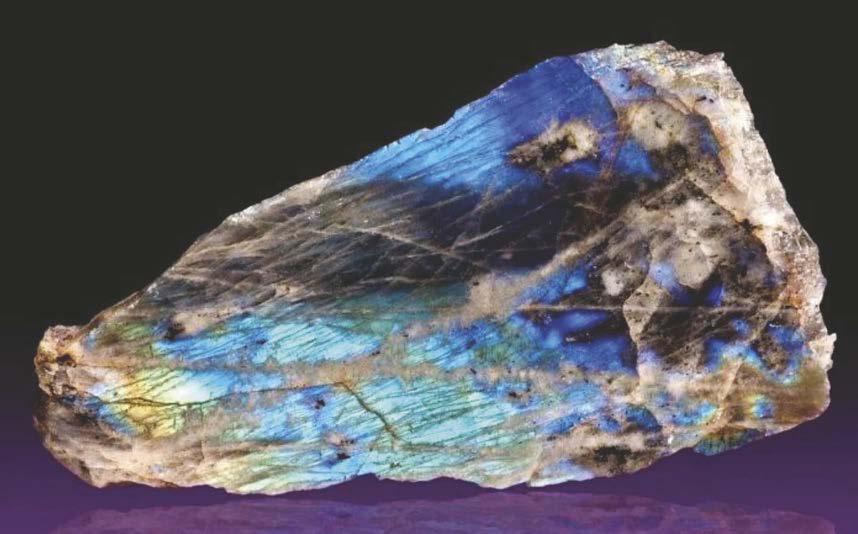
PROPERTIES AND OCCURRENCE
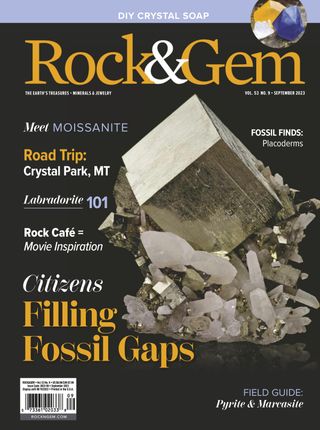

Denne historien er fra September 2023-utgaven av Rock&Gem Magazine.
Abonner på Magzter GOLD for å få tilgang til tusenvis av kuraterte premiumhistorier og over 9000 magasiner og aviser.
Allerede abonnent? Logg på
FLERE HISTORIER FRA Rock&Gem Magazine
Rock&Gem Magazine
A New Amber Locality Fills a Gap
A sandstone quarry in central Ecuador has yielded the first significant deposit of Mesozoic amber from South America.

1 min
January / February 2026
Rock&Gem Magazine
Did "Left-Handed" Fish Leave Water Earlier than Thought?
Fossil evidence suggests that fish (or \"fishapods\") dragged themselves onto land during the middle Devonian Period.
1 min
January / February 2026
Rock&Gem Magazine
"Lab Quakes” Produce Surprising Results
When faults let loose and earthquakes result, the main effect we mortals experience is the violent shaking.
1 min
January / February 2026
Rock&Gem Magazine
This Egg is No Spring Chicken
How to date a dino egg
1 min
January / February 2026
Rock&Gem Magazine
Have we Already Mined the Critical Minerals We Need
Then why are we throwing them away?!
1 min
January / February 2026
Rock&Gem Magazine
One Toxic Worm
A critter that creates & tolerates orpiment!
1 min
January / February 2026
Rock&Gem Magazine
ROCK & GEM FIELD GUIDE: Silver
Silver (Ag) is a native element and one of Earth's most prized precious metals.
2 mins
January / February 2026
Rock&Gem Magazine
DINOSAURS OF THE HELL CREEK MUSEUM
In the Badlands of South Dakota, just outside the small town of Belle Fourche—pronounced “Bell Foosh”—a new attraction has taken shape that every dinosaur enthusiast should see. The Dinosaurs of the Hell Creek Museum is part hands-on exhibit, part science center and part active research lab.
3 mins
January / February 2026
Rock&Gem Magazine
The Lost Twins of Kongsberg
A Silver Story Resurfaced
3 mins
January / February 2026
Rock&Gem Magazine
Switzerland's ICE PALACE
Walk Inside a Glacier at The Top of Europe
7 mins
January / February 2026
Translate
Change font size