Prøve GULL - Gratis
BEACHES: NOT JUST SUN AND SURF
Rock&Gem Magazine
|July 2023
For many of us, the word "beach" evokes pleasant images of summers spent enjoying sun, sand and surf. But for geologists this word has a more specific meaning, referring to waterborne accumulations of sand that sometimes host economic concentrations of gemstones and other valuable minerals.

The world's beaches have yielded tons of gold, millions of carats of diamonds, numerous fine specimens of nephrite jade, huge amounts of amber and much of the world's titanium. Some beaches, however, are not known for their valuable metals and minerals, but for their unusual colors-white, black, green and even purple.
NOME'S BEACH OF GOLD
While beaches today draw hordes of summer vacationers, in 1900 the Bering Sea beaches at Nome, Alaska, attracted more than 20,000 adventurers and miners in a wild search for placer gold.
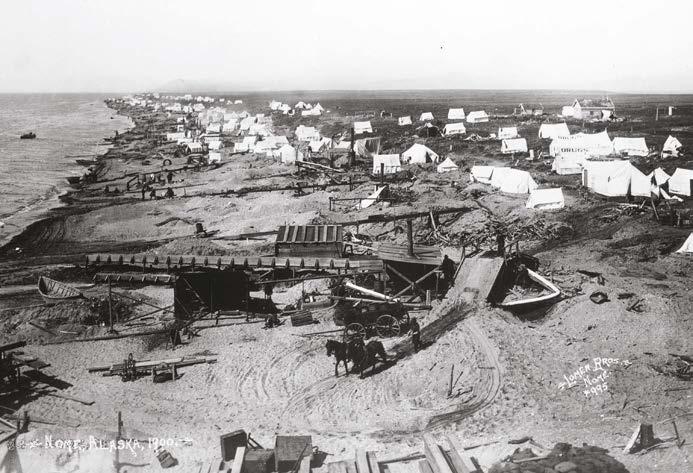
Nome's gold occurred along a narrow, 30-mile-long tidal beach where the traditional mining-claim system was largely ignored. The beaches were wide open to everyone and miners initially worked with gold pans, then sluices and rockers, later with pumps and hoses, and finally with dredges. Nome's location, just 125 miles south of the Arctic Circle, limited mining to the brief summer season.
Dredge miners still recover gold at Nome today. Over its 123-year history, the Nome Mining District has produced 3.6 million troy ounces (111 metric tons) of gold, most of it from the beaches. The Nome gold rush is memorialized in the song North to Alaska and the 1960 John Wayne movie of the same name.
NAMIBIA'S DIAMOND BEACHES
Beachcombers sometimes whimsically imagine the water-polished bits of colorless quartz glittering in the shoreline gravels at their feet to be diamonds. But imagination is not necessary on the beaches of the southwest African nation of Namibia, where the sands are yielding millions of carats of diamonds.

Denne historien er fra July 2023-utgaven av Rock&Gem Magazine.
Abonner på Magzter GOLD for å få tilgang til tusenvis av kuraterte premiumhistorier og over 9000 magasiner og aviser.
Allerede abonnent? Logg på
FLERE HISTORIER FRA Rock&Gem Magazine

Rock&Gem Magazine
A New Amber Locality Fills a Gap
A sandstone quarry in central Ecuador has yielded the first significant deposit of Mesozoic amber from South America.

1 min
January / February 2026
Rock&Gem Magazine
Did "Left-Handed" Fish Leave Water Earlier than Thought?
Fossil evidence suggests that fish (or \"fishapods\") dragged themselves onto land during the middle Devonian Period.
1 min
January / February 2026

Rock&Gem Magazine
"Lab Quakes” Produce Surprising Results
When faults let loose and earthquakes result, the main effect we mortals experience is the violent shaking.
1 min
January / February 2026
Rock&Gem Magazine
This Egg is No Spring Chicken
How to date a dino egg
1 min
January / February 2026
Rock&Gem Magazine
Have we Already Mined the Critical Minerals We Need
Then why are we throwing them away?!
1 min
January / February 2026

Rock&Gem Magazine
One Toxic Worm
A critter that creates & tolerates orpiment!
1 min
January / February 2026
Rock&Gem Magazine
ROCK & GEM FIELD GUIDE: Silver
Silver (Ag) is a native element and one of Earth's most prized precious metals.
2 mins
January / February 2026
Rock&Gem Magazine
DINOSAURS OF THE HELL CREEK MUSEUM
In the Badlands of South Dakota, just outside the small town of Belle Fourche—pronounced “Bell Foosh”—a new attraction has taken shape that every dinosaur enthusiast should see. The Dinosaurs of the Hell Creek Museum is part hands-on exhibit, part science center and part active research lab.
3 mins
January / February 2026
Rock&Gem Magazine
The Lost Twins of Kongsberg
A Silver Story Resurfaced
3 mins
January / February 2026
Rock&Gem Magazine
Switzerland's ICE PALACE
Walk Inside a Glacier at The Top of Europe
7 mins
January / February 2026
Translate
Change font size